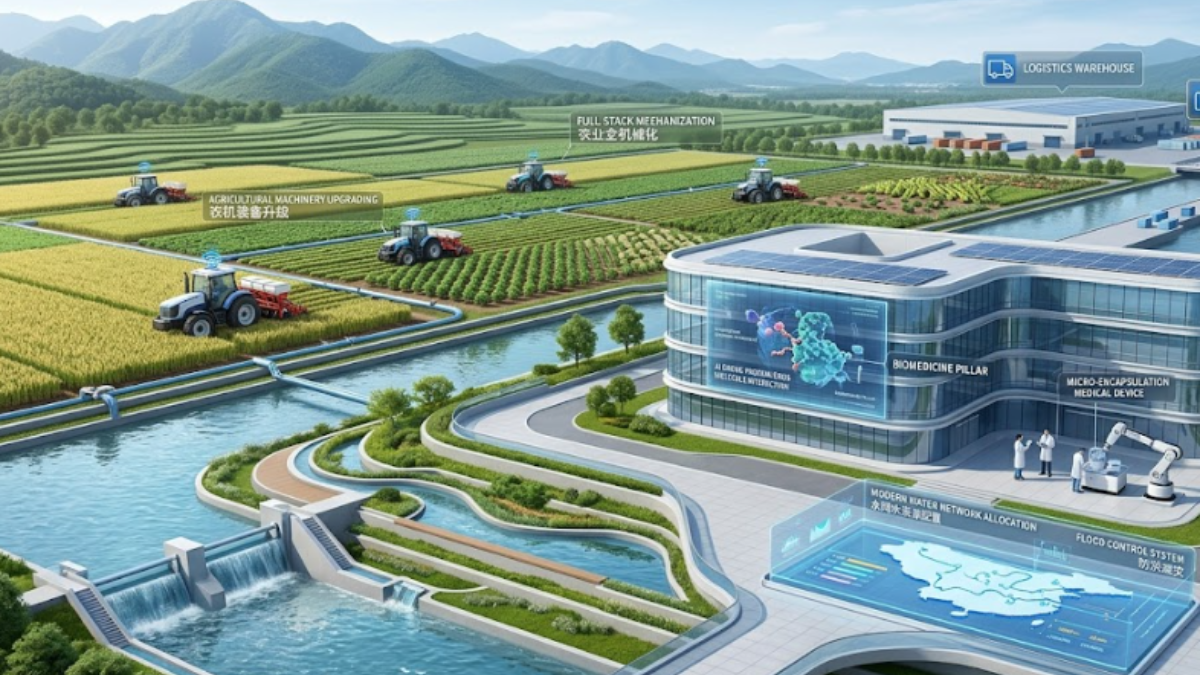
If you've been tracking China's industrial policy moves, last week handed you a clear signal. Chinese Vice Premier Liu Guozhong - a member of the Political Bureau of the CPC Central Committee - wrapped up a multi-day inspection tour of east China's Shandong province, issuing directives across three sectors that are moving fast: biomedicine, agricultural machinery, and national water infrastructure.
China’s biomedicine innovation and modern water network development aren't being treated as separate policy tracks here. They're being pushed in parallel, under the same senior-level mandate. That's worth paying attention to.
Here's what was actually said - and what it means for you.
China Biomedicine Innovation: AI, Core Tech, and Enterprise-Led R&D
That phrase "emerging pillar industry" matters more than it looks. In Chinese policy language, upgrading a sector to "pillar" status typically triggers faster funding cycles, expanded regulatory support, and stronger enterprise incentives. Quickly.
During the Liu Guozhong Shandong province inspection tour 2026, the vice premier's directives hit a few specific targets: strengthen basic research, focus on key core technologies in innovative drugs and medical devices, and deepen the role of artificial intelligence empowerment in biomedicine research to accelerate real breakthroughs. The AI mandate isn't window dressing. China's biomedical institutions have been pushing AI-assisted drug discovery and AI-driven clinical trial design for several years now, but this marks vice premier-level endorsement of that direction. China's AI sector growth signals from earlier this year show exactly where this trajectory is headed.
What's also significant is the emphasis on who leads. Liu said enterprises should be the "mainstay of innovation" - not universities, not state labs, but commercial companies. That aligns closely with what's been happening in Wuhan's AI-driven health tech cluster, where private AI health ventures are attracting serious capital and clinical partnerships outside the traditional state research model.
Liu also stressed the need to deepen international exchanges and cooperation in biomedicine. That signal matters. China isn't pursuing a closed innovation model here - the goal is to expand and strengthen the biomedicine industry by integrating global partnerships alongside domestic capacity, not replacing one with the other.
Who Actually Leads Innovation - and Why That Question Is Complicated
There's a real tension in Chinese industrial policy between state-directed and enterprise-driven innovation. Liu's framing leans clearly toward the latter.
That has direct implications for foreign partners and investors watching biotech capital market rules in China, because it shifts who controls IP pipelines and who captures upside from commercialization. The specific call to strengthen the transformation and application of scientific and technological achievements - something Liu emphasized explicitly - is where the commercial opportunity lives for both domestic companies and international players.
This connects naturally to questions around tech transfer regulatory rules, and how China manages the line between building biomedicine industry independent innovation capacity and maintaining open international cooperation. Both goals are being pursued simultaneously. And if you want to see how this fits into China's innovation blueprint at the macro level, the Summer Davos disclosure from earlier this year is the clearest single source available right now.
Agricultural Machinery: Digital Transformation Meets Subsidy Policy
This part is more practical - and closer to ground level.
Liu called for accelerating the R&D and deployment of advanced agricultural machinery and equipment. The phrase "advanced and applicable" is doing a lot of work there. China's gap between high-end ag-tech research and actual field deployment is real, and closing it requires both digital transformation of agricultural machinery enterprises and smarter use of existing government programs.
Advanced agricultural equipment trade-in policy updates are something distributors and machinery firms operating in China should be monitoring closely. Liu directly told enterprises to make good use of subsidy policies for machinery purchases and trade-ins - which is efficient policy design, since it drives upgrades without requiring new spending. Use what's already there.
For anyone tracking B2B procurement or the broader innovation industrial transition happening across Chinese manufacturing, agricultural machinery is an underrated part of the story. It's where physical AI for industry - robotics, sensors, autonomous field equipment - is beginning to hit real-world deployment at scale. And with China's manufacturing expansion data trending upward, the industrial base to support that push is strengthening.
The stated end goal: improve the overall mechanization level of agricultural production. That's a measurable target, not just a policy aspiration.
Modern Water Network Development: The Infrastructure Push Nobody's Talking About
Water networks don't generate the same headlines as biotech or AI. But Liu's framing of them as "major national infrastructure" - comparable to roads or power grids - signals just how seriously China is treating this push.
The directive covers a lot of ground: flood control and water resource allocation systems China-wide, disaster prevention capacity, and coordinated urban and rural water supply security across all administrative levels. Systems-level thinking applied to water. With climate-driven flooding events becoming more frequent and harder to predict, the timing of this push isn't accidental.
Modern water network construction as national infrastructure connects naturally to the smart city infrastructure push, where digital monitoring and real-time utility management are now standard requirements for urban development frameworks. The green infrastructure integration dimension - linking water management to energy efficiency and environmental targets - is also something China's infrastructure planners are actively building in.
Urban and rural water supply network integration specifically addresses a persistent gap that's been challenging for decades. It now has explicit vice-premier-level attention behind it. That changes timelines.
Reading These Three Directives Together
What ties all three sectors together is a consistent underlying model: coordinated national infrastructure paired with enterprise-led innovation. It shows up in biomedicine, in ag-tech, and in water systems. Different sectors, same logic.
China's state-level tech policy frameworks show how these priority areas get coordinated from the top down, and why inspection tours like this one carry real implementation weight. Separately, AI governance and biomedical oversight are becoming an increasingly global conversation - which means China's domestic moves in AI-empowered biomedicine will increasingly intersect with international regulatory frameworks, for better or worse.
Three Sectors. One Clear Direction.
China biomedicine innovation and modern water network development are now firmly in "national priority" territory - not pilot programs, not aspirational targets. The directives from this Shandong inspection tour are specific enough to suggest real implementation pressure is being applied, not just encouraged.
Enterprises are being told to lead on innovation. AI integration is being demanded. Infrastructure coordination is happening at every level, from national policy down to local supply networks. Whether you're tracking this for investment, competitive intelligence, or regulatory planning, the signal coming out of Shandong is clear: these sectors are moving, and the timeline is being compressed.