Summary
The Google $15 billion India data centre Visakhapatnam project is being framed as a landmark technology investment. But on the ground, the mood is far less than the celebratory.
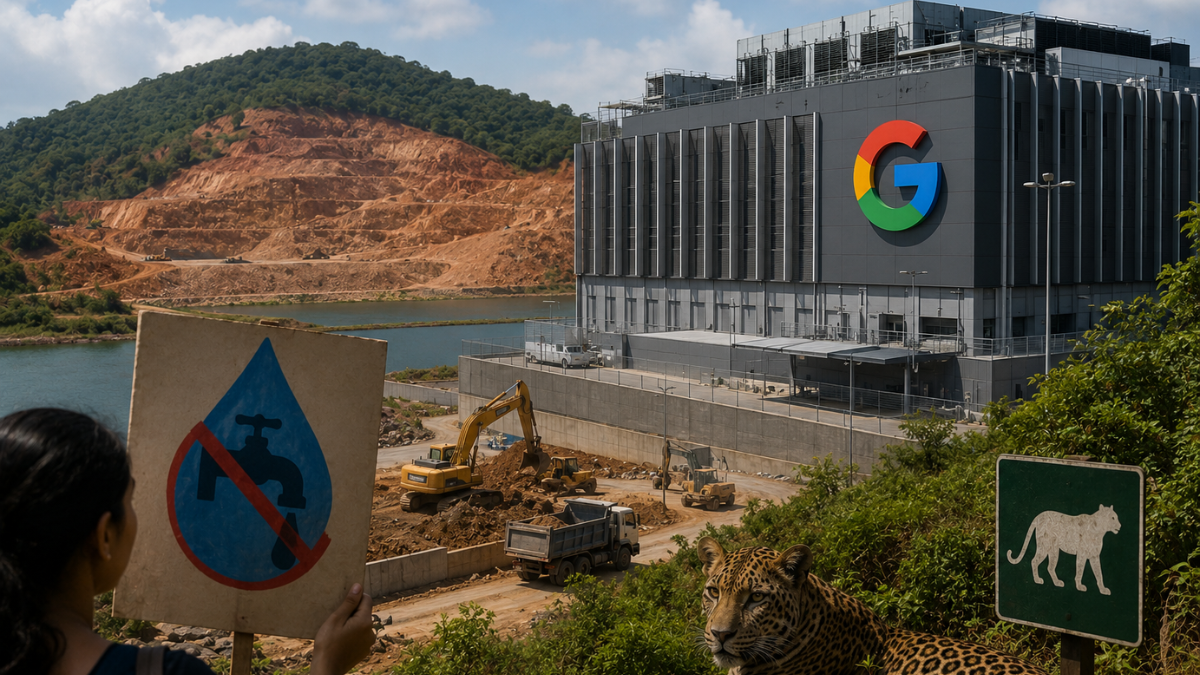
As construction activity gathers pace near Tarluvada, residents and environmental groups are questioning whether the city can support a hyperscale facility while it already faces periodic water rationing. The concerns extend beyond taps running dry. Protesters also point to the project’s location near a wildlife sanctuary, construction noise, and the speed at which approvals were reportedly granted.
Google says it will follow Indian regulations and use air-cooling technology designed to protect local water resources. Andhra Pradesh’s government says claims of water diversion and ecological harm are inaccurate.
Still, a project this large was never going to pass quietly.
Important Key Points:
- A Massive $15B Tech Deal: Google has teamed up with Adani Group to set up a huge data center in Visakhapatnam to make it their largest cash investment in India to date.
- Fears Over Empty Taps: Visakhapatnam already copes with daily water shortages and rationing. Residents and local groups are questioning how a massive industrial complex can operate without cutting into the city’s drinking water.
- Disturbing Nearby Innocent Wildlife: The chosen site sits barely 860 meters from the Kambalakonda Wildlife Sanctuary. Activists warn that non-stop construction, bright lights, and heavy truck traffic will disrupt leopards, pangolins, and other native species.
- Promises From the Top: Google claims they’ll use specialized air-cooling setups so they don't have to pull from local freshwater supplies. Meanwhile, state officials maintain that no household water will be redirected.
- Lawsuits in Motion: Local activist groups aren't taking those claims at face value. They’ve dragged the project to the High Court and environmental tribunals, demanding full public access to environmental impact checks before any major building starts.
- The Bigger Conflict: This situation highlights a tension we're seeing all over the world right now: the push for rapid digital expansion clashing directly with basic community resources like land, trees, and water.
Google $15 billion India data centre Visakhapatnam: Why the project matters
Google’s proposed hub is reportedly its biggest investment in India to date. The Google $15 billion investment in India Andhra Pradesh plan is expected to support cloud services, AI workloads and the country’s growing digital economy, while creating a major physical base for technology infrastructure in the region.
The project is being developed with the Adani Group, making the Google Adani data centre project in Visakhapatnam one of India’s most closely watched technology partnerships. Government and project supporters say it could create up to 188,000 jobs across construction, services and related industries.
That promise matters. Large data centres can attract suppliers, telecom providers, power projects, engineers and local support businesses. They’re also part of a broader global race for AI data centre expansion, where countries want more computing capacity within their borders.
But jobs and infrastructure don’t erase local concerns. They raise the stakes.
Google $15 billion India data centre Visakhapatnam and the city’s water pressure
Visakhapatnam, a city of roughly 2.5 million people, already has a difficult relationship with water. According to figures cited by activists, the city receives about 410 million litres per day, while demand is closer to 480 million litres.
That gap explains the anxiety around the Visakhapatnam water shortage data centre impact. When households are used to rationing, even a promise that a new industrial project will not use drinking water can feel inadequate. People want to know where the water will come from, how much will be needed, and what happens during a bad summer.
Green Visakha, a local environmental group, has argued that guaranteed water supplies for the project over the next two decades could put ordinary residents at risk. Its campaign has included public meetings, awareness drives and demonstrations carrying messages such as “We cannot drink DATA.”
It’s a sharp line. And it lands because data centres have a real water reputation problem.
Servers generate a lot of heat. Cooling them can require substantial water, especially at the scale needed for AI operations. Global concern about data-centre cooling demand has grown alongside investment in high-density computing, while the wider debate around data centre power demand is putting pressure on operators to prove that local communities won’t bear the cost.
Google says this facility will use advanced air cooling. The company’s stated approach, often described as Google air cooling tech India data centre planning, is intended to reduce dependence on local freshwater supplies.
Does that solve the problem? It may reduce one major risk, but residents are right to ask for public, site-specific details rather than broad assurances.
What the government and Google have said
Andhra Pradesh has defended the development, calling some activist claims misleading. The state has also said that water allocated for rural and residential use will not be diverted to upcoming data centres, and that a nearby reservoir will not be used.
Officials say they remain open to addressing valid issues raised by the public.
Google has said the project will comply with applicable laws and environmental requirements. It has also stated that sound-dampening measures will help it operate as a quiet neighbour.
That language matters, because this isn’t only a water dispute. It’s also a test of whether large digital infrastructure can win public trust before construction becomes impossible to reverse.
The stakes aren’t unique to India. From global AI capex spending to the pressure on the international AI supply chain, companies are committing enormous sums to build computing capacity quickly. Local review processes often struggle to move at the same speed.
Wildlife concerns near Kambalakonda Wildlife Sanctuary
Another flashpoint is the proposed site’s proximity to Kambalakonda Wildlife Sanctuary. The Kambalakonda Wildlife Sanctuary Google data centre concern centres on construction activity, heavy vehicle movement and persistent noise near habitat known to support species including leopards and pangolins.
Activists say the site is about 860 metres from the sanctuary. The government’s position is that it remains farther away than legally required.
Distance alone doesn’t settle the issue, though. Wildlife impacts can come from noise, lighting, traffic and altered land use, not just from building inside a protected boundary. The question around the Kambalakonda Wildlife Sanctuary noise impact Google data centre project is whether project safeguards will be strong enough, consistently monitored, and publicly visible.
A stripped hillside and earthmoving equipment can make nearby communities nervous. Honestly, that’s not hard to understand.
The Andhra Pradesh High Court PIL and other legal challenges
The dispute has now moved into court. A Jal Biradari public interest litigation Google case asks whether the project could strain water availability by placing pressure on a nearby reservoir.
The Andhra Pradesh High Court PIL Google data centre proceeding has prompted the court to ask the state to respond to the allegations. The next hearing is reportedly scheduled for August 24.
Separate cases have also been filed at India’s environmental tribunal by the Human Rights Forum. The group argues that authorities did not properly assess the impact of sourcing water connected to a rural drinking-water scheme. This is why the phrase Human Rights Forum files case against Google Adani data centre project has become central to searches around the project.
Legal challenges don’t automatically mean a development is unlawful. They do create a formal process for testing whether environmental reviews, water commitments and public consultations were sufficient.
And that’s exactly what residents want: evidence they can inspect.
Why this controversy reaches beyond Visakhapatnam
The Google Adani joint data centre project in Tarluvada, Visakhapatnam, sits at the intersection of local ecology and a worldwide shift toward AI computing. India wants more domestic infrastructure. Businesses want lower latency, more cloud capacity and more dependable AI services. Governments want the jobs.
You can see the same trend in efforts to build a green electricity data centre, growing AI infrastructure investment, and new partnerships such as the India-Japan AI pact.
But “digital” doesn’t mean weightless. These projects need land, power lines, cooling systems, roads and water planning. They affect the places where they’re built.
That’s the tension behind Visakhapatnam water crisis protests against hyperscale AI data centres. People aren’t necessarily rejecting technology. They’re challenging the idea that their needs should come second to it.
Can air cooling and better planning reduce the risk?
Google’s proposed advanced air-cooling approach could be significant if it performs as described. Traditional water-intensive cooling has drawn criticism in dry regions, so Google's advanced air cooling technology to save water in Indian data center plans is clearly relevant to Visakhapatnam’s concerns.
Still, technology claims need operational transparency. Residents should be able to see projected water use, backup-water arrangements, power demand, wastewater plans and independent environmental monitoring.
A sensible framework would include:
- Public disclosure of annual and peak water needs.
- Clear confirmation that household and rural supplies cannot be diverted.
- Noise and biodiversity monitoring near Kambalakonda.
- Independent reporting on cooling performance.
- A grievance channel with published responses, not just closed-door meetings.
This kind of disclosure isn’t anti-development. It’s how a project earns its social licence to operate.
Smaller-scale edge AI computing may distribute some computing demand over time, but hyperscale facilities will remain essential. The issue is where they go and what safeguards arrive with them.
What happens next for the Visakhapatnam data centre?
The Andhra Pradesh government will defend its position in court, while environmental groups are likely to keep pressing for detailed scrutiny. Google and Adani face an equally practical challenge: explaining the project in terms that residents can verify.
The Google $15 billion India data centre Visakhapatnam debate isn’t really about whether India should build AI infrastructure. It’s about whether a city with water constraints and sensitive wildlife nearby can host it without asking residents to take all the risk.
If the project proceeds, transparency will matter as much as technology. Maybe more.
GlobalByte Perspective:
At GlobalByte News, we see the situation in Visakhapatnam as a simple reality check for the global tech push. For a long time, the major tech brands have talked about cloud computing and AI as if they exist somewhere up in the air. But as these giant server plants expand, their impact on actual land, power, and local water supplies is getting hard to ignore.
There is no doubt that Google’s $15 billion deal with Adani brings huge investment to the region. Yet, setting up a resource-heavy plant in a coastal city that already faces regular water shortages was always going to draw a strong reaction. Corporate statements about the air cooling sound fine in meetings, but when families are worried about their everyday water supply, basic promises are rarely enough.
Building right next to the Kambalakonda Wildlife Sanctuary also brings fair questions about construction noise, truck traffic, and the safety of local animals. People taking this matter to court aren't just trying to block development; they want clear facts, open data, and proper checks before heavy building gets underway.
Our Take: The takeaway here goes way beyond Andhra Pradesh. As tech firms race to build more computing capacity, getting official government clearance is only half the job, and that Companies need to show the local neighborhoods how their resources will be protected. Without clear data and genuine trust from the people living near the Wildlife Sanctuary, even a multi-billion-dollar project will run into trouble.