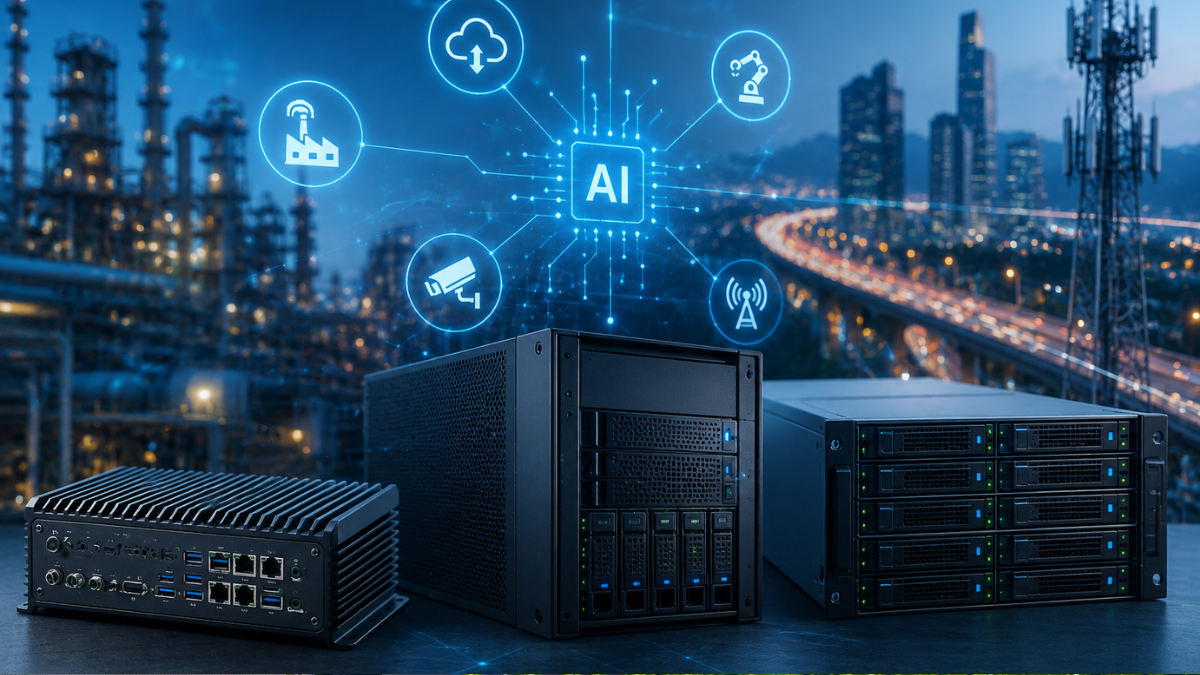
Processing data at the point of creation isn't a pilot project anymore. For enterprises running smart city infrastructure, industrial AI, or high-volume IoT across the Gulf, it's the operational baseline. And if you've tried to scale those workloads through centralized cloud, you already know the problem - latency, compliance friction, bandwidth costs that compound at scale.
Edge AI computing solutions for enterprise smart cities in Dubai and the UAE have matured significantly over the past two years. The hardware is real; it's deployable today, and it's built for what 2026 is actually demanding from these systems. So the real question isn't whether to go edge. It's which edge architecture fits your specific operation.
Why Dubai's Smart City Push Is Outrunning Cloud Infrastructure
Dubai isn't cautiously testing smart city concepts. It's running live deployments at scale - traffic management, utilities, public safety, port operations - all generating real-time data that needs immediate processing. The smart city tech innovation driving GCC urban development follows a consistent pattern: more sensors, denser data streams, tighter response windows.
Cloud architectures weren't designed for this. Routing feeds from hundreds of smart intersections to an overseas data center, processing them, and getting a response back fast enough to matter - the physics of data transfer don't support that. You need compute where the data originates.
But scaling edge AI computing solutions for enterprise smart cities in Dubai, UAE, also runs into a regulatory wall. UAE data localization laws are increasingly strict about where sensitive data can sit and who can access it. That makes sovereign edge AI infrastructure solutions with data localization compliance a procurement requirement, not a preference. Public cloud, where data may physically reside in Singapore or Ireland, can't satisfy that. Local on-premise edge hardware can.
Three Deployment Tiers - and Why the Differences Actually Matter
When choosing edge AI computing solutions for enterprise smart cities in the UAE, the deployment tier matters as much as the hardware specs. Most enterprises hit the same friction point: the tier they're evaluating doesn't match the operational reality of the site they're deploying to.
Standalone Edge is a single-node system. Built for remote or low-staffing environments - unmanned substations, retail branches without on-site IT, monitoring installations in isolated facilities. The goal is enterprise-grade compute in a compact, self-managing package. When people ask what the best turnkey edge AI solutions for remote facilities without dedicated IT staff look like, this is the answer. Simple. Deployable. Gets out of the way.
HA Edge is a two-node redundant setup where one node automatically absorbs the other's workload if it fails. No downtime, no manual intervention. Redundant high availability HA edge computing nodes in GCC environments are increasingly specified for hospitals, airport operations, and financial platforms where even a few minutes of unplanned downtime creates serious downstream consequences. With two nodes, the single-point-of-failure problem disappears.
Advanced Edge is the cluster tier. Three to five nodes with automatic failover and dynamic resource scaling. Advanced Edge scalable cluster with automatic failover is what smart grids and large industrial platforms need when workloads spike unpredictably, and a single node can't absorb the load. When a node fails, the cluster redistributes workloads automatically across the remaining active nodes. No service window required.
These three deployment models reflect the varied scale requirements of edge AI computing solutions for enterprise smart cities across Dubai and the UAE. The gap between tiers isn't just performance - it's about the risk tolerance and operational context of each specific facility.
The Hardware Powering Edge AI Computing Solutions for Enterprise Smart Cities in Dubai, UAE
Two server platforms carry most of the weight in current deployments, and they're designed for opposite ends of the performance spectrum.
The compact tier runs AMD EPYC 8004 processors with support for up to two GPUs. Small footprint, quiet operation, efficient power draw. If you're evaluating compact GPU-enabled edge servers for low-noise office environments or dense urban deployments, this is the relevant starting point. Physical AI solutions for business are moving in this direction - smaller, quieter, and positioned closer to where operations actually happen.
Then there's the high-performance tier. The KS 5000U class runs dual Intel Xeon or AMD EPYC 9004/9005 processors, delivers up to 320 CPU cores, and supports four GPUs. That's what GPU-accelerated server hardware for localized AI workloads in 2026 looks like in practice. KS 5000U dual Intel Xeon AMD EPYC edge server performance at this level handles inference workloads that would have required a full rack setup just a few years ago. And how dual Intel Xeon processors handle high-throughput computing at the edge is fairly direct: more cores, more parallelism, more headroom - without routing anything through the cloud.
AMD EPYC and Intel Xeon processor options give procurement teams flexibility on the architecture while keeping the form factor and deployment model consistent. That matters when you're rolling out identical hardware across multiple sites in a region.
Cloud vs. Edge: A Shift Already Underway Across GCC
The technical argument for on-premise edge computing systems vs. centralized cloud latency has been settled for a while. What's changed is that the business and regulatory case has finally caught up.
Globally, AI computing infrastructure investment is tilting toward distributed edge architectures. Cities that have become digital economy city benchmark consistently follow the same architectural pattern: local data processing, local AI inference, local sovereignty. The AI digital security infrastructure requirements that surfaced at major 2026 summits reinforce the same model.
Sustainability is a real factor here too. AI and green energy integration analysis consistently shows that local edge inference consumes significantly less energy per workload than routing data to centralized facilities and back. For Gulf enterprises with serious sustainability targets, that efficiency gap isn't trivial.
Industrial adoption is moving fastest. Industrial IoT edge nodes for smart airport and retail automation are being deployed at scale because edge-native AI architectures are essential for predictive maintenance in factories - and for any application where a 150ms cloud roundtrip breaks the real-time feedback loop entirely. AI-driven industry transformation across manufacturing and utilities confirms this pattern clearly.
AI supply chain integration is also pushing edge requirements upstream. When suppliers and logistics partners generate edge data, your infrastructure needs to meet it at the edge - not filter it through a cloud layer that adds latency and cost. The edge computing portfolio for AI inference and virtualization in UAE is expanding for exactly this reason.
What to Check Before Committing to an Edge Architecture
Staffing reality matters more than most vendor pitches acknowledge.
Bare metal hardware gives you maximum flexibility, but turnkey edge AI solutions bare metal hardware configurations with pre-installed operating systems and container platforms are dramatically faster to deploy when you don't have engineers on-site. Enterprise data storage and AI infrastructure hardware providers in the Middle East increasingly offer both options - hardware-only for teams with deployment capacity, and fully integrated turnkey configurations for sites that don't.
Heterogeneous computing platforms are becoming the norm at the edge tier. Multi-accelerator configurations that mix CPUs and GPUs for different workload types are now standard practice, not a premium add-on. Hardware that can't expand GPU capacity later will hit a ceiling faster than expected.
In UAE conditions, energy efficiency isn't just a data center conversation anymore. Green AI data center deployment patterns are now shaping edge hardware selection too. Thermal performance and power draw per inference are part of the spec process in this region.
The right edge AI computing solutions for enterprise smart cities in Dubai UAE, will match the specific operational profile of each site - not just default to the highest-spec hardware available. The three-tier deployment model exists precisely so you don't over-invest at facilities with modest requirements, or under-invest at sites where uptime is genuinely non-negotiable.