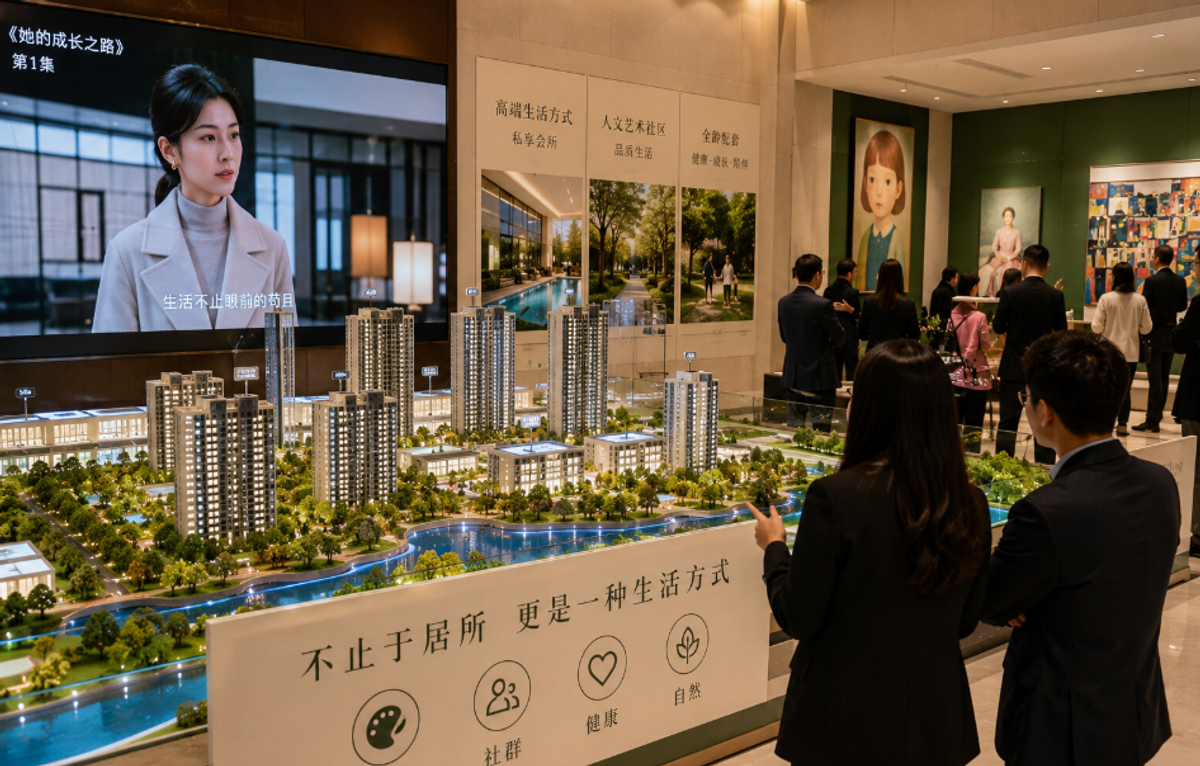
Imagine scrolling through short videos and landing on a drama about a woman navigating office politics, self-doubt, and that low-grade ache of not quite belonging. You watch three episodes. Maybe five. There's no ad. No floor plan. No call to action. But every scene is shot inside a real apartment complex in Hangzhou - and by episode six, you're already picturing yourself living there.
That's the pitch. And it's working.
Promoting lifestyles to sell property - China real estate developers have turned it into a genuine art form. Across major cities, developers are producing short dramas, staging billion-yuan art exhibitions, and building community running clubs, all to sell a way of living long before any contract gets signed. In a cooling market where buyers have real options, that shift matters more than it might look.
The Short Drama That Sparked an Industry Conversation
Xingyao Holding, a Hangzhou-based developer, produced a 17-episode short drama series centered on a character named Mu Fangzhou. That name closely mirrors the developer's actual residential project: Mufangzhou, in Hangzhou's Qiantang district. The overlap isn't subtle. It's the point.
The plot covers career struggles, family tensions, and a quiet search for belonging. There's no property pitch anywhere in it. What's there instead: a rooftop pool, a private gym, a communal dining room - all real facilities inside the actual development, used as natural backdrops throughout the series.
The Xingyao Holding production cost under two hundred thousand yuan - roughly $29,500. Far less than a traditional advertising campaign. The idea reportedly came from the firm's post-eighties general manager and was filmed using existing project facilities, keeping overhead low. Since the drama aired, viewers drawn to the on-screen lifestyle have booked site visits.
This approach isn't entirely without precedent. In June of last year, Nantong's Weifu Group used its project as the main filming location for another short drama - and that series topped short-drama platform charts within 48 hours of release, pulling over 10 million views. How low-cost short dramas generate site visits for property projects has become a legitimate case study across the sector, and the proptech startup scene is paying close attention.
When the Sales Office Becomes an Art Gallery
Not every developer went the drama route. In Shanghai's Xuhui riverside district, Chenjia Development did something more blunt: scrapped the traditional sales office entirely.
In its place: a four-part art exhibition featuring original works by Chen Yifei, Marc Chagall, and Yoshitomo Nara. The collection is valued at over 1 billion yuan. Shanghai Xuhui riverside luxury real estate marketing at this level is less about selling square meters and more about signaling who you are as a buyer - and who your neighbors will be.
"For high-end projects like this, the art exhibition itself has become part of the property's value proposition," said Yan Yuejin, deputy head of E House China R&D Institute.
The Shanghai market momentum in premium segments makes this kind of positioning increasingly viable. Buyers at this price point aren't evaluating a home in isolation. They're evaluating a statement about themselves.
What's Actually Driving This Shift in Buyer Priorities
The deeper story here is about changing expectations - and developers scrambling to catch up.
A decade ago, a Chinese homebuyer's checklist was fairly predictable: location, school district, expected appreciation. The apartment itself was almost secondary. That's changed. Particularly in premium and upgrade segments, buyers now focus far more on daily life quality - community culture, neighbor relations, what the shared spaces actually feel like at 7 pm on a Tuesday.
Yan Yuejin highlighted this directly, noting that upgrade homebuyers increasingly prioritize community feel over investment metrics. Chen Wenjing, director of policy research at China Index Academy, put it plainly: "In a market where housing has become a buyer's game, the developer that can first make a potential homeowner imagine themselves living there may have the edge."
Promoting lifestyles to sell property in China's real estate market, then, isn't a gimmick. It's a direct response to what buyers say they want.
Context matters too. China's digital policy direction shapes how this content gets distributed across platforms - which directly affects reach. And as China's global economic reach deepens, the aspirational signals luxury buyers respond to are evolving with it.
Pets, Running Clubs, and the Slow Build of Community Loyalty
Some of the most effective creative real estate marketing strategies in China don't involve cameras at all.
China Resources Land has introduced dedicated pet activity zones in select projects - a detail that resonates strongly with urban pet owners who've rarely had that kind of space designed for them. Word travels fast in that community. The buyers find you.
Longfor Group took a different approach: organized sports events and running clubs across multiple cities. Building resident loyalty through community running clubs isn't a traditional sales play, but it creates the kind of authentic community atmosphere that upgrade buyers say they're looking for. You can't fake that in a brochure. And honestly, most developers have tried.
China's aspirational consumer brands across multiple industries figured this out years ago - that the emotional story outlasts the spec sheet. Real estate is catching up.
The Bigger Picture for Creative Real Estate Marketing in China
Promoting lifestyles to sell property China real estate developers are pioneering is likely to influence markets well beyond China's borders.
AI-powered real estate tools are starting to support personalized lifestyle content at scale, making these campaigns sharper and cheaper to run. The Beijing innovation hub is generating technology that feeds directly into this space. And as cities invest in parks, public infrastructure, and connected amenities - look at smart urban living China initiatives gaining traction nationally - the lifestyle argument becomes easier to make and easier to film.
The seventeen-episode short drama property sector trend won't speak to every buyer. A billion-yuan art collection in a sales office isn't for everyone, either. But promoting lifestyles to sell property China real estate-style is built on something broadly true: sellers who make buyers feel something first tend to win over the ones who are hardest to reach on price alone.
In a buyer's market, that's not a soft strategy. That's the strategy.