Summary
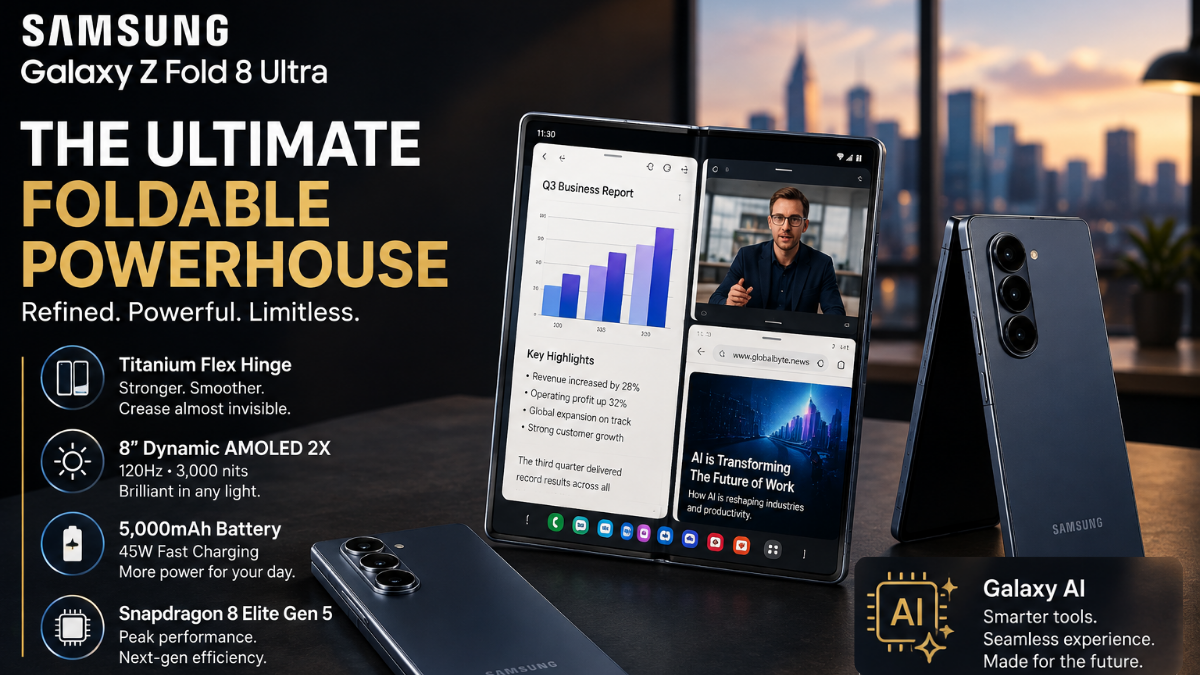
The Samsung Galaxy Z Fold 8 Ultra arrives as a highly refined, iteration-focused powerhouse that cements its position at the absolute peak of the foldable phone category. At $2,100, you're paying a massive premium for the most polished folding hardware currently in mass production. Equipped with the Snapdragon 8 Elite Gen 5, a brilliant 8-inch, 3,000-nit screen, and a re-engineered "Titanium Flex" hinge that virtually erases the display crease, this device delivers a smooth pocketable tablet experience. While its camera array remains noticeably bulky and the heavy-handed integration of "Galaxy AI" might feel a bit forced, the jump to a 5,000 mAh battery and 45W charging speeds solves your biggest daily power anxieties. If you're a demanding multitasker or corporate power user, you'll find this to be the most capable mobile workspace on the market, provided you're ready to absorb the rising memory component costs reflected in the Ultra's steep retail price.
Key Points
- A major refinement, not a radical redesign: Samsung is improving the foldable formula rather than changing it completely.
- The crease is finally becoming less annoying: The new hinge makes the inner display crease far less noticeable during everyday use.
- The 8-inch display is the real productivity advantage: It makes spreadsheets, documents, video calls and multitasking much easier than on a normal phone.
- Battery life gets a meaningful upgrade: The 5,000mAh silicon-carbon battery addresses one of the biggest weaknesses of large foldables.
- Performance is extremely strong, but heat remains a trade-off: Sustained heavy workloads can trigger performance reductions as the thin body struggles to dissipate heat.
- $2,100 keeps it firmly in the luxury category: The price makes sense mainly for professionals and power users who can take advantage of the larger workspace.
- AI still needs to prove its value: Some features are genuinely useful, while others feel more like Samsung adding AI because the market expects it.
- The camera bump remains a compromise: Samsung has improved the overall hardware, but the bulky rear camera setup affects the phone's practicality.
- Chinese rivals are raising the pressure: Thinner competing foldables are making Samsung's premium pricing harder to justify.
- The next battle is already taking shape: Rollable and multi-fold devices could become the next major step beyond today's book-style foldables.
Introduction & Core News Development
Unfolding a phone in public used to draw curious stares from passersby. Today, it's just how you get serious work done on the train or in the middle of a hectic airport terminal. When you look at the modern mobile market, you'll quickly realize the Z Fold 8 Ultra acts as a statement of sheer maturity for the entire industry. Samsung didn't try to reinvent the wheel this year. Instead, they spent their energy sanding down the stubborn, rough edges that made earlier generations feel like expensive science experiments.
As soon as you lift this device out of the box, you'll feel the difference. It doesn't feel like a delicate prototype anymore; it feels like a heavy-duty, precision-engineered appliance. It slides into your front pocket with a footprint that feels remarkably similar to a standard, flat-screen flagship, yet it opens up to reveal a sprawling 8-inch canvas. This screen completely changes how you manage your morning routine, whether you're scanning complex spreadsheets, editing documents, or running three apps side-by-side.
While rival manufacturers continue to chase thinner profiles at the expense of structural durability, Samsung relies on the incredibly powerful hardware inside to keep its competitive edge. You aren't just buying a novelty screen; you're investing in a pocket-sized computer that handles intensive productivity tasks without breaking a sweat.
Background & Industry Context
Let's look back for a second. Early foldables were defined by a laundry list of compromises that you had to accept if you wanted to live on the cutting edge. You had to deal with bricks in your pocket, deep screen creases that trapped dust, and fragile plastic displays that scratched if you pressed too hard with a fingernail. Over the last few years, Samsung has systematically knocked down these pain points with steady, calculated engineering changes.
The Z Fold 8 Ultra represents the absolute peak of this "evolutionary, not new" design philosophy. You're watching a fascinating split in the smartphone market. Standard flat-screen phones have hit a hard ceiling for design innovation, forcing companies to turn to complex, flexible form factors to justify their premium pricing.
Meanwhile, the sudden rise of specialized consumer AI hardware has changed what we expect from our screens. You need more visual real estate to interact with large language models, read AI summaries, and manage automated workflows. That's why the Z Fold 8 Ultra sits right at the busy intersection of ultra-premium hardware design and the industry's massive pivot toward on-device intelligence. It’s built for a world where your phone does a lot more than just display static apps. And fast.
Technical Breakdown & Architecture
The Titanium Flex Hinge & Display Dynamics
When you look closely at how the Z Fold 8 Ultra is put together, you've to appreciate the engineering wizardry needed to cram these components into a body that measures a tiny 4mm when unfolded. The star of the physical redesign is the new "Titanium Flex" hinge. Samsung ditched the older gear mechanisms for a dual-axis, drop-shaped assembly that gently guides the flexible inner screen into a wider teardrop fold when closed.
What does this mean for your daily use? It means you won't have to stare at that distracting, deep valley running down the center of your screen anymore. Under direct office lights, the crease is almost entirely invisible, and you'll barely feel it when you slide your thumb across the panel.
The inner screen itself is a gorgeous 120Hz Dynamic AMOLED 2X display. Samsung boosted the peak brightness to an eye-watering 3,000 nits. It’s not just about bragging rights; it’s about readability. When you're standing outside in bright midday sunlight trying to review a contract, the screen remains crisp, clear, and perfectly legible. They’ve also added a highly effective anti-reflective coating that cuts down on distracting glare. That is a massive help when you're working under harsh fluorescent office lights.
Silicon-Carbon Battery Mechanics & Thermal Throttling
For years, the biggest Achilles' heel of any large foldable was battery life. Trying to power two screens with a split battery pack usually meant searching for a charger by late afternoon. Samsung finally tackled this issue by switching to advanced silicon-carbon cell technology. By replacing traditional graphite anodes with silicon-carbon, they packed a massive 5,000 mAh capacity into the exact same physical space. This upgrade easily pushes you through a full day of heavy use, even if you spend hours on cellular data running demanding apps.
Under the hood, the custom Qualcomm Snapdragon 8 Elite Gen 5 processor runs the show. It's incredibly fast, but you need to understand the physical realities of putting this much power into a folding chassis. Heat dissipation is a constant battle. Because the phone is so thin, there's very little room for a traditional cooling setup.
When you push the device hard, like playing graphic-heavy games or rendering high-res video, you'll notice the thermal management kicking in. After about twenty minutes of sustained, heavy workloads, the system scales back performance by roughly 30% to keep the outer glass from getting too hot to hold. It's a classic engineering trade-off, and it's something you simply have to accept when you choose a super-thin folding design over a thick, traditional gaming phone.
Business Impact & Strategic Implications
If you look at this from a business perspective, the Z Fold 8 Ultra serves two distinct purposes. It works as a high-end status symbol in the boardroom, but it's also a highly effective productivity tool. The ability to snap three windows into place, say, keeping a video call open on the left, your notes on the right, and your email at the bottom, gives you a massive efficiency boost that standard phones can't touch.
Still, that $2,100 price tag is a tough pill to swallow, and it'll definitely slow down widespread corporate adoption. IT departments will have to think long and hard about whether they can justify buying these devices for entire teams.
Samsung’s strategy here's crystal clear: they're targeting the absolute top of the premium market, a move that mirrors the high-end industrial automation focus of Samsung's RX division. By keeping the Ultra model distinct from their cheaper, standard folding options, they're building a highly profitable, tiered ecosystem. Few saw this coming.
They've stopped trying to please everyone with a single device. Instead, they're focusing their attention on power users who are willing to pay top dollar for the absolute latest chip technology and the most advanced software optimizations available.
Industry Perspective & Ecosystem Dynamics
The competition in this space is getting incredibly fierce. Chinese brands are releasing remarkably thin hardware, showing everyone just how sleek a smartphone can be if you push the boundaries of materials science. This aggressive competition puts immense pressure on Samsung to justify its premium pricing.
The battleground is shifting rapidly. Hardware specs are starting to take a backseat to the software and services layer. As we saw at the latest industry gatherings focusing on mobile AI tech, the software experience is where you win or lose users.
Samsung's decision to build a highly advanced, automated call-screening tool directly into One UI shows they're paying close attention to what users actually want. They're focusing on real-world utility, like blocking spam and summarizing voicemails in real time, rather than just offering flashy gimmicks.
Behind the scenes, Samsung is also reorganizing its global operations. Branches like Samsung Electronics America are restructuring to stay agile, while parent company investments in their next-generation semiconductor wafer fab guarantee they'll have a steady supply of custom silicon to power their aggressive AI roadmap for years to come. Hardly.
GlobalByte Perspective
The Galaxy Z Fold 8 Ultra feels less like Samsung trying to reinvent the foldable and more like the company finally polishing the formula it has been working on for years. The thinner body, almost invisible crease, brighter 8-inch display and larger 5,000mAh battery address several complaints that have followed foldables for generations.
But refinement comes at a price. At around $2,100, the Fold 8 Ultra is clearly aimed at people who will actually use its large screen for work, multitasking and demanding apps, not buyers looking for a more interesting smartphone. The hardware is impressive, but the price and bulky camera design still make it difficult to call it a sensible upgrade for existing Fold owners.
The bigger question is what Samsung does next. The Fold 8 Ultra may represent the most mature version of the traditional book-style foldable, but rivals are already pushing thinner designs while the industry is looking toward rollable and multi-fold screens. Samsung's next challenge won't simply be making another Fold better; it will be finding a new reason for people to fold their phones in the first place.
Future Outlook & Strategic Roadmap
Looking down the road, the next major challenge for Samsung will be moving past the simple "fold-in-half" design. The Z Fold 8 Ultra represents the absolute limit of what you can do with this specific folding style. Over the next couple of years, you should expect the focus to shift toward rollable screens and multi-fold devices that can expand even further.
Engineers will also need to work on slimming down the bulky camera modules so they don't ruin the phone's balance, and they'll need to develop under-display cameras that match the quality of standard front-facing lenses. The real hurdles for the near future aren't just about screen durability; they're about battery density and creating smarter, more efficient AI assistants that can manage your daily schedule without you having to constantly double-check their work.