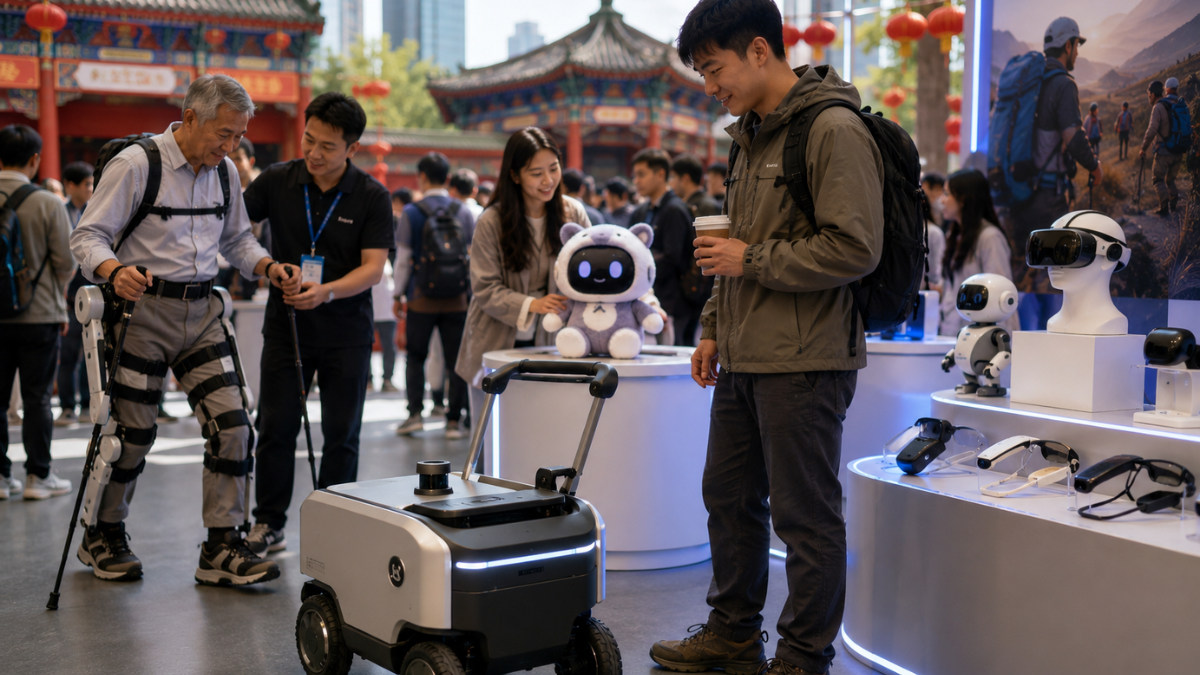
A camping cart rolled quietly through a crowded Beijing street fair last month, keeping pace with its owner, steering around strangers, costing less than a mid-range smartphone. Zhang Lei, a local camping enthusiast, watched it navigate the crowd and ordered one on the spot. Price? Under 2,000 yuan - roughly $294. No programming. No technical knowledge required. Just walk, and it follows.
That scene captures the affordable consumer AI hardware market growth trends of 2026 better than any industry forecast.
AI isn't just a chatbot anymore. It's something you can carry, wear, or buy at a street fair.
AI Moves Off the Screen and Into Everyday Life
At the Longfusi digital economy fair in Beijing - held alongside the 2026 Global Digital Economy Conference - more than 300 AI products from over 40 companies were on display with actual price tags. Not prototypes behind velvet ropes. Products you could pay for and take home that afternoon.
The autonomous following camping cart with obstacle avoidance technology drew the biggest crowds. But it wasn't alone. A few meters away, an older visitor jogged slowly in a lightweight exoskeleton under a staff member's guidance. Nearby, an emotion-aware plush toy responded to voice and touch, offering brief companionship to anyone who stopped. What stood out wasn't the novelty. It was commercial viability - everyday application scenarios for intelligent consumer hardware, available right now, at prices that didn't require a second mortgage.
You can see how fast this is moving in the broader data on consumer digital device trends, which keep pointing in one direction.
Consumer Grade Exoskeleton Suit Price and Features: A Market Arriving Now
Exoskeletons used to cost hundreds of thousands of yuan. Military labs, rehabilitation clinics, nowhere near everyday life.
That's changed. Consumer-grade exoskeleton suit price and features have shifted dramatically - most models in China now sell between 6,000 and 20,000 yuan. Beijing-based outdoor company Toread, with brand manager Gao Yuwen at the helm, launched a hiking exoskeleton for roughly 7,000 yuan in June 2026. It moved over 100 units in a single day on one platform. Rental options lower the barrier further still. A Hangzhou park rents exoskeleton experiences for 9.9 yuan per hour, while the Great Wall, Mount Tai, and Huangshan Mountain all offer them at roughly 80 yuan for three hours.
Charlee Charles, a travel support specialist who tried one at the Great Wall, put it plainly: "There are many elderly people and people with disabilities who dream of doing something like this but feel they cannot. With this kind of assistance, they do not have to remain at the bottom."
AI companion products for elderly emotional support don't always look like a companion robot. Sometimes they look like a wearable that lets someone actually make the climb.
Companions, Smart Carts, and an Actual Price Ladder
The consumer AI hardware market growth this year has produced something the category never had before: a real price ladder.
At a Beijing robotics retail store, an entry-level storytelling robot sells for 349 yuan. A mid-range companion with long-term memory and proactive conversation runs 2,299 yuan. Affordable emotional support robots under a thousand dollars are genuinely available now, not just on a roadmap. More advanced models with complex emotional interaction cross 10,000 yuan - but the baseline has dropped enough that most families can participate in some tier of this market.
AI glasses and translation earphones have become routine stock at the Yiwu International Trade Market in Zhejiang, not niche curiosities. Robotics experience stores are opening in cities across China, not just in tech hubs. And AI takes the lead in shopping trends from China's 618 festival, confirming that AI-enhanced products are competing on mainstream shelves, not just conference floors.
Affordable Consumer AI Hardware Market Growth: Why Prices Keep Falling
Here's the part that doesn't get enough attention.
China's smart hardware manufacturing supply chain ecosystem is deeply integrated. Acoustics, optics, batteries, molds, final assembly - all domestic. Companies can iterate faster, cut costs earlier in the production cycle, and move new concepts to mass production on timelines that aren't realistic elsewhere. Smart wearable devices mass production cost reduction isn't happening by accident.
The China AI industry growth forecast shows continued acceleration, driven partly by this domestic supply chain integration. The chip layer is getting more competitive too. Local AI chip suppliers are filling gaps that required imports just a few years ago, and moves like the BYD consumer AI chip announcement signal that major manufacturers are competing hard at every layer of the hardware stack.
Scale matters too. With over 1 billion internet users and 1.4 billion consumers, China's domestic market can sustain specialized product categories that would die elsewhere. Exoskeletons find buyers in hiking, rehabilitation, and elderly care - simultaneously, in the same country. Emotion-aware toys serve child companionship and psychological comfort. Autonomous following devices are showing up in camping, logistics, and short-distance transport. Each of those is a distinct market that can fund its own product evolution.
Policy Is Doing Real Work Here
China's 15th Five-Year Plan (2026-2030) lists AI plus consumption quality improvement as a priority development area. Last month, the Ministry of Commerce and seven other departments released an implementation guideline with 17 measures across five areas, aimed at deepening AI integration into consumer markets - covering smart products, services, and new consumption scenarios.
This is what a real policy tailwind looks like. China's digital consumption reached 25.3 trillion yuan in 2025, up 8.7 percent year on year. AI features are shifting from premium add-ons to standard product specs, and the China AI sector’s explosive growth story is increasingly being told through what consumers can actually buy, not just what researchers can model.
These Affordable Consumer AI Hardware Market Growth Trends Are Going Global
The affordable consumer AI hardware market growth trends you're seeing in China are not staying there.
The product categories pioneered in Chinese consumer markets are appearing on global roadmaps. Physical AI solutions trends for 2026 confirm this direction. At AI hardware at CISCE 2026, the exhibitor list included players from across the international value chain - not just Chinese companies.
Korean chipmakers targeting consumer markets are entering the same competitive space, which adds pricing pressure that benefits global consumers. Meanwhile, breakthroughs in 3D stacking AI chip technology are giving manufacturers new tools to build around component constraints. The open-source AI market shift is making model capabilities cheaper to embed in physical products across all markets - which is what ultimately lowers device costs even outside major manufacturing hubs.
Even mobile AI tech at MWC Shanghai showed AI hardware convergence accelerating across categories in ways that mirror what Chinese consumer hardware companies are already shipping.
Joe Weinman, founder of the International Institute for Future Industries, put it well: "By bringing together data, algorithms, computing infrastructure and human talent, these new productive forces are creating highly capable yet affordable solutions that will benefit not only China but also the wider world."
That camping cart rolling through a 600-year-old Beijing street fair might look like a novelty. But the consumer AI hardware market growth it signals is building toward a world where AI capabilities in physical products become normal. Not expensive. Not niche. Just normal.