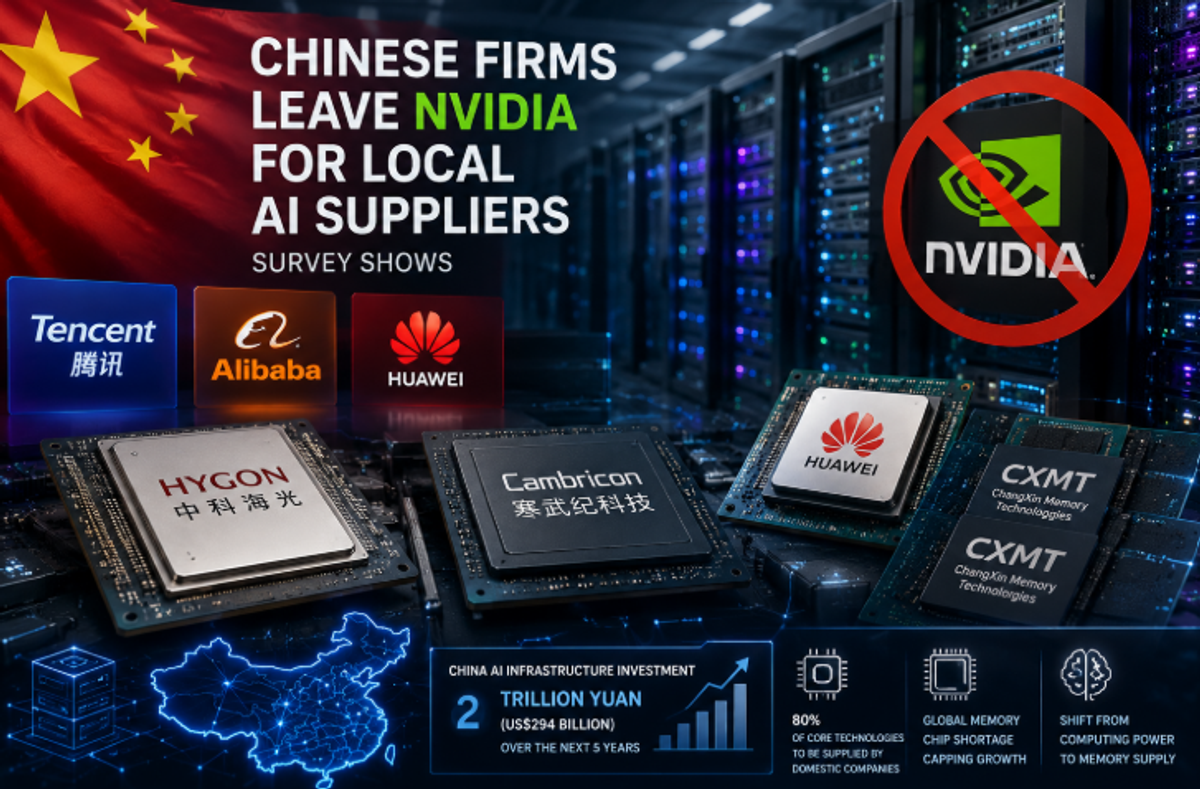
The shift is real. Chinese firms leave Nvidia for local AI suppliers at a pace that's now showing up in hard budget allocations - and a Bloomberg Intelligence survey released July 7, 2026, finally puts concrete figures behind what the industry had been watching develop for months.
Sixty executives from Chinese software, finance, manufacturing, and retail companies were polled. Their plan for AI accelerator spending over the next 12 months: 46 percent going to domestic products. That's up from just 30 percent today. A 16-point jump in planned spending - in a single year. For the broader strategic picture driving all of this, Chinese AI companies reshaping global competition in 2026 is essential reading alongside this data.
Why Chinese Firms Are Leaving Nvidia for Local AI Suppliers: The Bloomberg Numbers
The findings go beyond chip preferences. They reflect real financial strain.
A full 80 percent of executives surveyed said their total infrastructure spending is running over budget this year. The main culprit? AI-related project costs. That's four out of five companies already over budget, and spending more on AI than planned.
That cost pressure is reshaping sourcing decisions. Domestic alternatives aren't always cheaper - but they're far more accessible under current trade conditions. Beijing has also actively discouraged use of Nvidia's H20 chips, so you've got supply pressure and policy pressure pulling in the same direction. The Nvidia H20 market share contraction in China isn't sudden. It's gradual, incremental, and - based on this survey - not reversing.
Who Stands to Gain: Huawei, Hygon, and Cambricon
Three names dominate the data. Tencent and Alibaba's AI infrastructure building suppliers are anchored by Huawei Technologies, which has the most developed domestic AI chip stack of any Chinese company. How companies here are ditching Nvidia advanced accelerators for domestic silicon isn't a hypothetical anymore - it's an active procurement shift playing out across enterprises right now.
Hygon Information Technology is being evaluated by a large share of respondents as a credible accelerator alternative. Cambricon Technologies’ advanced accelerator demand is picking up too, as companies hunt for H20 substitutes that don't carry geopolitical exposure.
On the deal side, the Tianshu Zhixin ByteDance GPU deal shows this isn't just small companies hedging - even major hyperscalers are actively diversifying away from Nvidia. And on the engineering side, Chinese AI chips 3D stacking explains how domestic manufacturers are using advanced packaging to close performance gaps that once seemed unbridgeable.
Huawei's ambitions extend beyond data centers, too. The BYD self-driving chip Huawei story makes clear that its silicon roadmap spans automotive, edge computing, and AI inference - not just cloud training hardware. It's a broader platform play, and the data center shift is only one piece of it.
The 2 Trillion Yuan Data Center Plan and What Domestic Supply Means in Practice
China is directing roughly 2 trillion yuan - about $294 billion - into data center infrastructure funding nationwide over the next five years. The policy target attached to that figure: at least 80 percent of core technologies, including chips, should come from domestic companies.
When government-backed procurement targets are that explicit, they reshape the entire supply chain beneath them. You can see the infrastructure-level impact in projects like the heterogeneous computing CAS platform from the Chinese Academy of Sciences - full-stack domestic computing built specifically to reduce foreign dependency.
The political urgency behind this is equally clear. What China’s AI sector explosive growth 2026 - signaled at Premier Li Qiang's Summer Davos speech - means in practice is that this buildout carries national priority status. How government-led initiatives expand AI deployment in healthcare and city management is only part of it. The procurement pressure is structural.
The competitive dynamics at the chip level also showed up directly at the CISCE Nvidia Qualcomm exhibition, where foreign and domestic semiconductor firms competed in the same exhibition space. Not symbolically - literally side by side.
Memory, Not Just Compute, Is the Real Bottleneck Now
Here's the more subtle finding buried in the survey data, and honestly it might be the most important one: the bottleneck is shifting from raw computing power to securing the supply of high-bandwidth memory chips that support rapid data transfer.
A global memory chip shortage is likely to cap growth at firms like SMIC. ChangXin Memory Technologies is positioned to benefit - ChangXin Memory Technologies’ HBM storage benefits make it a natural domestic alternative just as global supply tightens further.
The CXMT Tencent server DRAM deal - a $2.94 billion supply agreement - makes the strategic logic concrete. When Tencent locks in a multi-billion dollar domestic memory deal, that's not routine procurement. It's a supply chain hedge. Understanding the role of ChangXin Memory in bypassing global memory chip shortages deserves more attention than most coverage gives it.
The H200 Policy Wildcard and Why the Direction Is Already Set
The US debate over Nvidia H200 chip shipments to China continues. Why the US debate over allowing Nvidia H200 shipments to China impacts local suppliers is that it creates urgency, not just uncertainty. If Washington approves H200 exports, domestic adoption might slow at the margins. If it doesn't, the substitution accelerates. But Chinese software firms aren't waiting to find out either way.
Budget reallocations are locked in. And the technical credibility of domestic options keeps growing - the Lingsheng supercomputer world ranking is evidence that domestic chips can perform at scale when properly integrated into large systems.
The competition for Nvidia's vacated market share isn't only domestic, either. Korean chipmakers targeting China markets show non-US semiconductor firms actively positioning for the same gap. And the software shift is running in parallel - ChatGPT market share China open-source AI covers how Chinese open-source models are displacing OpenAI at the application layer, mirroring exactly what's happening with domestic hardware versus Nvidia at the infrastructure layer.
What Happens Next as Chinese Firms Leave Nvidia for Local AI Suppliers
The Bloomberg News survey of sixty Chinese software, finance, manufacturing, and retail executives points in one direction. Chinese companies are moving away from Nvidia toward domestic suppliers not just because Washington pushed them to - but because domestic alternatives are improving, supply is tightening. Budget overruns are making expensive, hard-to-source foreign chips increasingly hard to justify quarter by quarter.
The substitution of locally made AI semiconductors for foreign ones is making real progress. Watch Huawei's accelerator roadmap. Watch ChangXin Memory's production ramp. And watch the H200 policy decision in Washington - it's the one variable that could adjust the speed of this transition without changing its direction.