Summary
Chery AiMOGA robotics IPO overseas police robots plans are putting one of China’s fastest-moving automotive technology groups under a brighter spotlight. The company wants to expand robot deliveries, build a larger international presence, and potentially seek public-market funding while competition heats up.
That’s a lot to take on at once.
AiMOGA Robotics, incubated by Chery Automobile in January 2025, is no longer limited to showroom demonstrations or dealership support. Its bipedal humanoid machines are now being used in public-service roles, including traffic management and crowd guidance in Chinese cities. And Chery’s ambitions don’t stop at home.
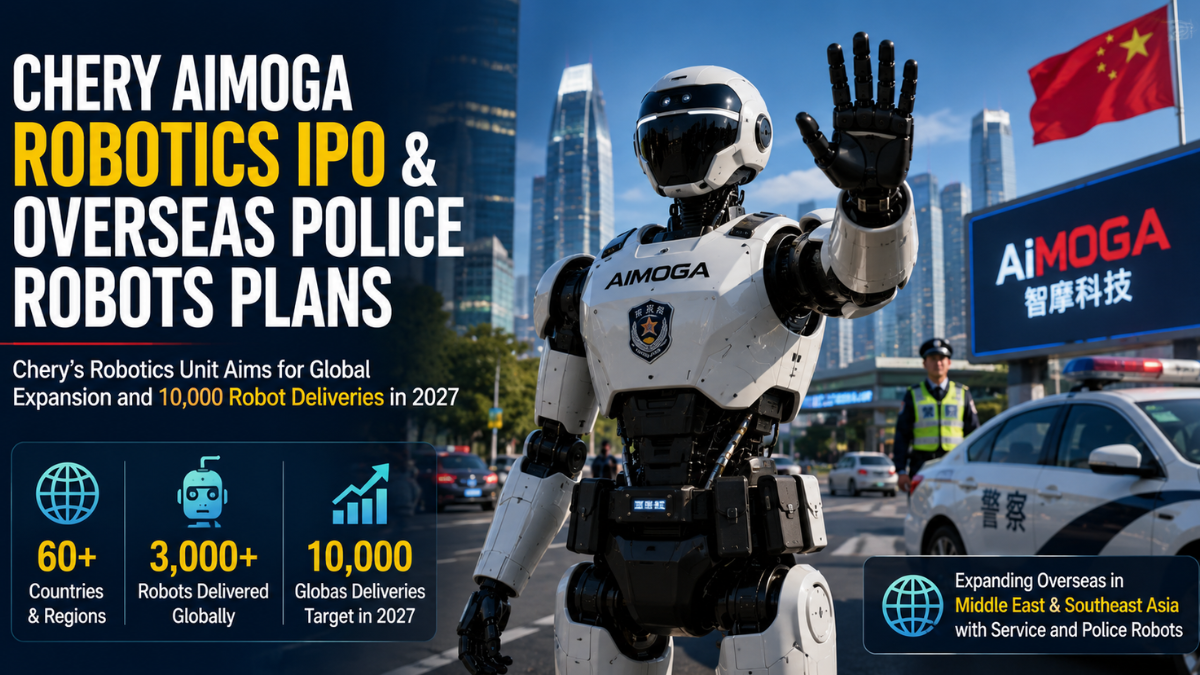
The company says it has delivered more than 3,000 robots globally, including 2,000 outside China, and now operates across more than 60 countries and regions. Its stated target is even bigger: 10,000 global robot deliveries next year.
Key Points
- AiMOGA was incubated by Chery Automobile in January 2025.
- The company says it has delivered 3,000+ robots globally, including 2,000 outside China.
- AiMOGA operates across 60+ countries and regions.
- The company is targeting 10,000 global robot deliveries next year.
- Around 110 humanoid police robots have reportedly been deployed in Chinese cities for traffic and crowd-management support.
- AiMOGA is preparing for a potential IPO, but no exchange or timeline has been confirmed.
- The company plans to explore Middle East and Southeast Asian markets, including service and police-related applications.
- Chery’s existing international network could make overseas expansion easier than it would be for a standalone robotics startup.
- Public-service robots face tougher challenges around safety, privacy, local regulations and public acceptance.
- AiMOGA’s biggest test will be turning robot deployments into repeatable commercial revenue, rather than relying mainly on demonstrations and pilot projects.
Why Chery’s AiMOGA robotics unit is preparing for an IPO
The Chery Automobile robotics division AiMOGA IPO discussion is still at an early stage. Zhang Guibing, who leads the business and serves as president of Chery International, said the company is making preparations and talking with several potential listing venues. No timetable or exchange has been publicly confirmed.
A listing could give AiMOGA capital for research, product development, overseas rollout, and the less glamorous work that matters when a company grows quickly - governance, transparency, and operating discipline.
That doesn’t make an IPO automatic. Public listings bring pressure too. Investors will want proof that robots can generate repeatable revenue, not just create a memorable scene at an expo.
Still, the move fits Chery’s history. Separate listings of related businesses are not unusual within its wider corporate orbit, and China’s robot sector is attracting intense investor interest. Unitree's IPO milestone has only made the race more visible, while other robotics startups are also weighing public-market routes.
For investors watching the space, this is less about one announcement and more about a pattern. China auto giant Chery enters robotics IPO race alongside Unitree and Lumos, betting that its manufacturing background and global distribution network can become real advantages.
Chery AiMOGA robotics IPO overseas police robots strategy goes beyond showrooms
The Chery AiMOGA robotics IPO overseas police robots story is really a commercial-use story. Funding matters, yes. But the company’s ability to show practical deployments will matter much more.
AiMOGA began with a bipedal humanoid robot used in Chery dealerships. That made sense as a testing ground: predictable environments, known customer interactions, and a clear brand role. Public-safety work is far tougher.
Earlier this year, the company introduced humanoid police robots and says 110 units have been deployed across several Chinese cities. These machines assist with traffic management, crowd guidance, and public-safety awareness campaigns.
That’s why the phrase AiMOGA bipedal humanoid police robot traffic management is more than a search term. It describes the first real stress test for this kind of machine. A robot directing pedestrians or helping at a congested junction has to be visible, understandable, weather-resistant, and safe around moving vehicles. A polished demo won’t cut it.
Chery deploys 110 AiMOGA humanoid police robots across Chinese cities for traffic control because the job can be punishing for human officers. Heat, rain, exhaust exposure, and accident risk are part of the daily reality. Robots won’t replace judgment-heavy policing, but they may take on repetitive support tasks where staffing is thin.
And that brings up a more useful question: how Chery AiMOGA humanoid robots are addressing traffic police labor shortages? By handling guidance, visibility, routine information, and basic traffic-support duties while human teams focus on decisions that require authority and situational awareness.
Overseas demand may be strongest in difficult climates
Chery AiMOGA plans overseas expansion of police and service robots in Middle East and Southeast Asia, according to Zhang. The reasoning is practical. Extreme heat in parts of the Middle East, along with heavy rain and humid conditions in Southeast Asia, can make outdoor traffic work especially demanding.
The company sees an opening there.
That doesn’t mean deployment will be easy. Police and public-service robots face local procurement rules, safety standards, privacy expectations, language requirements, and public acceptance issues. A robot that works well in one city might need major changes before it can operate elsewhere.
For now, Chery humanoid robots Middle East Southeast Asia plans appear to be part of a staged expansion rather than an overnight launch. Service robots and companion robots are expected to lead the initial international push, while police-related deployments could follow where regulations and customers align.
That’s sensible. Public-facing robots are hard enough. Sending them into sensitive government roles is harder.
The company’s broader strategy also reflects the rise of AI-powered smart cities, where connected infrastructure, automation, and public services increasingly overlap.
The numbers Chery needs to hit
The AiMOGA 10000 global robot deliveries target 2027 is ambitious. Reaching it would require more than making robots in volume. Chery will need reliable support networks, local partners, spare-parts availability, software updates, and a clear answer to a basic buyer question: what does this robot save or earn for us?
Simple. Effective. Free to start is not how enterprise robotics works.
The 10,000-unit target puts AiMOGA targets 10000 global humanoid robot deliveries as Chery eyes stock listing at the center of the company’s pitch. Scale can reduce unit costs, but scaling too fast can expose product flaws. And humanoid robots still have plenty of them: limited battery life, uneven real-world navigation, maintenance needs, and high price tags.
Zhang has said humanoid robots may need roughly a decade to mature before widespread adoption accelerates. That’s a refreshingly restrained view in a sector that often makes very loud promises.
You can see why China's humanoid robot market is becoming a focus for automakers, manufacturers, and investors alike. The opportunity is huge. So is the execution risk.
Why automakers are entering humanoid robotics
China automaker humanoid robotics commercial adoption is gaining momentum because carmakers already understand industrial production, supply chains, sensors, software integration, and high-volume cost control. Those capabilities don’t magically solve humanoid robotics. They do provide a serious starting point.
Chery International Zhang Guibing AiMOGA robotics leadership is central here because Chery already has extensive export experience. Its overseas vehicle network could help AiMOGA enter markets where a standalone robotics startup would need years to build relationships.
But there’s a catch. The company expects fierce cost competition, much like China’s electric vehicle market. Some weaker robotics firms will likely disappear or be acquired as the field matures.
Robotics in manufacturing remains a more established business case than public-facing humanoids. Yet Chery is betting that service roles, dealerships, and public spaces can become the next layer of demand. It’s also part of a wider international push toward physical AI for business, where software is designed to act in the real world, not just on a screen.
What AiMOGA is exporting, and what could slow it down
AiMOGA companion robots service robots export plans may prove more commercially realistic in the near term than a broad overseas rollout of police humanoids. Companion and service machines can be tailored to hotels, retail, events, healthcare support, reception, and customer-facing settings without carrying the same public-authority implications.
The company’s police robot concept is still worth watching, though. It shows where Chery thinks its technology could go.
Global expansion will depend on a patchwork of rules. Countries may require machines to meet product-safety standards, data-protection rules, communications requirements, and public-sector purchasing conditions. China’s own move toward humanoid robot digital IDs offers a glimpse of how regulation may become part of the business model, not an afterthought.
And then there’s customer trust. People don’t judge robots like washing machines. They watch them, test them, film them when they fail, and expect them to behave sensibly in messy environments.
That’s the hard part.
Chery AiMOGA robotics IPO overseas police robots: what happens next?
The Chery AiMOGA robotics IPO overseas police robots push is a serious attempt to turn an automaker’s robotics experiment into a global business. It combines a potential stock listing, a 10,000-delivery goal, police-robot trials in China, and overseas ambitions in demanding climates.
Chery has a credible international foundation. What it still needs is proof that its robots can perform reliably, meet local rules, and deliver enough value that customers keep ordering them after the novelty fades.
Watch its overseas service-robot deployments first. They may reveal more about AiMOGA’s future than any single IPO headline. Tokyo's physical AI bet, self-dressing robotic technology, and a growing robotics investment portfolio all point to the same reality: the market is moving fast, but practical adoption will decide who lasts.
GlobalByte Perspective
AiMOGA’s story is becoming more interesting because Chery is trying to take humanoid robots from showrooms and demonstrations into real-world jobs. The reported use of 110 robots for traffic management shows the company is already testing where these machines can be useful outside controlled environments.
The bigger opportunity is overseas. Chery says it has already delivered more than 3,000 robots globally and wants to reach 10,000 next year. Its existing international network could give AiMOGA an advantage that smaller robotics startups don't have. But expanding into public-service roles will bring tougher safety, privacy, and regulatory requirements.
GlobalByte Perspective: The IPO story is interesting, but the real test is whether AiMOGA can prove that its robots solve practical problems at a cost customers are willing to pay. Chery has manufacturing experience and a global distribution network. Now it needs to turn those advantages into a sustainable robotics business.