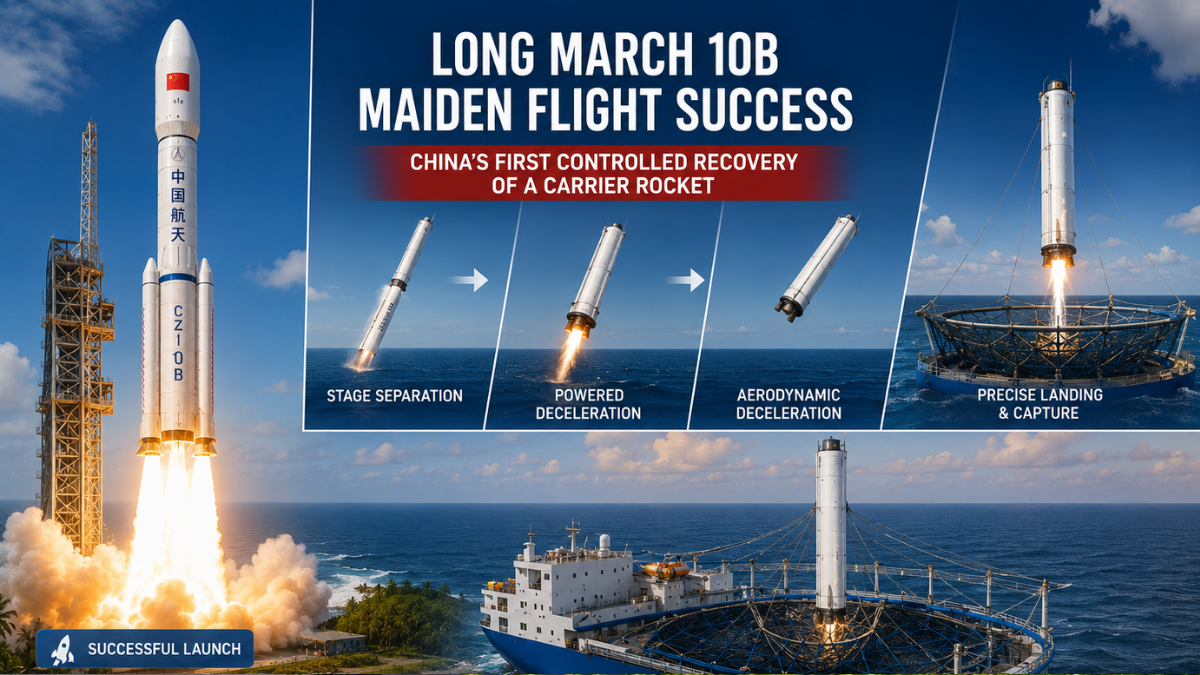
On July 10, 2026, the China Long March 10B rocket maiden flight net recovery mission did something that has no precedent anywhere on Earth: it launched from the Hainan Commercial Space Launch Site, delivered its satellite payload to low Earth orbit, and then caught its own returning first-stage booster in a ship-mounted net - in open ocean, on the very first attempt.
That's not an incremental improvement on anything. It's a new category.
Xinhua reporters Gu Tiancheng and Chen Kaizi filed from the Wenchang aerospace report site, confirming two simultaneous records - China's first controlled carrier rocket first-stage recovery, and the world's first sea-based recovery of an orbital-class booster. Both. Same flight.
What the Long March 10B Is Built to Do
The Long March 10B is a liquid-fueled reusable commercial launch vehicle developed by the China Academy of Launch Vehicle Technology (CALT), a subsidiary of China Aerospace Science and Technology Corporation (CASC). It stands roughly 63 meters tall and 5 meters wide. Long March 10B takeoff weight sits at approximately seven hundred sixty metric tons, with a liftoff thrust of around 890 tons. In reusable configuration, it carries 16 tons to low Earth orbit - the Long March 10B reusable configuration LEO payload capacity that puts it in direct commercial competition with current Falcon 9-class hardware.
Chen Muye of CASC was specific about the mission purpose: "The Long March 10B is primarily aimed at China's commercial launch market, with stronger carrying capacity and wider mission adaptability." He named the target use cases - low Earth orbit satellite internet constellation deployment, large commercial satellites, and eventually missions tied to China's crewed lunar landing space infrastructure development.
Reusability isn't a nice-to-have here. It's the whole design premise.
The Hainan Commercial Space Launch Site has been China's busiest orbital launch location, and an earlier Long March 4B launch from the same infrastructure shows the operational tempo this site already maintains. The 10B is designed to match that pace - but with most of the rocket returning intact after every flight.
The Six-Minute Sequence That Made History
After first-stage separation, the booster has to do four distinct things before the net can catch it.
First, glide and attitude adjustment - the vehicle flips and orients itself, reading its position in the atmosphere like a diver reading the water before entry. Then powered deceleration, the engine reigniting to bleed off velocity. Then aerodynamic deceleration, using drag rather than thrust to slow the descent further. And finally, the catch: a "well"-shaped high-strength buffer arresting net, combined with an onboard cable mechanism that physically grabs the descending vehicle and holds it.
The whole sequence takes about 6 minutes.
What makes it technically viable is an online trajectory planning system that adjusts the descending rocket's attitude in real time all the way down. It's not flying a preset program - it's actively solving for the correct descent path, correcting for wind, velocity errors, and position drift as they occur. The liquid oxygen methane engine propellant settling management protocols during the powered deceleration phase handle another subtle problem: fuel has to stay correctly positioned through multiple attitude changes and an engine restart. Get that wrong, and the engine doesn't light when you need it most.
A parallel reusable rocket engine test from another Chinese aerospace team recently logged 620 continuous seconds of burn time - a signal that propulsion development across China's commercial launch sector isn't only happening at CALT.
Net Capture vs. Landing Legs: Why CALT Made a Different Call
The SpaceX Falcon 9 landing legs vs CALT net capture comparison gets a lot of attention, and it's genuinely worth working through.
SpaceX's vertical landing approach requires the booster to carry deployable legs. Those legs ride to orbit and back on every single flight, contributing nothing to payload. They're structural weight you're paying to launch, recover, inspect, and relaunch every time. Net-based recovery eliminates that weight. Chen Muye put it plainly: "Net-based recovery simplifies the rocket's structure, reduces its weight, and increases its carrying capacity."
And there's a second advantage that gets less coverage. How net-based recovery systems expand landing deviation tolerance for orbital-class rockets is the real operational argument for the approach - the net's wider catch zone compensates for targeting error that a landing-leg system can't tolerate. On a moving ship in open ocean, that extra margin isn't a nice-to-have. It's essential.
Does this make net capture "better"? Honestly, it shifts complexity from the rocket to the ship. But the first attempt worked, which suggests CALT has that ship-side complexity under control.
The Navigator: The Platform That Made the Catch Possible
In November 2025, CALT delivered the "Navigator" - the world's first marine platform purpose-built for rocket net-system recovery. It's large: 144 meters long, 50 meters wide, with a full-load displacement of 25,000 tons.
The Navigator sea recovery platform’s dynamic positioning parameters use DP2-class capability - the same positioning standard used by deepwater drilling ships. That DP2 dynamic positioning vessel capacity means the ship can hold a precise station in open ocean without anchors, through variable sea conditions. This matters because the rocket and the ship have to meet at the same point in space at the same time. The Navigator can't wait at a fixed GPS coordinate - it has to track where the booster will land and stay there, continuously, as conditions change.
It worked on the first try.
Why Commercial Spaceflight Is Paying Attention
China Spacesat and China Satellite Communications both hit their daily stock limits the day of the announcement. The Guotai Defense ETF 512660, tracking the aerospace market response, moved sharply. Investors understood immediately what reusability means for the economics of constellation deployment.
Programs like Qianfan Constellation with their high-cadence weekly space launch schedules need dozens of flights to build orbital coverage. Every dollar saved per launch multiplies across the full deployment. The B2B launch service procurement framework for low Earth orbit satellite internet is competitive - and reusability is increasingly what separates viable bids from uncompetitive ones.
That's the commercial logic behind the design. Simple and direct.
This Didn't Happen in Isolation
The Long March 10B maiden flight is one milestone inside a much longer pattern.
China's orbital data centers are expanding, and they depend on affordable orbital access to scale. The Beijing space computing hub initiative needs satellite infrastructure to be economical enough to build out at meaningful density. China's AI growth trajectory increasingly intersects with space - satellite imagery, space-based connectivity, orbital compute nodes. Cheaper launches aren't just a space story. They're a computing story.
And it's not just rockets making the news. The same country setting Lingsheng supercomputer ranking records at the top of the global list, achieving superconducting magnet breakthroughs and China's fusion reactor records simultaneously, is now also setting sea-based rocket recovery records. None of this is accidental. It reflects China's innovation blueprint - a coordinated industrial strategy that treats deep-tech capability as national competitive infrastructure, not isolated research wins.
That context matters for understanding China's global tech competition with the US and Europe, which is reshaping how commercial technology leadership gets distributed across industries and borders.