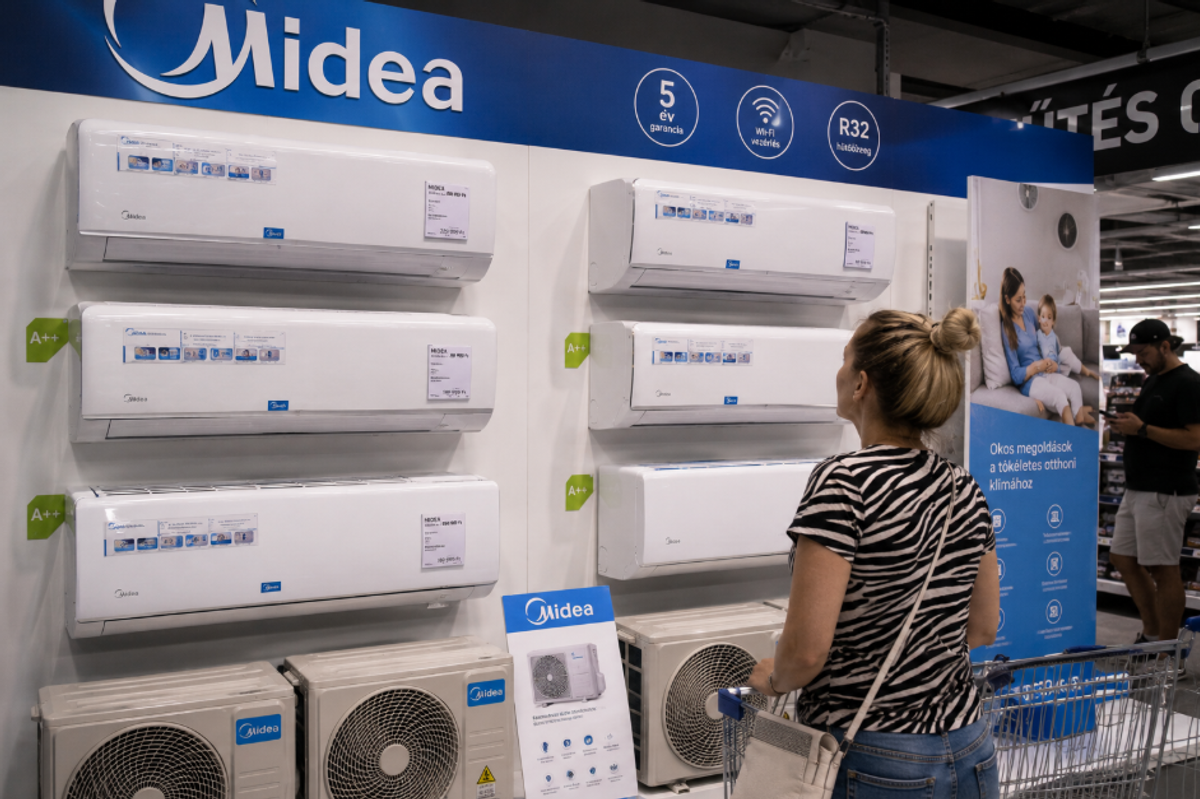
Something unusual happened this summer. While EU officials were publicly debating Chinese "overcapacity," ordinary Europeans were frantically hunting down Chinese air conditioners - and coming up empty-handed. Europe's demand for Chinese cooling products has become one of the most-discussed stories in global trade, and the Chinese air conditioners market demand Europe 2026 narrative isn't cooling off anytime soon.
So what's actually driving this? It's not just a brutal summer. And it's definitely not an accident.
When a Heatwave Crashes a Trade War
The timing is almost comically ironic. China-EU trade consultations have been ongoing for months, with European officials framing Chinese exports as a threat to domestic industry. Then summer 2026 hit - hard - and suddenly the abstract politics of tariffs collided with the concrete reality of a heat emergency.
Foreign media put it plainly: "With the heatwave hitting, Europe is finding the trade war with China difficult to win."
That's not wrong. Market forces don't wait for diplomatic calendars. When people are sweltering in old apartment buildings with no AC, they're not thinking about geopolitics.
Why European Demand for Chinese Air Conditioners Keeps Growing in 2026
Here's something most people outside Europe don't fully grasp. The low coverage rate of air conditioning in European households isn't because Europeans don't want it. It's because getting it installed is genuinely painful.
Older buildings across France, Italy, Germany, and the UK carry strict regulations about facade modifications. You can't just drill into the wall and mount a unit. Approval processes stretch for months, labor costs are steep, and in many cases the building authority simply says no. This created a market that looked, on the surface, like it didn't exist.
Chinese manufacturers looked at the same situation and saw something completely different.
The Product Breakthrough Nobody Saw Coming
The AC unit selling out across Europe isn't a standard model. It's a portable split-type air conditioner - developed over roughly three years - engineered specifically to work around European building restrictions. No wall penetration required. Low-noise-level reduction technology built in to satisfy strict local regulations. And, critically, tool-free self-installation that lets users set everything up without calling an expensive technician.
That last point matters more than it sounds. High manual labor costs are a genuine barrier to appliance adoption in Europe. Eliminate the installation fee, make the setup simple enough that anyone can manage it, and you change the entire economics of the purchase decision.
This is what it means to break the "impossible triangle" of regulatory barriers, user needs, and cost control. Not by ignoring any corner of it - by engineering through all three simultaneously. Understanding product strength breakthroughs in portable split-type air conditioners requires appreciating just how long and deliberate that engineering process was.
The Supply Chain That Can Actually Handle the Surge
None of this works without the manufacturing muscle behind it. China produces approximately 80% of the global air conditioner market - and that dominance isn't just about size. It's about coordination speed.
From complete unit manufacturing at the Shunde Guangdong air conditioner manufacturing hub to the refrigeration valve industry cluster in Xinchang Zhejiang, plus nationwide compressor production capacity spread across the country - when demand spikes, the chain responds fast. When Europe's heatwave hit without much warning, manufacturers achieved full-chain coordination efficiently: upstream components, cross-border logistics, last-mile delivery. China's manufacturing expansion data confirms how deeply this agility is built into the system.
It's not a new pattern. The surge in orders for Chinese electric blankets during the 2022 European energy crisis showed the same thing. An emergency creates demand; China's industrial chain is ready before competitors have fully mapped the opportunity.
Robust Chinese factory activity across the past few years has validated this again and again.
From "Made in China" to "Designed for You"
Here's where the Chinese air conditioners market demand Europe 2026 story gets more interesting, because this isn't just about volume anymore.
Chinese home appliances’ deep localization strategy means companies are doing the user research first - figuring out exactly why a specific market hasn't adopted something, identifying the precise friction points, then engineering products that make those friction points disappear. The portable AC flooding European shelves didn't come from copying a Western design. It came from asking why Europeans couldn't install standard units, then spending three years making those reasons irrelevant.
That's the shift from product export to innovation export paradigm. China's global industrial shift toward the high end of the global value chain is showing up in consumer appliances now, not just EVs and semiconductors.
Chinese brands reshaping global competition are increasingly competing on deep scenario understanding rather than price - and the results are starting to show on empty store shelves across Europe.
What Chinese Air Conditioners' Market Demand in Europe 2026 Signals for Trade Policy
The irony in the current tariff situation is hard to ignore. Trade barriers work by making imported goods less price-competitive against local alternatives. That logic holds reasonably well when competing products are roughly equivalent.
It falls apart when the imported product solves a problem nobody else has solved.
Non-penetrating installation AC units for European buildings essentially didn't exist before Chinese manufacturers built them. There's no European product to protect against. Supply chain integration trends 2026 confirm this growing dynamic: innovation-led manufacturing targeting genuine market gaps significantly weakens the leverage of conventional trade barriers.
China-UK economic cooperation and broader European trade relationships will need to reckon with this reality. Blocking commodity imports is manageable. Blocking products that solve a problem nothing else solves is a fundamentally different challenge.
Chinese overseas tech transfer rules are becoming more structured as well, which means Chinese manufacturers are bringing proprietary technology to global markets with greater confidence and legal clarity than before.
The broader pattern connects directly to China's economic resilience blueprint - one built on continuous R&D investment, deep localization, and a deliberate push toward the high end of the global value chain. As the Science and Technology Daily's Chinese air conditioner report noted: truly good products cannot be blocked by any trade barriers. This summer tested that claim. The evidence came back pretty clearly.
The Bigger Picture
The Chinese air conditioners market demand Europe 2026 story is really about what happens when agile supply chain capacity meets genuine product innovation aimed at real, specific user problems.
How Chinese air conditioners achieved massive sales in Europe during the heatwave isn't complicated once you understand the backstory. Why agile supply capacity of China's industrial chain prevents global shortages comes down to decades of coordination infrastructure built into every tier of manufacturing. And why European trade barriers are failing to block resilient Chinese tech innovations comes down to a simple, stubborn reality: if a product makes a real problem disappear and nothing else does, demand will find a way through.
From product export to innovation export - that paradigm shift is happening across categories now. Air conditioners are just the most visible proof point this year.