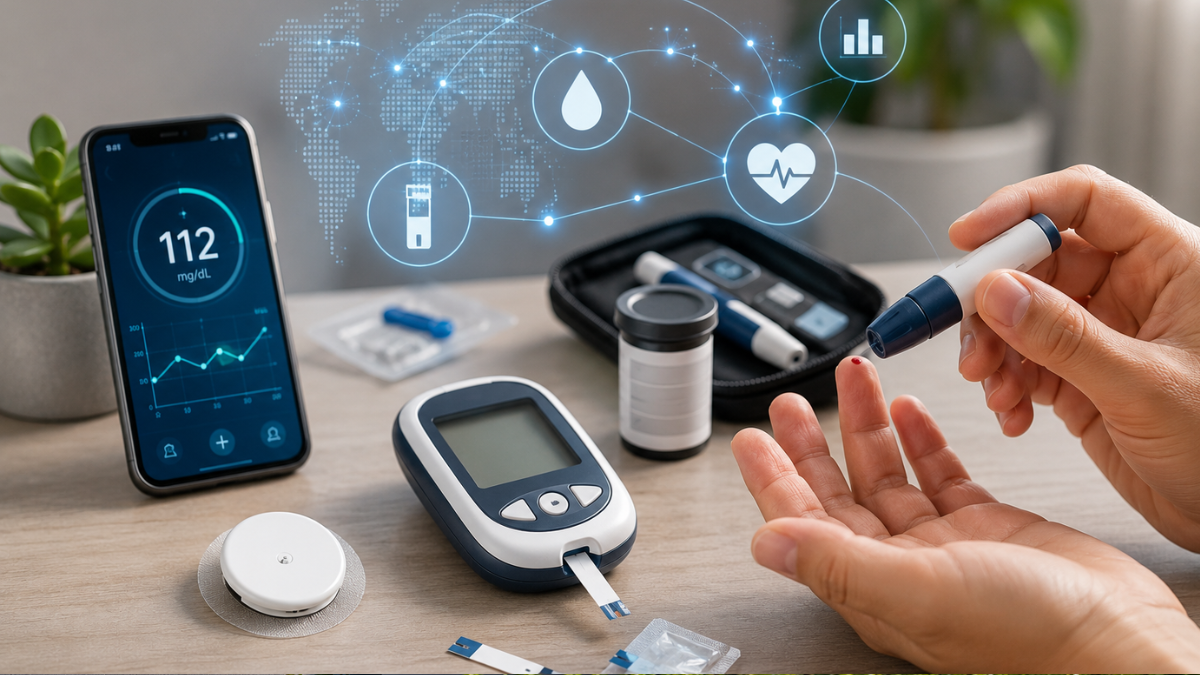
The continuous glucose monitoring system market size in the AI prediction wearables sector is growing faster than most healthcare markets can keep pace with. Valued at roughly $16.8 billion in 2025, the global blood glucose monitoring industry is on track to reach $39.4 billion by 2035 - a compound annual growth rate of 8.9% over the decade.
That's more than doubling in ten years.
Diabetes affects hundreds of millions of people worldwide. Left unmanaged, it drives cardiovascular disease, kidney failure, nerve damage, and vision loss. The tools people use to track and manage it are getting dramatically smarter, and the market is reflecting that.
The Numbers and What They Actually Mean
The global blood glucose monitoring system market size forecast 2035 puts total revenue at $39.4 billion. Two product categories define this space: self-monitoring blood glucose (SMBG) systems and continuous glucose monitoring (CGM) systems. Self-monitoring blood glucose systems market share analysis shows traditional fingerstick devices still hold a significant portion - but CGM is outpacing them in growth rate, adoption, and technology investment.
Why? Because the underlying disease burden is rising. Over 85 million people in the Middle East and North Africa region alone are living with diabetes. Globally, the numbers dwarf that. And as populations age and chronic disease rates climb, demand for smarter monitoring tools keeps accelerating.
AI Prediction Is Transforming Continuous Glucose Monitoring Systems
This is the piece that changes everything.
AI-enabled continuous glucose monitoring software solutions don't just record a glucose number - they learn from it. Predictive artificial intelligence applications in metabolic health now flag likely hypoglycemic events before they happen, based on pattern recognition built up over weeks of personal glucose data.
How do predictive algorithms forecast acute hypoglycemic events in diabetes patients? They model the curve. The algorithm identifies the time of day, the rate of decline, and the recent meal patterns that historically precede a dangerous glucose drop. You get an alert before the crisis. That's a fundamental improvement over older technology (which could only show you a number, not predict what it was about to do).
The AI industry growth forecast across healthcare sectors makes clear this is only getting bigger. The broader dynamic - how AI accelerates industry empowerment by turning raw sensor data into real clinical decisions - applies directly to glucose monitoring.
Roche's Accu-Chek SmartGuide CGM, rolled out in the UAE, Kuwait, Qatar, and Saudi Arabia in late 2025, is the most visible current example. Smart glucose monitoring systems regulatory approvals in the Middle East are now establishing a playbook for AI-enabled CGM adoption in emerging markets. Smart glucose guide continuous tracking solution clinical validation 2026 studies are confirming these tools perform in real-world settings, not just controlled trials.
The AI sector explosive growth happening globally is pulling significant investment and talent directly into metabolic health applications. That's not a coincidence - it's where the data density and the clinical impact happen to overlap.
Wearable Continuous Glucose Monitoring Systems: What's Driving the Market
Why are wearable continuous glucose monitoring systems growing faster than standalone monitors? Integration, mostly.
Wearable CGM sensors connect directly to automated insulin delivery system integrated CGM sensors - the closed-loop systems (sometimes called artificial pancreas systems) that adjust insulin doses automatically based on live glucose readings. For someone managing Type 1 diabetes, that's a genuine quality-of-life change. The device senses, the algorithm calculates, the pump delivers.
Non-wearable blood glucose tracking device advancements in 2026 are still progressing in clinical settings - bench-top analyzers are more accurate than they've ever been. But for the person managing diabetes at home, day-to-day, wearables are simply more practical.
The mobile AI tech signals from major industry conferences confirm that CGM sensors are integrating tightly with the same mobile platforms people already use daily. And physical AI solutions entering clinical environments are reducing the manual burden on care teams who previously had to interpret and track glucose data themselves.
How do smart insulin pens communicate with continuous glucose sensors? Bluetooth, mostly - syncing to shared apps where both patients and clinicians see the same data in real time.
Home Care Demand and Regional Growth: Where This Is Concentrated
Home care settings for medical devices for diabetes management are one of the strongest demand drivers in this market - and one of the most underreported ones.
Patients want to manage their condition at home. It's more affordable, more comfortable, and when people genuinely engage with their own data, it's often more effective. Geriatric diabetes management user-friendly glucose monitors is a quietly important growth niche here. Older adults need devices that are simple and reliable, and that design constraint is pushing the whole category toward better usability for everyone.
AI innovations for human needs - the idea that the best technology should disappear into the background and just work - is exactly the design direction winning in the CGM space.
On the regional side: North America leads on market share, backed by high insurance reimbursement rates and well-established B2B medical device distribution networks for digital health wearables. Asia Pacific is the fastest-growing region. The continuous glucose monitoring CAGR is rising significantly in Asia Pacific, reflecting a large and rapidly expanding diabetic population, combined with accelerating product launches across Japan, South Korea, and China. And the Gulf states are moving quickly - Kuwait, Saudi Arabia UAE digital health monitoring system rollouts signal serious national investment, backed by sovereign health tech funding for non-invasive metabolic tracking.
The biomedicine innovation pipeline in emerging markets is also maturing, helping regional manufacturers close the gap with global incumbents.
What's Coming Next
Next-generation non-invasive blood sugar monitoring technologies are the biggest wildcard in the 2026-2035 window. Optical sensors, microwave spectroscopy, saliva-based measurement - all are under development and moving toward clinical validation. None are widely commercial yet. But the timelines are compressing.
What secondary health complications can be prevented by real-time glucose tracking? Cardiovascular disease, kidney damage, nerve degeneration, vision loss. The downstream health case for investing in better monitoring tools is enormous, and payers are increasingly able to put a dollar figure on it.
AI-assisted biotech platforms are accelerating next-generation sensor development at a pace that wasn't possible five years ago. The global AI competition landscape is reshaping who builds these platforms - more players, from more regions, competing on accuracy and cost simultaneously.
Metabolic health monitoring platforms enterprise-level hospital procurement is also evolving. Hospitals are moving to multi-year integrated CGM platform contracts instead of buying individual devices piecemeal. High-throughput predictive healthcare algorithm benchmarks are now part of the procurement conversation - hospitals want real-world performance data, not just spec sheets.
AI supply chain integration across medtech is gradually reducing CGM manufacturing costs, which matters for expanding access in markets where device pricing remains a barrier. Digital device purchase trends confirm consumers increasingly treat health wearables as essential purchases, not optional upgrades.
AI tech innovations to watch at major industry expos consistently put metabolic monitoring near the top of the priority list. That's where the investment is heading - and the market numbers reflect it.
Key Takeaways
The continuous glucose monitoring system market size in the AI prediction wearables space is heading to $39.4 billion by 2035. The drivers are clear:
- AI prediction tools that flag dangerous glucose events before they become emergencies
- Wearable CGM sensors integrated with automated insulin delivery systems
- Home care demand from a growing global diabetic population
- Regional expansion across Asia Pacific and the Gulf states
- Non-invasive sensor technologies approaching commercial viability within the decade