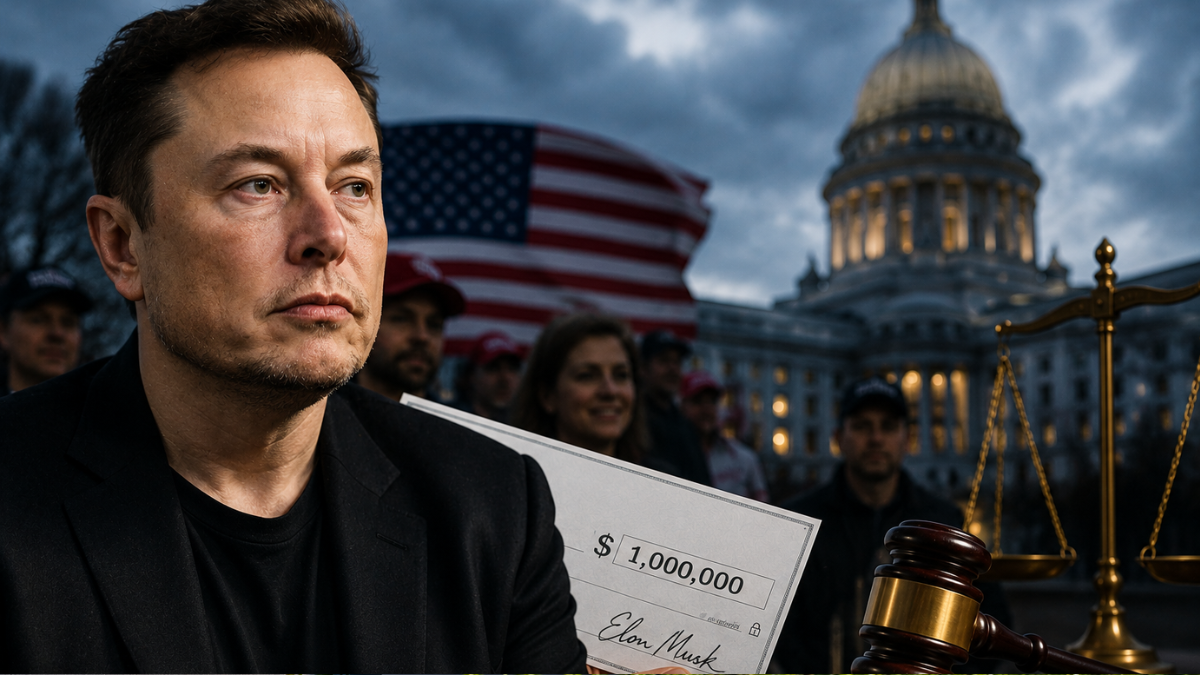
The Elon Musk Wisconsin election bribery investigation just moved into a new phase. Wisconsin's bipartisan Elections Commission voted 5-1 last week to refer criminal complaints against Musk to the Brown County District Attorney's office, finding probable cause that he violated state law by offering million-dollar payments to voters before the 2025 Supreme Court race. Prosecutors now have 40 days to decide whether criminal charges are coming.
This wasn't a party-line vote. Three Democrats and three Republicans sat on that commission, and five of the six landed on the same conclusion. That's the detail that keeps getting lost in the noise.
How the Million Dollar Check Controversy Started
Musk backed Republican-supported Supreme Court candidate Brad Schimel - hard. Musk and the groups he supported poured at least $20 million into the race. Total spending across all sides topped $100 million, making it the most expensive judicial race in U.S. history. Schimel still lost, by 10 points, to Democratic-backed Susan Crawford.
Three Wisconsin voters actually received $1 million checks from Musk. Two of them got theirs in person at a public rally in Green Bay, just days before the election. On camera. In front of a crowd. With the vote still days away.
Two weeks before that, Musk's political action committee - America PAC - had already been offering $100 to registered voters who signed a petition opposing "activist judges," or who referred someone else to sign it. So the payments weren't a one-off gesture. They were part of a structured, ongoing voter-contact strategy.
Musk's business interests already face pressure from multiple directions - from questions about SpaceX engineering dominance to the growing competitive challenge represented by BYD's challenge to Tesla's lead. But this Wisconsin situation is different. It's not competitive pressure. It's potential criminal liability.
What the Bipartisan Elections Panel Actually Found
The commission's motion doesn't bury the lead. It says Musk broke Wisconsin law by making a social media post offering $1 million to people who voted in the Supreme Court election "to induce them to vote in that election."
Inducement. That's the word that matters legally.
Wisconsin law prohibits paying voters to participate - even indirectly. The commission, including Republican members, concluded there's probable cause that Musk's actions crossed that line. Emilee Miklas, the commission's spokesperson, confirmed the vote happened in closed session. The underlying complaints remain confidential under state law, filed by voters in Milwaukee and Green Bay.
Brown County District Attorney David Lasee, a Republican, hadn't responded to media requests as of Tuesday. His office has 40 days to report back to the elections commission on whether charges will move forward.
What Musk's Legal Team Is Arguing
Musk's attorneys aren't conceding anything, and their argument isn't frivolous.
In 2025 court filings, they argued the payments were constitutionally protected free speech - that any attempt to restrict the giveaways would violate both the Wisconsin and U.S. constitutions. Their framing was deliberate: the payments were "intended to generate a grassroots movement in opposition to activist judges, not to expressly advocate for or against any candidate."
Political expression. Not voter bribery.
Courts have genuinely struggled with where political organizing ends and illegal voter inducement begins. A Pennsylvania judge sided with this exact argument in 2024, when America PAC ran a nearly identical program before the presidential election - offering $1 million a day to voters in seven battleground states who signed a First and Second Amendment petition. That judge found prosecutors hadn't demonstrated it was an illegal lottery, and the program ran through Election Day.
Wisconsin is a different jurisdiction. Different statutes, different judges. And this time, the finding going in is probable cause - not prosecutorial overreach.
Previous Efforts to Stop the Checks Failed
Wisconsin's Democratic attorney general tried to block the handoffs in real time. She sued to stop Musk from handing checks to two voters before the election. State courts rejected the effort.
The checks went out.
Now the legal reckoning is arriving through a slower, more formal channel. The Wisconsin Democracy Campaign - a government watchdog group - has a separate lawsuit pending in Brown County. That suit alleges Musk and two groups he funds violated prohibitions on vote bribery and unauthorized lotteries, and that the whole operation amounted to an unlawful conspiracy and public nuisance. Still pending. Still active.
Cases where billion-dollar deals under the microscope involve direct payments to private individuals mid-election don't have much legal precedent. That's part of what makes this one genuinely important.
Why the Stakes Reach Beyond One State Race
The Elon Musk Wisconsin election bribery investigation is a test case - not just a local story.
If America PAC election bribery laws violations Wisconsin result in criminal charges, it draws a legal line for how voter-directed cash programs get treated everywhere going forward. The model Musk used - structured as petition-signing rather than explicit vote-buying - has already been replicated. If it survives legal scrutiny, it becomes a playbook. If it doesn't, the game changes.
There's a broader pattern worth noting. As tech giants reshaping competitive landscapes pour resources into democratic processes, regulators are paying closer attention. The tech industry trust crisis runs partly on the gap between how tech leaders present their intentions and how their actions land in the real world. Even ChatGPT's falling global share shows how quickly dominance can erode when institutional trust gets rattled.
Global AI governance tightening is pushing governments to scrutinize powerful tech actors more carefully. The national security rules on tech investors taking shape across jurisdictions signal that regulators no longer treat concentrated tech wealth as politically neutral. And the AI sector influence on public policy debate is very much alive in 2026 - with cases like this one feeding directly into it.
The regulatory scrutiny of powerful tech figures isn't easing. Wisconsin may just be the first formal test.
Where This Case Goes From Here
A month after the Wisconsin Supreme Court race, Musk announced he'd be pulling back on political spending. Whether that's a genuine shift or a strategic pause, the investigation doesn't pause with him.
The bipartisan Wisconsin elections panel finding probable cause is significant precisely because it isn't a partisan complaint. It's a formal government determination - the kind that forces a prosecutorial response, not just a PR one. Brown County DA David Lasee, a Republican, now has to make the call. Charge Musk, decline, or explain why. That's the 40-day clock.
Whatever he decides, it sets precedent. Either voter-directed cash programs structured carefully enough can avoid Wisconsin's election bribery statutes, or they can't. The Elon Musk Wisconsin election bribery investigation is now the legal reference point for that question - and every future election where a billionaire decides to get directly, personally involved at the voter level will reference whatever happens next.