Summary
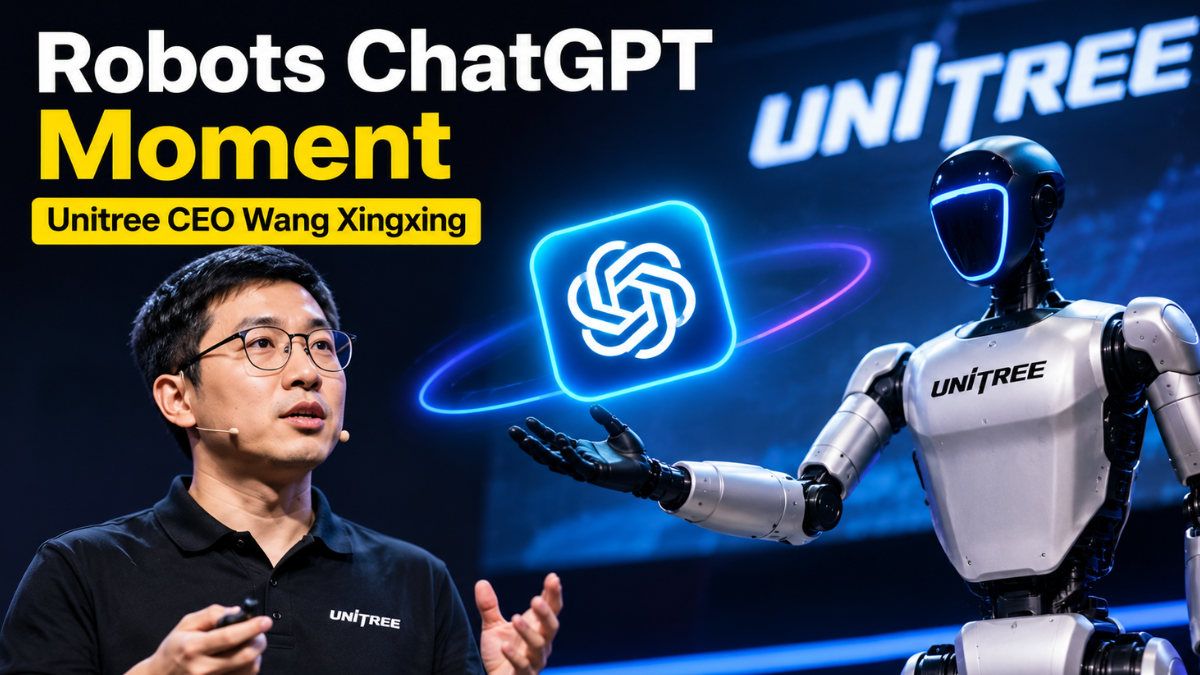
The Robots ChatGPT moment Unitree CEO Wang Xingxing predicts could change how humanoid machines work, learn, and enter everyday life. But it hasn’t arrived yet. At the World Robot Conference Beijing 2026 Unitree speech, Wang argued that the next leap depends far less on flashy hardware and far more on software that can understand messy, unfamiliar real-world situations.
That distinction matters. A robot can dance, do kung fu, or carry a box in a controlled demo. Asking it to enter your home, understand “put the groceries away,” avoid the dog, open the right cupboard, and recover when something falls is a completely different problem.
Key Points
- The next robotics breakthrough is likely to be software, not hardware.
- World models could help robots understand unfamiliar environments and recover from mistakes.
- 80% household-task autonomy is an ambitious target, not today's reality.
- Factories and warehouses are likely to see useful humanoids before homes do.
- Unitree’s growth shows how quickly China’s humanoid robotics market is scaling.
- IPO excitement doesn't remove the industry's execution and profitability risks.
- The biggest test will be reliability in messy, unpredictable real-world situations.
Robots ChatGPT moment Unitree CEO Wang Xingxing sees on the horizon
Wang Xingxing, founder and CEO of Unitree, said the industry is moving toward a “ChatGPT moment” for embodied intelligence. He means a point when robots become useful to far more people because they can follow ordinary voice or text instructions in environments they haven’t been specifically programmed to handle.
ChatGPT made language AI broadly accessible in 2022. You didn’t need to be a machine-learning researcher to type a question and get a useful response. Wang’s vision is similar, except the output is physical action.
The Unitree CEO Wang Xingxing ChatGPT moment embodied intelligence idea rests on one demanding standard: a robot should enter an unfamiliar home and successfully complete roughly 80% of assigned tasks through voice or text commands.
That’s a high bar. Honestly, even people need clarification sometimes.
Unitree’s visibility has grown alongside Unitree’s public-market push, which has put more attention on whether robot makers can turn impressive prototypes into dependable products.
Why robot hardware is ahead of robot intelligence
Humanoid bodies have improved quickly. Motors are stronger, balance is better, hands are more capable, and vision systems can identify many everyday objects. Yet the biggest bottleneck facing the humanoid robotics industry is still decision-making AI.
A robot may recognize a mug. It may even pick it up. But can it tell whether the mug is full, fragile, hot, dirty, or sitting on a surface that will wobble when touched? Physical intelligence requires context, prediction, and the ability to adjust after a bad first attempt.
That is the heart of the Physical AI world models humanoid robots breakdown. A world model gives a machine an internal way to simulate what may happen next. Instead of blindly reacting pixel by pixel, it can reason through likely outcomes before moving.
Unitree says it is putting major R&D resources into world models because the company sees an Embodied AI physical world simulation models Unitree gap between current robot hardware and reliable real-world behavior. That gap is expensive. It also explains why polished stage demonstrations can create unrealistic expectations.
physical AI solutions may reach businesses first, where tasks and spaces can be controlled. Homes are harder. They’re cluttered, unpredictable, and full of edge cases.
Robots ChatGPT moment Unitree CEO Wang Xingxing says may take years
Wang was optimistic, though not reckless. He suggested a major leap in robot software could happen within two to three years in a best-case scenario, while a five-to-10-year timeline may be more realistic.
That’s the tension behind the Humanoid robots software bottleneck decision making AI debate. Hardware innovation is visible. Software progress is often slower, less dramatic, and harder to measure from a short video clip.
Galbot CEO Wang He offered a more specific target. His company expects a robotics ChatGPT moment by 2028, when humanoids could handle 70% to 80% of everyday tasks without specialized training. The Galbot CEO Wang He robotics ChatGPT moment 2028 prediction is ambitious, but it points to the same underlying need: robots must generalize.
You don’t want to train a household robot for every drawer, every appliance, and every oddly shaped object you own. You want it to figure things out safely. That’s the whole point.
Can humanoid robots complete 80% of household tasks?
Wang imagines a future in which humanoids handle 80% of household chores through simple commands. The phrase Humanoid robots household tasks 80 percent autonomy sounds exciting, but it needs a practical definition.
Does “complete” mean loading a dishwasher correctly every time? Does it include folding fitted sheets? Can the robot identify medication, manage stairs, or understand when it should ask you rather than guess?
Those details determine whether a robot is genuinely helpful or just an expensive assistant that creates new work.
Some niche applications are much closer. Factories and warehouses offer repeatable routes, known objects, and better safety controls. That’s why humanoid robotics in manufacturing may scale before all-purpose home robotics.
Then there are specialized breakthroughs such as robotic self-dressing technology. They’re useful reminders that real progress often arrives task by task, not all at once.
Unitree stock drops after a spectacular Shanghai debut
Investor excitement has not made Unitree’s path less volatile. The Unitree 688836 SS stock price drop Shanghai IPO story reflects that reality: shares opened down about 11% after soaring nearly sixfold during their market debut.
The Unitree shares fall 11 percent following massive sixfold surge during Shanghai IPO debut headline captures a market trying to price a company in a sector with enormous potential and uncertain near-term profits. Unitree is already known for robot dogs and humanoid machines, but many of its customers are universities and research institutions rather than households.
That isn’t necessarily bad. Research buyers help companies test hardware and collect data. Still, it shows how early the market remains.
China’s lead comes with a global political complication
China reportedly delivered more than 40,000 humanoid robots in the first half of 2026 and holds a claimed China 97 percent global humanoid robot market share in shipments. That scale gives local firms more manufacturing experience, more deployment data, and a stronger supplier ecosystem.
You can see the policy side of that expansion in China’s humanoid robot rules and the industry’s focus on embodied robot mass production.
But geopolitics may limit how easily Chinese manufacturers expand abroad. The reported US FCC ban foreign humanoid robots Unitree issue has raised concerns for exporters of Chinese humanoid and quadruped robots. National-security restrictions can reshape supply chains quickly, especially for machines equipped with cameras, sensors, connectivity, and autonomous navigation.
Meanwhile, other countries are placing their own bets. Tokyo’s physical AI bet shows this is becoming a global competition, not a two-country race.
What needs to happen before the robots ChatGPT moment Unitree CEO Wang Xingxing describes?
More data helps, but raw data alone won’t solve the problem. Robot systems need better simulation, stronger memory, safer action planning, and faster ways to learn from mistakes without damaging objects or hurting people.
The How world models and physical AI simulations will allow humanoid robots to navigate real homes question is really about generalization. Can a machine apply what it learned in one kitchen to another kitchen with different lighting, layouts, and clutter?
Useful infrastructure matters too. Governments and companies are investing in data collection, computing capacity, and standards, as seen in recent robot data updates.
And robotics doesn’t exist in isolation. Autonomous driving research, including the Horizon Robotics partnership, contributes lessons in perception, mapping, planning, and safety. The hard part is making those systems work when the robot has arms, legs, and direct contact with the physical world.
The road from robot demos to useful everyday machines
The Robots ChatGPT moment Unitree CEO Wang Xingxing describes could arrive when robots stop needing carefully staged environments and start handling ordinary requests with reliable judgment.
That’s still a difficult leap. Investor enthusiasm, giant shipment numbers, and impressive choreography don’t erase the software problem. In fact, the same challenge appears across AI markets, where generative AI’s business gap shows that excitement doesn’t automatically become practical value.
For now, expect humanoids to improve first in structured workplaces, then expand into more varied settings. The robot that can reliably help in your home is coming. It just needs a much better brain.
GlobalByte Perspective
Unitree’s “ChatGPT moment” idea is interesting because the real breakthrough in humanoid robotics probably won’t be another impressive demo. It will be the moment a robot can understand a simple instruction, deal with an unfamiliar environment, make a mistake, and still finish the job safely.
That is where the industry is heading, but it’s not there yet. Hardware is moving quickly; reliable physical intelligence is the harder problem. Unitree’s focus on world models and embodied AI shows where the next competition could happen, not just in motors and sensors, but in how well robots understand the physical world.
For GlobalByte News, the bigger takeaway is simple: the humanoid robot race is moving from “Can it move?” to “Can it actually think and act?”