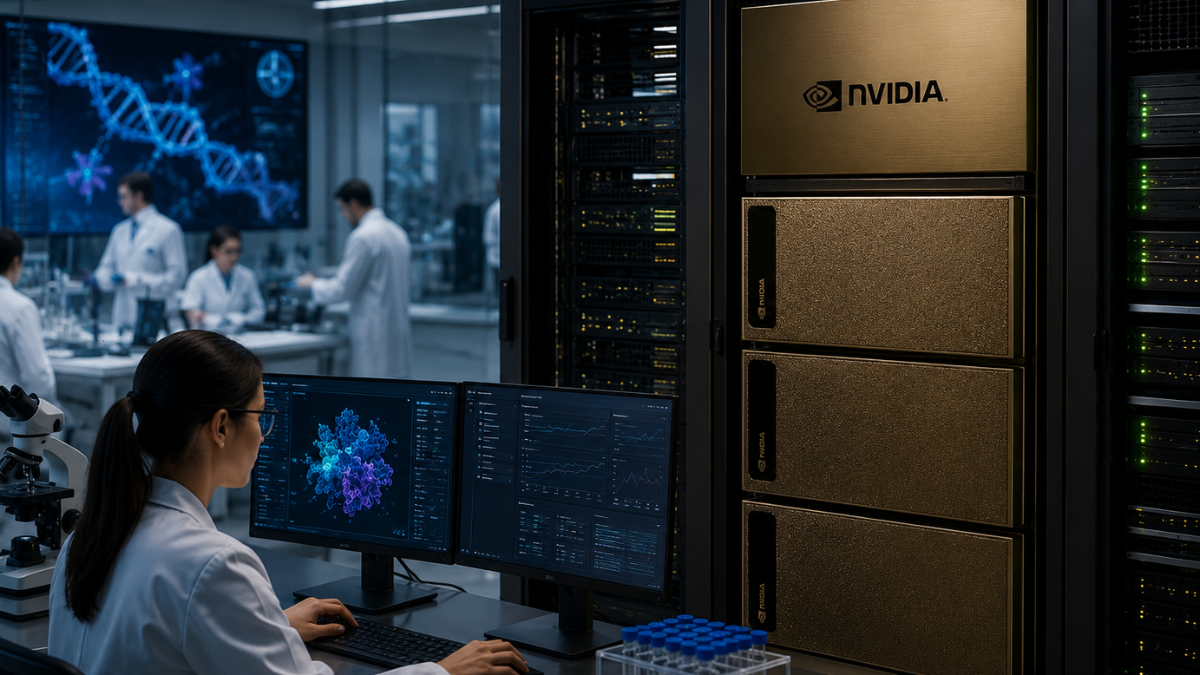
Bristol Myers Squibb made a notable move on July 20, 2026. The pharmaceutical company announced it's purchasing an Nvidia DGX SuperPOD built on the new Vera Rubin architecture, making it the first life sciences company to buy an Nvidia DGX SuperPOD of this generation. If you've been watching how the Bristol Myers Nvidia DGX SuperPOD Vera Rubin drug discovery strategy has been developing, this announcement feels less like a surprise and more like a confirmation. But the details are worth understanding.
This isn't Bristol Myers testing the waters with AI. It's doubling down with Nvidia's most advanced compute platform to date.
What Is the Nvidia DGX SuperPOD Vera Rubin System?
Nvidia unveiled its Vera Rubin architecture earlier in 2026 as the successor to its current lineup of AI computing systems. Bristol Myers wasn't starting from scratch here. The company already owned an older SuperPOD system, one that sits roughly two or three generations behind the Vera Rubin-based version they're now acquiring.
So the intent is clear. BMS already believes in AI-powered drug research. This upgrade is about giving that belief significantly more capable hardware to work with.
Financial terms weren't disclosed, which is standard for infrastructure investments at this scale. But if you want a sense of how seriously pharma is approaching AI computing infrastructure investments right now, this deal is a concrete example.
Why Bristol Myers Chose the Vera Rubin Architecture for Drug Discovery
Honestly, part of the answer comes down to electricity.
Greg Meyers, Bristol Myers' Chief Digital and Technology Officer, was direct about it: "When you host these things, you have to pay an electric bill." The Vera Rubin-based DGX SuperPOD delivers roughly 10 times more compute capacity per watt spent compared to older hardware generations. That's not a minor efficiency tweak. It's a different cost structure entirely for running large AI workloads around the clock.
This is the part of the Bristol Myers Nvidia DGX SuperPOD Vera Rubin drug discovery investment that gets overlooked in the headlines. Raw compute power matters. But compute-per-watt is what determines whether those workloads are financially sustainable at scale.
The global AI supercluster deployment race has made energy efficiency a first-class concern for anyone building serious infrastructure. Electricity isn't getting cheaper - Meyers said so directly. And Nvidia GPU procurement constraints have made getting ahead of hardware demand cycles a strategic move in itself. First-mover status here isn't just a marketing badge. It's a supply advantage.
From 10 Drug Candidates to Dozens
Robert Plenge, Bristol Myers' Chief Research Officer, gave one number that explains the value proposition better than any press release could.
"Maybe before we could do 10 and now we can do dozens," he said, describing how expanded compute changes early-stage drug development.
That shift is more significant than it first sounds. In pharmaceutical research, testing more candidates before expensive clinical trials begin directly improves the odds of finding something that works. The question changes from "which of these 10 do we bet on?" to "which of these 40 actually look promising?" You're not just going faster - you're running a fundamentally different kind of experiment.
Plenge also said BMS is already using AI tools to cut the time to prepare medicines for clinical testing by 20% to 30%, with potential to reach 50% in the coming years. The parallel with AI-assisted protein synthesis platforms is worth noting - similar logic applies across biology: more compute enables more throughput, faster iteration cycles, and smaller teams producing results that once required much larger ones.
The Sickle Cell Candidate That AI Found
One detail from Plenge's comments cuts through all the broad statements about AI transforming pharma.
He said an experimental sickle cell disease treatment - currently in early clinical development at Bristol Myers - would likely not have been discovered without AI-enabled research. That's not a future possibility. That's a drug candidate being tested in humans right now, one that probably wouldn't exist without AI models running on Nvidia infrastructure.
Whether this treatment ultimately proves effective is still unknown. But the discovery itself happened. AI-enabled research sickle cell disease treatment development at BMS is real, not a talking point - and that distinction matters when you're evaluating whether these infrastructure commitments make sense.
How BMS Is Deploying AI Across Its Research Organization
The scope is broader than most outside observers realize. Bristol Myers uses AI across all of its small molecule programs and most of its large molecule programs, according to Meyers. That's not a proof-of-concept running in one corner of the organization.
That scale is actually what's driving the hardware upgrade. As BMS deploys larger models - the kind needed for complex molecular simulations and multi-target analyses across its Bristol Myers Squibb small molecule program AI models work, compute demands grow faster than most organizations anticipate.
Anyone running heterogeneous AI computing infrastructure at enterprise scale knows this curve well. What's sufficient for a pilot doesn't stay sufficient for long. The Vera Rubin-based DGX SuperPOD is BMS's answer to that scaling problem - more headroom, better efficiency, and a hardware generation designed to hold up as model sizes keep growing.
What This Means for the Rest of Pharma
BMS being the first pharma company to buy Nvidia DGX SuperPOD Vera Rubin hardware puts real pressure on everyone else in the space.
When a competitor can test five times as many drug candidates in the same timeframe, with trial preparation 30% faster, standing still isn't a neutral choice. Physical AI solutions transforming industry aren’t abstract here - this is AI doing molecular biology at scale, not processing spreadsheets.
The pace of change at the infrastructure layer is accelerating. Recent supercomputer architecture breakthroughs and advances in AI chips powering scientific research are reshaping what's technically possible every year. Pharma companies that don't keep pace with infrastructure investment will eventually feel the gap in research output.
Some organizations are already evaluating whether firms departing Nvidia for alternatives represents a viable path - though in life sciences, the Nvidia ecosystem remains the dominant choice for now. And the larger story of biomedicine innovation and AI is increasingly about infrastructure as much as algorithms. The two are inseparable now.
What the BMS-Nvidia Deal Actually Proves
The Bristol Myers Nvidia DGX SuperPOD Vera Rubin drug discovery announcement is more than a hardware purchase. It's evidence that compute infrastructure is now research infrastructure. For serious pharmaceutical companies, the two aren't separable anymore.
From testing 10 drug candidates to testing dozens. From 30% faster trial preparation to a potential 50%. From an AI-assisted sickle cell discovery that almost didn't happen to whatever comes out of the expanded pipeline next.
For anyone tracking pharma AI supercomputing infrastructure investment 2026 as a theme, BMS just demonstrated what real commitment looks like in this space - not a pilot program, not a press release about "exploring AI capabilities," but a capital investment in the most capable hardware currently available.
The pharmaceutical companies that stay competitive over the next decade won't just have good science. They'll have the compute infrastructure to run it.