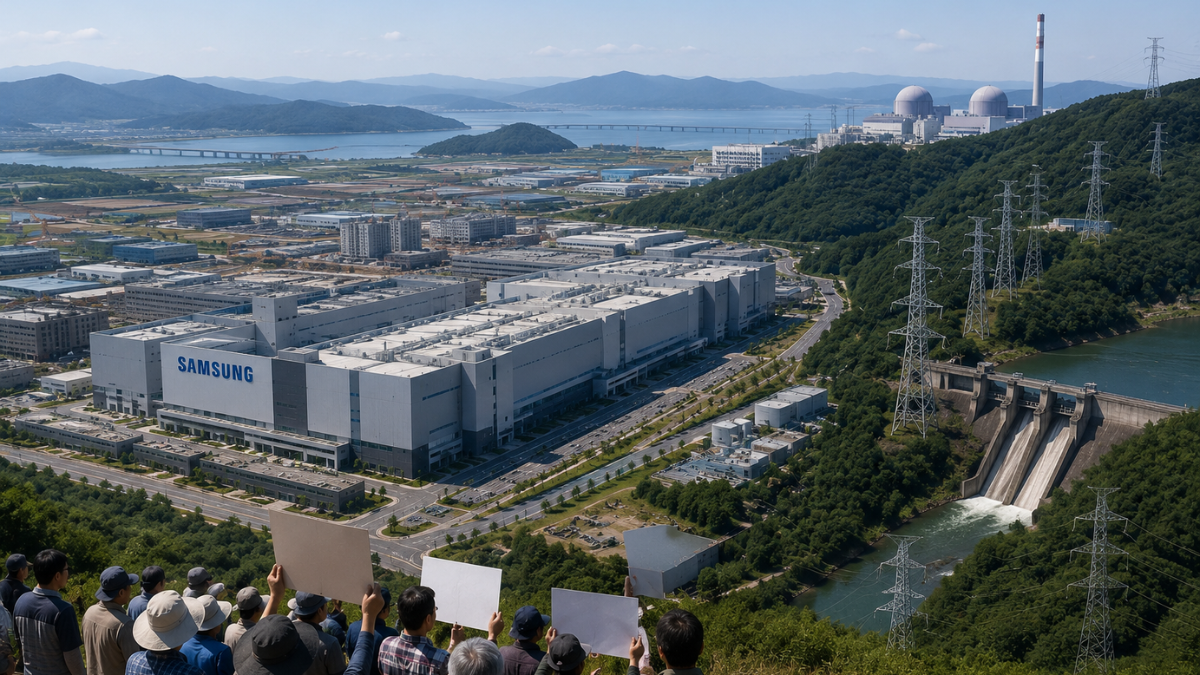
The ambition is enormous. South Korea wants to build an entirely new semiconductor hub in its southwestern provinces - a $540 billion complex meant to rival its dominant Seoul-area clusters and spread the gains of the AI boom beyond the capital region. President Lee Jae Myung wants it running by 2030. Samsung Electronics and SK Hynix are lined up to build there.
But the South Korea AI chip hub infrastructure story is already running into two hard realities: power and water. And behind those technical problems sits a third challenge that experts say could be just as stubborn - local communities that weren't consulted and aren't pleased.
What the Honam Semiconductor Industrial Complex Actually Is
The so-called Honam semiconductor industrial complex is the centerpiece of this plan. Estimated at a minimum of 800 trillion won, roughly the equivalent of a South Korean $540 billion semiconductor hub, it's one of three government "mega-projects" announced under Lee's administration.
Four chip fabrication plants are planned across the southwestern provinces of Gwangju, North Jeolla, and South Jeolla. Samsung wafer fab expansion timelines are being closely tracked by investors, since Samsung is expected to anchor a significant portion of the complex. Korean fabless chipmakers are watching too - a functional southwestern hub would open up domestic foundry access they currently lack.
What's driving all this? Partly global urgency. The AI computing infrastructure build-out happening across Asia has created massive appetite for advanced chip production. South Korea wants a much larger share of it.
Why Power and Water Demands Threaten South Korea’s AI Chip Hub
Here's the scale of the problem.
The four planned fabs alone are projected to consume 70% to 80% of the total annual electricity currently used across the entire southwestern region. That's not a rounding error. It's a structural infrastructure gap that didn't exist before this project was announced.
Semiconductor manufacturing is inherently power-hungry. Whether fabs are producing memory chips destined for a major DRAM supply chain deal or building logic chips using AI chips 3D stacking technology, the electricity demand per wafer is staggering. Cleanrooms run 24/7. You can't power-cycle a chip fab at the end of the day.
"A huge amount of new power demand is coming into a region that previously had little, and that's the core of the problem," said Neal Won, principal analyst at S&P Global Energy.
The AI chip fab power grid requirements go far beyond what existing southwestern infrastructure currently supports. The energy ministry argues the region already generates more electricity than local demand requires, which sounds reassuring until you realize "current local demand" and "four advanced semiconductor fabs" are not remotely comparable categories.
Water is its own crisis. The Honam complex will need roughly 650,000 metric tons per day, more than Gwangju's entire residential water supply. The plan combines five existing dam systems and reclaimed water reuse. One key proposal: raising Dongbok Dam to unlock an additional 250,000 metric tons daily. The semiconductor manufacturing water supply challenges don't resolve themselves just because officials publish a blueprint.
What Happened at Yongin - and Why It Matters
South Korea's been down this road before. The Yongin semiconductor cluster near Seoul ran into exactly these problems. SK Hynix's first Yongin fabs, announced back in 2019, were designed to receive 265,000 metric tons of water daily from a weir in a neighboring city. Residents of that city objected. The process was delayed by months.
Yongin's mayor, Lee Sang-il, was direct about the lesson: "The responsibility to calm opposing voices and resolve differences lies with the central government." That wasn't a compliment. It was a warning.
The southwestern project sits in a far less industrialized region than Yongin. Same dynamics, applied there, could move considerably slower, not faster.
The Nuclear Problem Nobody Wants to Solve
One proposed fix for the AI chip fab power grid requirements is small modular reactors - SMRs positioned near the fab cluster. SMR nuclear reactors for semiconductor fab electricity supply sound appealing on paper: stable, high-output power without long-distance transmission losses.
But in Yeonggwang county, which already hosts nuclear reactors, locals aren't interested. Roh Byeong-nam, a farmer and co-chair of a local anti-nuclear coalition, said residents would pursue litigation if the government pushes forward with new reactor construction or life extensions of aging plants.
"To now talk about new construction, on top of extending the lifespan of ageing reactors, is nothing less than a declaration that Yeonggwang will become a nuclear testing ground and eventually a permanent nuclear waste site," he said.
That's not a negotiating position. That's a legal threat. South Korea's semiconductor energy strategy can't quietly route around it.
Underground power transmission lines in densely populated areas are part of the government's mitigation plan. They help with land-use friction. They don't solve the generation shortfall. Countries investing in green AI data center infrastructure have found that blending renewable sources with reliable baseload power requires planning years in advance, not months before a project breaks ground.
The Dongbok Dam Dispute
The plan to raise Dongbok Dam has hit similar resistance. Kim Kwang-jin, who heads a residents' group near the dam, estimates 1,500 to 1,600 households could be directly or indirectly affected. His objection isn't just practical - it's about process.
"They announced it unilaterally without considering resident acceptance," he said.
The government's position is that the Dongbok dam raising water project causes less environmental disruption than building a new dam. That's probably true. But communities that feel excluded from decisions rarely respond well to after-the-fact justifications, even technically accurate ones. Genuine early consultation isn't a nice-to-have here. It's load-bearing.
The Bigger Stakes: Why the World Is Watching
South Korea doesn't have unlimited time. As firms shifting from Nvidia to regional alternatives accelerate procurement, global chip supply chains are rearranging fast. Every GPU chip order reshaping AI industry priorities signals where production demand is heading next. And tightening Nvidia chip purchase limits in certain markets are pushing more countries to build domestic capacity quickly.
Chip architectures are also evolving. The rise of heterogeneous computing platform designs is placing new and complex demands on fab infrastructure that planners need to account for now, not at buildout. At events like the AI chip exhibition Nvidia Qualcomm participated in recently, the sheer scale of global chip demand is on display. South Korea wants to serve that demand. The Honam complex is the plan.
But plans need power and water to run.
What the 2030 Deadline Actually Requires
Honestly, the South Korea AI chip hub infrastructure challenge is only partly a technical problem. The engineering for transmission lines, dam systems, and power generation is understood. What's less clear is whether the government can build the community trust required to actually execute those plans on schedule.
Experts are cautious. Without accelerated infrastructure approvals and genuine engagement with affected communities, operating the complex at full capacity by 2030 will be very difficult. The energy ministry says it will work closely with local governments and improve public acceptance, including burying transmission lines in populated areas where feasible. That's the right approach.
Whether it happens early enough to matter is still an open question. The South Korea AI chip hub infrastructure push is one of the most ambitious industrial projects in Asia right now, and getting it built - not just announced - will come down to whether the process can keep pace with ambition.