Summary
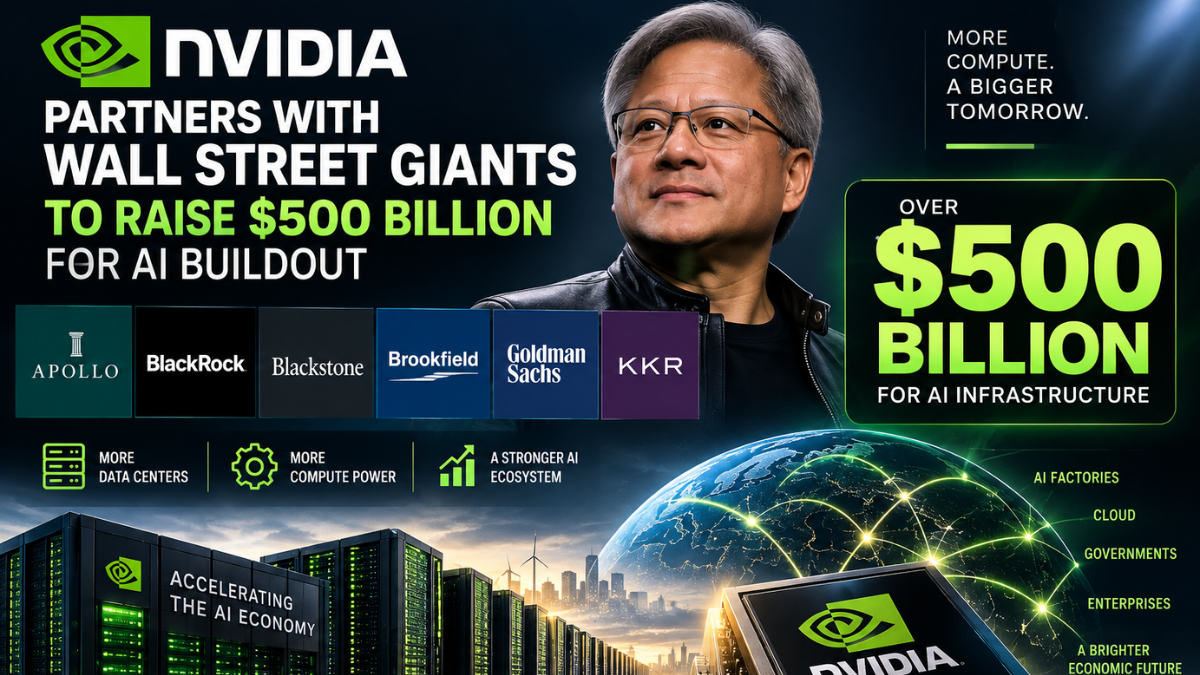
The Nvidia Wall Street 500 billion AI compute financing platform could change how companies pay for the infrastructure behind advanced AI. Nvidia has signed memorandums of understanding with six major financial institutions to mobilize more than $500 billion in third-party capital for AI data centers, GPU capacity, and related projects.
That is a huge figure. But it isn't a $500 billion cheque sitting in one account.
Instead, Nvidia wants to help build financing vehicles that connect private capital with companies, governments, cloud providers, and frontier AI developers that need scarce compute at scale. The arrangement could make expensive AI infrastructure easier to access, although the details that matter most, including pricing and deployment timelines, haven't been disclosed.
Why Nvidia Wall Street 500 billion AI compute financing platform matters
AI demand isn't limited by software ideas anymore. It is increasingly limited by physical capacity: GPUs, networking, power, cooling, land, and data center space.
That scarcity explains why the Nvidia Wall Street 500 billion AI compute financing platform is drawing attention. Nvidia is pairing its dominant hardware position with Wall Street's ability to fund long-lived infrastructure assets.
The six firms involved are Apollo, BlackRock, Blackstone, Brookfield, Goldman Sachs, and KKR. This Nvidia BlackRock Blackstone Apollo 500B AI fund framework is designed to create dedicated pools of capital that finance Nvidia-based infrastructure at scale.
For you, whether you're running an AI startup or evaluating the sector, the key point is simple: compute may increasingly be financed like infrastructure rather than bought upfront like ordinary IT equipment.
Nvidia Jensen Huang 125 billion backstop AI financing explained
Jensen Huang said Nvidia has the option to backstop up to $125 billion, equal to 25% of potential deals. That Nvidia Jensen Huang 125 billion backstop AI financing commitment could reduce perceived risk for capital providers and help projects get funded.
A backstop isn't the same as Nvidia immediately investing $125 billion. It is a potential support mechanism for qualifying transactions.
Huang said the platforms will help customers access scarce compute and build AI factories for industries and countries. That ambition fits with Nvidia AI factories infrastructure investment, where data centers are treated as production facilities for intelligence, not just rooms full of servers.
Still, there are real unknowns. Nvidia hasn't disclosed individual commitments from Apollo, BlackRock, Blackstone, Brookfield, Goldman Sachs, or KKR. Nor has it outlined who gets access first, what the financing costs, or when capital will begin reaching projects.
How Nvidia’s Wall Street 500 billion AI compute financing platform could work
The proposed model centers on Nvidia compute financing platforms AI data center buildout projects. Asset managers could provide capital for GPU clusters and supporting facilities, while customers pay through usage-linked structures over time.
That resembles leasing, project finance, and infrastructure funding more than a standard hardware purchase. An AI developer that cannot afford a large cluster upfront may gain access through a contract tied to compute consumption.
This is why Wall Street private capital AI compute financing is becoming a serious theme. Investors can potentially gain exposure to long-term infrastructure demand, while customers avoid absorbing the entire capital cost on day one.
There is precedent for the model. An AI data center lease shows how large-scale capacity can be commercialized through contractual arrangements rather than simple equipment sales.
The pressure behind the capital rush
Big Tech AI infrastructure spending is projected to exceed $730 billion this year, according to the figures cited in the announcement. That scale is remarkable, and it also raises uncomfortable questions about returns.
Investors are already watching AI capex pressure as cloud companies spend aggressively while trying to protect free cash flow. Private capital can spread some of that cost, but it doesn't make power constraints, construction delays, or weak demand disappear.
And compute is a global supply-chain issue, not merely a Silicon Valley spending story. The compute power supply chain now affects everything from advanced chips to energy equipment and cross-border trade.
Nvidia's wider AI infrastructure push
This financing effort sits alongside Nvidia's expanding investment and deployment activity. Nvidia's SSI investment highlights its interest in frontier AI developers, while the Vera Rubin deployment points to demand from industries outside technology.
The company is also pursuing regional infrastructure opportunities. Nvidia's Korea infrastructure bet reflects how governments and national champions are treating AI capacity as strategic infrastructure.
But Nvidia faces limits. H200 purchase limits and growing interest in Chinese GPU alternatives show that regulation and competition can reshape where demand lands.
What the Nvidia Wall Street 500 billion AI compute financing platform means for startups
For smaller AI companies, the promise is access. Training or serving advanced models requires enormous infrastructure budgets, and many startups can't make those purchases without external support.
A Nvidia usage linked AI compute investment platform could let qualifying customers pay over time based on contracted capacity or actual use. That's attractive, especially when GPUs are scarce.
Yet financing isn't free compute. Startups could face long commitments, minimum-usage terms, and less flexibility if model demand cools. You'd want to read every contract carefully.
Meanwhile, enterprise demand keeps broadening through projects such as Lenovo AI infrastructure and rising Nvidia supercomputer demand. The financing platform is Nvidia's attempt to ensure capital does not become the next bottleneck.
A new financing layer for AI's physical buildout
The Nvidia Wall Street 500 billion AI compute financing platform is a bid to turn AI capacity into a financeable infrastructure asset at extraordinary scale. It could help startups, cloud providers, enterprises, and governments obtain compute without funding every GPU cluster upfront.
The opportunity is clear, even if the execution is not yet. Until Nvidia and its partners disclose the project terms, capital commitments, and customer eligibility, this remains a powerful framework rather than a finished $500 billion deployment.
GlobalByte.News Perspective: Nvidia Isn't Just Selling GPUs Anymore
Nvidia's latest financing push may be more important than the $500 billion headline itself.
The real shift is that Nvidia appears to be moving further beyond its traditional role as a chip supplier and deeper into the financial architecture of the AI economy. If AI compute is becoming critical infrastructure, Nvidia has an obvious incentive to make sure customers can actually afford to deploy the hardware it produces.
That creates a powerful combination: Wall Street supplies the capital, Nvidia supplies the compute ecosystem, and customers commit to using that infrastructure over time.
For AI companies, this could be a major opportunity. A startup that cannot afford to purchase a massive GPU cluster outright may eventually be able to access one through a financing or usage-linked arrangement. The same logic could apply to enterprises, cloud providers, and governments building national AI infrastructure.
But there is an important distinction between making compute easier to finance and making AI infrastructure economically viable.
The $500 billion figure should therefore not be interpreted as guaranteed new spending. Nvidia has not disclosed how much each financial institution will commit, which projects will receive funding, what customers will pay, or how quickly the capital will actually reach data-center projects.
And that matters because AI infrastructure is becoming an increasingly capital-intensive bet. Data centers require not only GPUs but also enormous amounts of electricity, cooling capacity, networking equipment, land and grid connections. If AI demand continues growing, financing could become a competitive advantage. If demand slows, however, customers could be left carrying expensive long-term commitments for infrastructure they no longer need at the same scale.
Our view is that Nvidia is trying to solve what could become the next major bottleneck in AI: capital.
The company has already helped make GPUs the foundation of modern AI computing. Now it is attempting to build a financial ecosystem around that infrastructure. If the model works, Nvidia could capture value not only from selling the hardware that powers AI, but also from helping determine who gets access to that hardware, how it is financed, and how quickly new AI capacity gets deployed.
That makes this story less about Nvidia raising $500 billion and more about a potentially bigger transition: AI compute is beginning to look like infrastructure, and infrastructure needs financing.
GlobalByte.News takeaway: The next phase of the AI race may not be won solely by whoever builds the best model or fastest GPU. It could increasingly be won by whoever can secure chips + power + data centers + capital at the right price and scale.