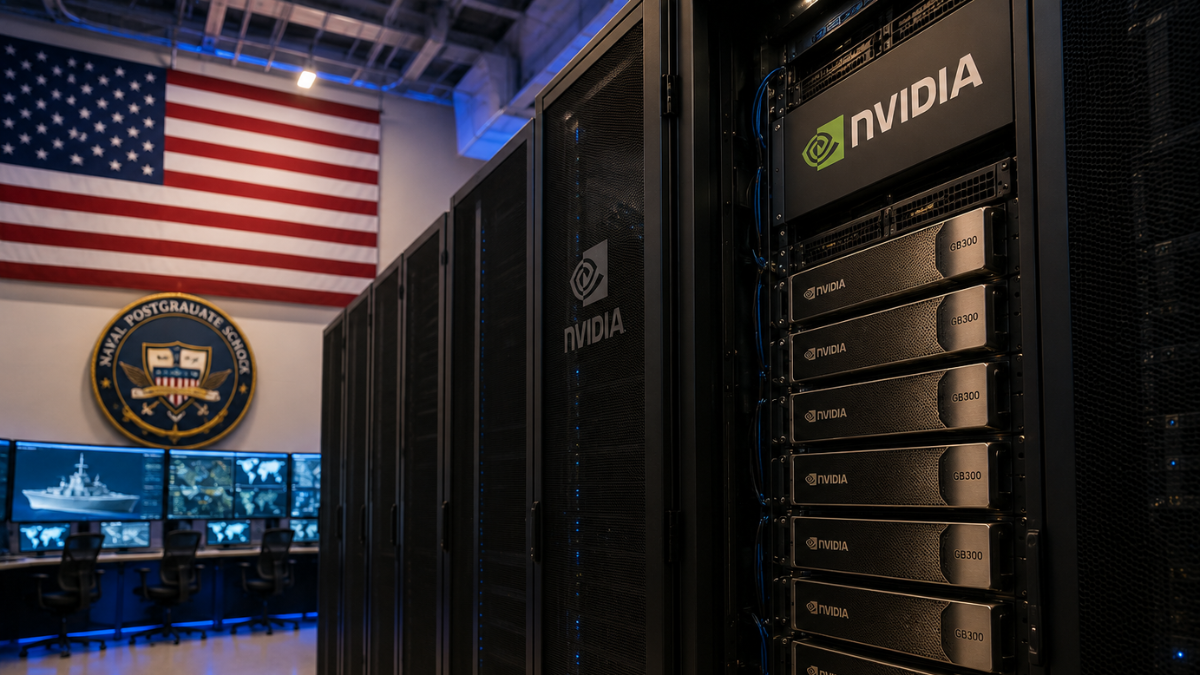
A supercomputer just showed up on a Navy campus in Monterey, California, and it didn't come from the Department of Defense. It came from Nvidia.
The Nvidia military supercomputer donation, announced Wednesday alongside the Naval Postgraduate School, marks the first time the chipmaker's most advanced servers have been handed directly to a branch of the U.S. armed forces. Not sold. Not licensed for eventual government use somewhere down the line. Donated, outright, to a nonprofit tied to the school itself.
That distinction matters more than it might sound at first. Nvidia's Blackwell architecture was already slated to power supercomputers built by the U.S. Department of Energy. But those are civilian-run systems, filtered through federal procurement layers before any military researcher gets near them. This one skips that step entirely.
What Nvidia Donated to the Naval Postgraduate School
The system is built on Nvidia's GB300 "Grace Blackwell" servers, the company's most advanced AI computing platform to date. Nvidia and NPS didn't disclose exact specs or the size of the installation. What they did confirm is where it lives now: the NPS campus in Monterey, tucked into a school that trains Navy officers and civilian researchers in fields like computer science and aerospace engineering, almost always with an eye toward how those disciplines play out in actual combat.
The donation went to the NPS Foundation, a nonprofit organized around supporting the school, rather than to NPS itself. That's a common structural workaround for gifts involving federal institutions, and it let Nvidia move the GB300 supercomputer donation through without wading into the procurement rules that typically govern hardware ending up on a military base.
Adm. Samuel J. Paparo, who leads U.S. Pacific Command, joined Nvidia CEO Jensen Huang at NPS for the announcement event. Their appearance together says something on its own. This wasn't framed as a quiet equipment drop-off. It was staged as a statement about where military computing is headed.
Why the Nvidia Military Supercomputer Donation Matters
"AI will be a backbone of America's defense," Huang said in a statement tied to the announcement. Coming from the CEO of the company that now sits at the center of nearly every major AI buildout on the planet, that's not filler. It's positioning.
Here's the thing: Nvidia doesn't need the publicity. It's already the chip supplier every hyperscaler, cloud provider, and increasingly every government wants a slice of. So why donate hardware worth a serious sum to a single military graduate school? Because being first matters in a race like this one. Getting Grace Blackwell chips into military use before a competitor gets there first buys Nvidia a kind of credibility money can't easily purchase later.
The US Navy Nvidia AI supercomputer installation also lands at a moment when both Washington and Beijing are pouring resources into military AI, from targeting analysis to autonomous drone systems. Neither side wants to be the one explaining, years from now, why it fell behind on this particular front.
Inside the GB300 Grace Blackwell System's Military Role
Grace Blackwell chips are Nvidia's flagship architecture, built to handle the kind of workload that used to require entire data centers packed with older-generation hardware. The commercial world already sees where this technology is heading. Bristol-Myers Squibb, for instance, recently became the first life sciences company to purchase Nvidia's Vera Rubin AI system, Nvidia's next-generation platform that picks up where Blackwell leaves off. Military adoption of Grace Blackwell chips for military use follows a similar logic: whoever gets the newest silicon first gets a head start on whatever comes out of it.
One of AI's core strengths, and this is the part NPS leadership keeps coming back to, is how fast it can chew through complex, constantly shifting problems compared to older simulation methods. Fleet operations, weather-dependent logistics, adversary behavior modeling. These aren't static equations. They shift by the hour, and traditional computing approaches were never built to keep pace with that kind of churn.
It's worth noting this isn't happening in a vacuum, either. Europe has been building its own answer to U.S.-China AI dominance, with efforts like the sovereign military AI platform emerging as a bid to keep European defense computing independent of both Washington and Beijing.
The US-China AI Supercomputer Race Behind This Donation
You can't really talk about a US military AI supercomputer Monterey installation without talking about China. Beijing has been moving aggressively on domestic supercomputing, partly because U.S. export restrictions have forced its hand.
China's answer has come in waves. There's the Lingsheng supercomputer's Top500 ranking claim, which rattled a few assumptions about who actually leads in raw compute. Separately, the Lingcheng supercomputer architecture has drawn attention for design choices that sidestep dependence on Nvidia chips entirely.
That workaround has become a pattern. With Nvidia H200 chip purchase limits restricting what firms like Alibaba, ByteDance, and DeepSeek can actually buy, Chinese compute infrastructure has leaned harder into homegrown alternatives. Sugon's push toward a 100,000-card AI supercluster is one example. A broader domestic supercomputing platform effort out of the Chinese Academy of Sciences is another.
None of that erases what Nvidia is doing here. If anything, it explains the urgency. A US-China AI military technology race doesn't wait for anyone to finish their five-year plan.
What This Means for Nvidia's Position
Nvidia's business has taken some hits lately even as its chips end up in higher-profile places. It briefly lost Nvidia's most valuable company title to Apple earlier this year, a reminder that market leadership in this industry doesn't sit still for long. And there's a slower, quieter trend worth watching too: a growing number of firms leaving Nvidia for local suppliers in markets where regulation or price makes Nvidia hardware harder to justify.
Against that backdrop, a high-visibility Nvidia Naval Postgraduate School supercomputer donation does real work for the brand. It signals that even as competitors chip away at market share elsewhere, Nvidia's silicon remains the default choice for the world's most demanding institutional buyers. Infrastructure investments keep piling up around that story too, like the recent AI data center lease in Texas that fully commercialized Hut 8's Texas campus, or the Nvidia and Qualcomm exhibition highlights from the 4th CISCE artificial intelligence exhibition. Nvidia is showing up everywhere at once, and a military campus in Monterey is just the latest stop.
How NPS Plans to Use the System
Trenton Hancock, the school's chief information officer, was upfront about the growing pains ahead. "Initially, we will need to carefully manage demand as we bring this capability online," he said in a statement. Translation: there's more interest in this hardware than there's capacity to serve, at least for now.
But the payoff, according to Hancock, is the ability to model problems that actually resemble what the fleet deals with day to day. Not textbook scenarios. Real ones, with all the messiness that comes attached. "What this system really gives us is the ability to explore more complex, real-world problems, especially those that mirror the challenges our operational fleet faces every day," he said.
Adm. Paparo framed it as an education issue as much as a hardware one. "As we modernize our technology, we must also modernize how we educate our leaders," he said. "Access to advanced computing capability means NPS students and faculty understand the opportunities and responsibilities that come with these technologies." That last word, responsibilities, is doing some quiet work in that sentence. Nobody at this event pretended military AI comes without tradeoffs.
Key Takeaways
The Nvidia military supercomputer donation to the Naval Postgraduate School isn't just a hardware handoff. It's a marker in a much larger contest over who controls the most advanced AI compute, and how fast that compute reaches the people actually making defense decisions. Nvidia gets a headline and a foothold inside U.S. military research. NPS gets a tool its faculty admit they're still learning how to fully use. And the broader race between Washington and Beijing over military AI keeps accelerating, with neither side showing signs of slowing down anytime soon.