Summary
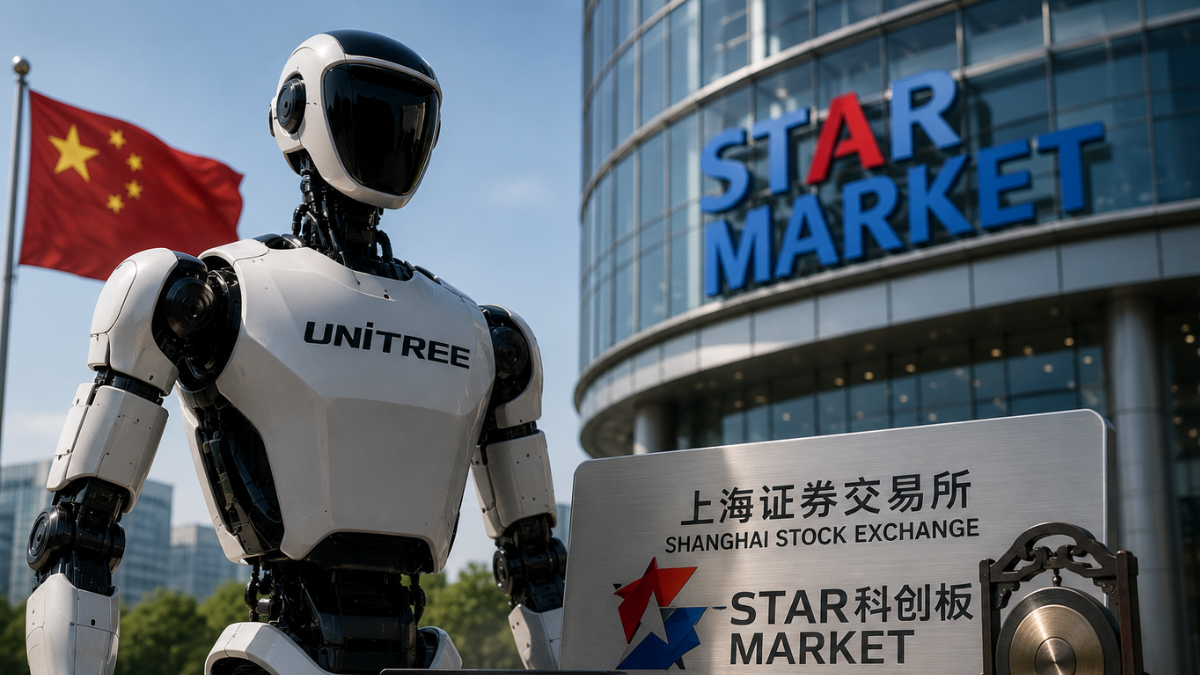
The Unitree Robotics Shanghai STAR Market IPO debut 688836 has become one of China’s most closely watched technology listings of 2026. Investors aren't just pricing a robot maker. They're betting on whether humanoid machines can move from viral dance clips and lab demos into a durable, profitable business.
That excitement is intense. Unitree's retail allocation was reportedly subscribed about 8,000 times over, while private-market indications and crypto-linked derivatives have pointed to a sharp first-day move.
But hype can turn quickly once real trading starts.
Key Points
- Unitree is taking humanoid robotics to the public market: Its listing gives investors a direct way to participate in China's growing embodied AI industry.
- Retail demand is extremely high: The IPO was reportedly oversubscribed by around 8,000 times, showing just how strong investor interest has become.
- The IPO price is 150.8 yuan: Unitree reportedly aims to raise around 6.1 billion yuan, with roughly 10% of its enlarged share capital being offered.
- The valuation is already a major talking point: The reported post-IPO valuation is around 61 billion yuan, leaving investors with a big question about how much future growth is already priced in.
- Unitree has a real business behind the IPO: Its G1, R1 and quadruped robots give the company existing products and revenue opportunities beyond future humanoid deployments.
- The biggest challenge is scaling: Building impressive robots is one thing; producing thousands reliably and profitably is much harder.
- Competition is getting tougher: Tesla Optimus, Boston Dynamics and other Chinese robotics companies are pushing the industry forward at the same time.
- China's robotics ecosystem is helping: Domestic manufacturing, AI development, investment and government support are creating favorable conditions for robotics companies.
- The first-day move isn't the real test: A sharp IPO rally would show strong market demand, but it wouldn't prove that Unitree can generate sustainable long-term returns.
- Commercial adoption matters most: Investors should watch actual customer deployments, repeat orders, production costs, margins and revenue growth after the listing.
- The bigger story is embodied AI: Unitree's IPO could become an important indicator of whether investors believe AI is moving from software and screens into machines that can physically perform work.
Why the Unitree Robotics Shanghai STAR Market IPO debut 688836 matters
Unitree is widely described as the world’s biggest humanoid robot maker by sales, and it will be the first general-purpose robotics company to make this kind of mainland China market entrance. Its Unitree Robotics Shanghai STAR Market stock debut is therefore being treated as a test of public appetite for embodied AI companies.
The company has drawn attention with robots that run, dance, perform martial arts, and move with a fluidity that makes people stop scrolling. Yet investors are focused on a less cinematic point: Unitree is already profitable, unlike many robotics businesses that remain years away from sustainable sales.
Its path to market also followed a closely watched STAR Market approval process. That matters because investors see the listing as part of a wider push to fund strategic technology companies at home.
IPO price, ticker, valuation and listing date
The Unitree humanoid robot IPO price 150.8 yuan gives investors a starting point, but it may not say much about the first trading price. Unitree reportedly raised 6.1 billion yuan, or roughly $905 million, by selling around 10% of its enlarged share capital.
That places the Unitree 6.1 billion yuan IPO valuation 61 billion yuan at the center of the debate. A relatively small public float can create scarcity, especially when retail demand is this extreme.
The Unitree stock price 688836 SS listing date remains a key item for traders watching the debut. Reports indicated the official trading date was expected to be announced after the IPO process, so you should rely on the Shanghai Stock Exchange and company filings rather than unregulated price chatter.
China’s China listing rules have been evolving to support technology innovation, while broader A-share AI growth has helped create a receptive backdrop for high-profile listings.
Why Unitree shares could surge, and why that isn't guaranteed
The Unitree IPO retail subscription 8000 times oversubscribed figure is the clearest sign of demand. Some reports also said IPO winners had received offers from scalpers at about 410 yuan per share, well above the 150.8 yuan offer price.
Private-share platforms have implied that Unitree could nearly triple on debut. Crypto-linked derivative markets have suggested even bigger gains, with some pricing scenarios pointing toward a near fourfold jump.
Simple. Exciting. Also risky.
Derivative markets are thin, speculative, and very different from regulated A-share trading. A scarcity premium can push a stock up fast, but it doesn't create new customers, factory deployments, or recurring revenue.
Investors are also watching whether Unitree shares follow other headline-making Chinese tech listings. A strong debut could reinforce interest in China humanoid robot industry commercialization 2026. A weak one would not end the trend, though it would remind the market that robots still have to earn their valuations.
Unitree's business case: G1, R1 and real commercial sales
The strongest part of the bull case is not the launch-day buzz. It is the company’s Unitree G1 and R1 humanoid robot commercial sales and its established quadruped robot business.
Unitree sells humanoid and four-legged robots into research, education, development, inspection, and early commercial-use settings. That mix gives it revenue sources that pure humanoid startups often lack. The Unitree G1 and R1 humanoid robots drive profitable robotics business model narrative rests on scaling these sales without letting production costs get out of hand.
Manufacturing is the bigger question. You can build an impressive machine in small volumes. Making thousands that work reliably, can be serviced, and fit a customer's budget is another job entirely. China’s progress in humanoid robot production suggests the supply side is moving, but demand still has to catch up.
And factories won't buy humanoids just because they look futuristic.
Can Unitree compete with Tesla and Boston Dynamics?
The comparison, Boston Dynamics Tesla Optimus vs Unitree Robotics, is useful but imperfect. Boston Dynamics has a long engineering pedigree and Hyundai ownership. Tesla has manufacturing scale, AI talent, and the possibility of deploying Optimus across its own facilities. Unitree has speed, lower-cost hardware experience, and a strong base in China.
Its investor group strengthens the story too. Tencent Alibaba DeepSeek investment Unitree Robotics signals support from influential Chinese technology names, while founder Wang Xingxing’s high-profile visibility has fed perceptions of policy backing.
Still, competition is getting crowded. Humanoids have limited mature factory applications, international market access can be difficult, and buyers want proof that robots reduce costs or solve labour shortages. The wider robotics manufacturing demand story may help, but orders need to become repeatable.
The broader embodied AI investment theme
Unitree’s debut is bigger than one ticker. It represents an Embodied AI humanoid robot maker stock listing at a moment when governments, manufacturers, and investors are all trying to identify the next viable robotics platform.
China is building support through humanoid robot policy, computing capacity, and a developing robot data strategy. Those pieces matter because better hardware alone isn't enough. Robots need data, training, safety standards, and jobs worth doing.
Outside China, Japan's physical AI push shows this is becoming an international contest. So does the expanding physical AI market, from logistics and factories to specialist service work.
Unitree Robotics Shanghai STAR Market IPO debut 688836: key risks
The Unitree Robotics Shanghai STAR Market IPO debut 688836 could deliver a spectacular opening day. It could also become a lesson in buying a story at its loudest moment.
Watch the post-listing valuation against revenue growth, gross margins, customer concentration, production capacity, and the share of sales coming from repeat commercial deployments. Keep an eye on export restrictions too, particularly if Chinese humanoid firms face barriers in the US.
The company is entering a market shaped by China's robot race, but that doesn't erase execution risk. For long-term investors, the relevant question isn't whether the stock jumps on day one. It's whether Unitree can keep selling useful robots after the crowd moves on.
GlobalByte Perspective
Unitree’s IPO is interesting for a reason that goes beyond the opening-day stock price. The company is bringing humanoid robotics into the public markets at a time when investors are still trying to figure out whether physical AI can become a real business or remain mostly a technology story.
The huge retail subscription shows how much excitement surrounds the sector. But from our perspective, that demand should not be confused with proven commercial scale. A heavily oversubscribed IPO can push a relatively small public float to extreme levels, especially when investors are competing for a high-profile robotics name.
The more important question is what happens after the debut.
Unitree already has an advantage that many early-stage humanoid companies don't: it has an existing robotics business, including quadruped and humanoid products such as the G1 and R1. That gives investors something more tangible to evaluate than a company built entirely around future robot sales.
But the next stage will be much harder. Unitree needs to show that it can manufacture robots in meaningful volumes, keep costs under control, support customers after deployment, and turn demonstrations into repeat commercial orders.
The comparison with Tesla and Boston Dynamics will attract headlines, but Unitree doesn't need to beat either company in every category. Its real challenge is proving that affordable, capable robots can find enough practical uses to support the valuation investors are putting on the business.
For GlobalByte News, the bigger takeaway is this: Unitree’s IPO is a test of investor confidence in embodied AI, not just a bet on one robotics company. If the company can convert today's enthusiasm into recurring revenue and large-scale deployments, the listing could become an important milestone for China's robotics industry. If not, the debut could serve as a reminder that impressive robots still have to make economic sense.