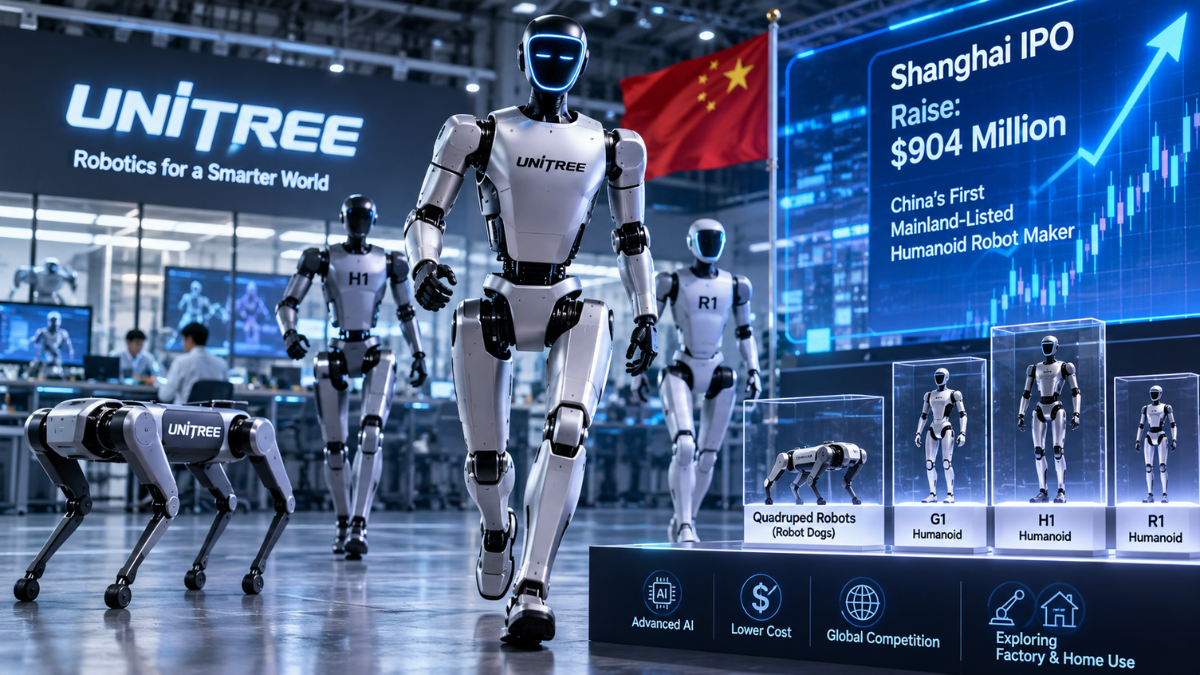
The Unitree Robotics Shanghai STAR Market IPO price has been set at 150.8 yuan per share, putting one of China’s most visible robot makers on track to raise 6.1 billion yuan, or about $904 million. Subscriptions are due to open Monday, and the deal could make Unitree China’s first mainland-listed humanoid robot manufacturer.
That’s a big milestone. But it doesn’t mean humanoid robots are ready to take over factories next week.
Unitree has captured attention with robot dogs, viral humanoid stunts, and a rare financial profile for this young industry: real revenue, plus reported profit. If you’re watching the sector, this IPO is less about one flashy robot and more about whether public markets will fund the long, expensive route from demos to dependable machines.
Unitree Robotics Shanghai STAR Market IPO Price and Fundraising Details
The Unitree IPO share price 150.8 yuan values the planned offering at 6.1 billion yuan. Put another way, the Unitree humanoid robot IPO $904 million raise would give the company a substantial pool of capital for research, manufacturing, and expansion.
The direct answer to What is Unitree Robotics' share price for its Shanghai IPO? is 150.8 yuan per share.
And How much money is Unitree raising in its Shanghai listing? The planned total is 6.1 billion yuan, roughly $904 million. This Unitree Robotics 6.1 billion yuan Shanghai listing follows its Unitree IPO approval, a step that brought the company closer to a landmark domestic listing.
The planned deal also reflects changing China's tech listing rules, which have made innovation-focused listings a major policy and market story. Investors will still need to judge the valuation carefully. Humanoid robotics is exciting, yes. It’s also speculative, capital-hungry, and crowded.
Who Is Unitree, and What Does It Build?
Unitree was founded in Hangzhou in 2016 by engineer Wang Xingxing. So, Who founded Unitree Technology in Hangzhou? The answer is Unitree Technology Founder Wang Xingxing, whose company initially became known for lower-cost quadruped robots, often called robot dogs.
Then came the humanoids.
The company’s G1, H1, and R1 models have appeared in videos running, dancing, and performing martial-arts moves. The Unitree G1 H1 humanoid robot viral kung fu demo helped turn an industrial technology company into a familiar name well beyond robotics circles.
But demos aren’t deployments. A robot that can kick, dance, or jog on a stage still has to prove it can work safely for hours, handle awkward objects, recover from mistakes, and avoid creating more problems than it solves.
The models behind the hype
If you’re asking, What humanoid robot models does Unitree manufacture?, the headline names are G1, H1, and R1. Unitree also continues to sell quadruped robots, which gives it a broader product base than a startup relying entirely on humanoid pre-orders.
That matters because How Unitree manufactures low-cost bipedal and quadruped robots is part of its appeal. China’s local supply chain for motors, sensors, batteries, and precision components can help reduce production costs. Cheap is not the same as reliable, of course. Still, price matters when universities and labs are deciding how many units they can afford.
Why Unitree’s Financials Stand Out
The company reported nearly 1.7 billion yuan in revenue for 2025, more than four times the previous level, along with adjusted net profit of around 600 million yuan. In the language investors will search for, Unitree reports 1.7 billion yuan revenue and 600M profit ahead of IPO.
So, Is Unitree Robotics profitable in 2025? Based on the figures disclosed in its prospectus, yes - it reported adjusted profit of about 600 million yuan.
That makes Unitree unusual. Many humanoid-robot companies are still spending heavily with little confirmed commercial revenue. Unitree also says overseas sales made up more than 40 percent of revenue during each disclosed reporting period. That global demand is encouraging, though it may still come largely from research institutions, developers, and demonstration projects rather than recurring factory contracts.
The current Unitree 2025 revenue 1.7 billion yuan profit story is impressive. It’s not a guarantee that growth will continue at the same pace.
Why Chinese Robot Makers Are Racing to List
The Chinese humanoid robot makers public listing race has a simple financial logic. Building capable humanoids costs a lot, for a long time. You need engineers, training data, AI software, test facilities, supply-chain capacity, safety validation, and manufacturing lines before mass adoption is certain.
Public capital can fund that gap.
Unitree’s move comes as Leju Robotics Kuavo AgiBot Hong Kong IPO plans and other listing ambitions gather pace. Leju Robotics, maker of the Kuavo humanoid, has applied to list on Shenzhen’s ChiNext market. Shanghai-based AgiBot has prepared for a Hong Kong IPO.
Why are Chinese humanoid robot makers rushing to list on stock exchanges? Because private funding alone may not cover years of development and scale-up. Government support and investor excitement are available now, too, and companies know market windows don’t stay open forever.
This is part of a wider technology-financing trend. China A-share resilience and CXMT's IPO surge show how investors are weighing domestic technology champions across more than just robotics. The related CXMT localization bid points to the same broader push for homegrown industrial capability.
The Embodied Intelligence Bet Has a Catch
The China embodied intelligence humanoid robot market is tied to a bigger idea: AI that can sense, move, and act in the real world. Policymakers see embodied intelligence as a strategic field, while businesses see a potential answer to labor shortages and repetitive physical work.
That said, the commercial case remains unfinished.
Most humanoid demand today appears to come from universities, research labs, government-backed programs, exhibitions, and early pilots. Why university research and lab demand power current humanoid sales is no mystery. These buyers can accept unfinished capabilities because experimentation is the point.
Factory buyers are less forgiving. They need uptime, safety, maintenance support, predictable output, and a return on investment.
China is pushing ahead with embodied robot production, while rules around identity and deployment are evolving through humanoid robot policy. Those developments could help standardize the sector. Or they could expose how far the technology still has to go.
Unitree vs Tesla Optimus and Boston Dynamics
The Unitree vs Tesla Optimus Boston Dynamics rivalry is real, although the companies are pursuing different strategies and markets.
Tesla has manufacturing scale and a huge AI narrative behind Optimus. Boston Dynamics has years of experience in highly capable mobile robots. Unitree’s advantage is its focus on affordability and its ability to ship products into a broad international market.
Does Unitree compete with Tesla and Boston Dynamics? Yes, especially in the race to build useful legged robots. But comparing viral videos alone won’t tell you who is winning. The tougher test is whether these machines can perform repeatable work with low downtime and acceptable cost.
For a wider view, the physical AI outlook and this humanoid manufacturing signal show why manufacturers worldwide are paying closer attention. Even Japan's physical AI push is part of the same international contest.
What Investors Should Watch Next
The Unitree Robotics Shanghai STAR Market IPO price gives investors a clear entry point, but the more revealing numbers will arrive after listing: order quality, margins, repeat customers, overseas growth, and how much revenue comes from practical deployments instead of one-off research purchases.
Watch shipments, too. How many humanoid robots did Unitree ship in 2025? That figure will matter because sales value can rise through high-priced projects without proving broad adoption.
Unitree has already achieved something meaningful. It has turned low-cost legged robots into a global business, built public recognition, and reported profitability before pursuing a major listing. The harder chapter is next: proving that humanoids are not just entertaining machines, but useful ones.