Summary
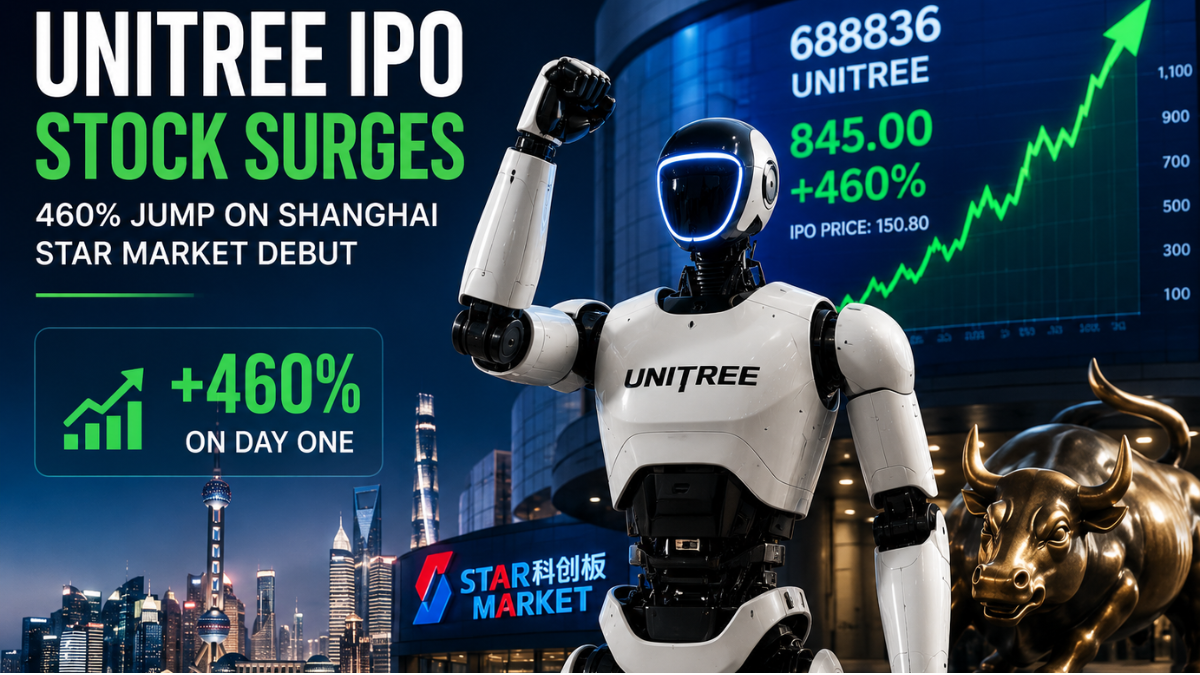
The Unitree Shanghai STAR Market IPO debut stock surge has put China’s humanoid robotics ambitions squarely in front of global investors. On its first day of trading, Unitree shares climbed more than five-fold before closing at 845 yuan, or 460% above the 150.8-yuan IPO price.
That is a startling start for any newly listed company. For a robot maker competing in a politically sensitive, still-unproven commercial market, it’s even more striking.
Unitree raised roughly $900 million by selling about 10% of its shares, and the closing price put its market capitalization near $50 billion. Investors weren’t simply buying robot dogs that can run, dance, or perform martial arts. They were buying a high-profile bet on China’s ability to build, fund, and scale physical AI.
Key Points
- Unitree shares closed at 845 yuan, up 460% from the IPO price.
- The IPO raised roughly $900 million and pushed Unitree’s market value close to $50 billion.
- Unitree benefits from strong first-mover visibility in humanoid and quadruped robotics.
- The company is reportedly profitable, which sets it apart from many robotics startups.
- A major challenge is turning research and demonstration sales into repeat commercial orders.
- Unitree faces growing US national-security and import restrictions.
- China’s push toward automation and robotics provides a strong domestic market opportunity.
- Unitree’s debut could encourage a wider Chinese robotics IPO wave.
- Investors should watch commercial sales, margins, production scale and international restrictions rather than the opening-day stock price.
Unitree Shanghai STAR Market IPO debut stock surge: the numbers behind it
The Unitree Shanghai STAR Market IPO debut stock surge was dramatic from the opening bell. Shares reportedly opened at 1,100 yuan, then pulled back before settling at 845 yuan. Even after that cooling-off period, the stock finished far above its offering price.
The Unitree 688836 SS stock price Shanghai listing stands out because the gain exceeded the average first-day rise for Chinese IPOs that year, while broader Chinese equities were under pressure. That contrast matters. It suggests investors saw Unitree as more than a short-lived market trade.
Its Unitree IPO valuation 50 billion dollars STAR Market figure also reflects something harder to model: scarcity. There are few public companies offering direct exposure to a Chinese humanoid robotics leader with consumer visibility, big-name backers, and reported profitability.
Of course, a large valuation isn’t the same as a guaranteed business outcome. Not even close.
Why investors gave Unitree such a premium
Unitree has a first-mover advantage in a market filled with prototypes and bold promises. Its quadruped robots have already become familiar online, while its humanoid machines have attracted attention through public demonstrations that are easy to understand, share, and remember.
That visibility has real value. A flashy robot doesn’t automatically create recurring revenue, but it can help a company recruit engineers, secure partnerships, win institutional customers, and raise capital while smaller competitors are still trying to prove they exist.
The company’s earlier Unitree IPO approval also gave investors a clearer route to public-market access. And China’s changing rules have helped. China's listing-rule shift has made technology-led listings a more central part of the country’s capital-market strategy.
Then there’s the shareholder story. Tencent, Alibaba, and DeepSeek have reportedly backed Unitree, which helps explain why the phrase Tencent Alibaba and DeepSeek backed Unitree sees stock pop 460 percent on day one resonated so strongly in coverage of the debut.
Investors tend to trust a company more when experienced technology groups have already put money, networks, and reputational weight behind it. Sometimes that confidence is justified. Sometimes it gets ahead of the actual business.
Profitability is the key distinction, but commercial adoption remains thin
The phrase Why Unitree profitability and first mover advantage set it apart in Sino US robotics battle gets to the heart of the investment case. Many humanoid robotics startups burn cash for years while building hardware, training models, and searching for customers willing to pay more than pilot-project budgets.
Unitree is reported to be profitable, which makes it unusual. That doesn’t mean its revenue mix is perfect.
A considerable share of robot sales has reportedly gone to universities, research institutes, and demonstration-focused buyers rather than large commercial fleets. That’s a genuine weakness. Research demand can be valuable, but it may be irregular, project-based, and harder to scale than contracts for factories, warehouses, hospitals, or retail operations.
The next test is boring in the best possible way: repeat orders, maintenance revenue, uptime data, and customers who can show that a robot actually reduces costs.
That’s where humanoid robotics manufacturing becomes relevant. Public demos draw headlines. Industrial deployment pays the bills.
How Unitree compares with Tesla Optimus and Boston Dynamics
The Unitree vs Tesla Optimus Boston Dynamics valuation comparison isn’t straightforward because these companies have very different ownership structures, product strategies, and financing paths.
Tesla has an enormous advantage in manufacturing scale, AI infrastructure, and access to real factories where Optimus could eventually be used. Boston Dynamics brings years of locomotion research and a deeply recognizable robotics brand. Unitree, meanwhile, has built a reputation for moving quickly, pricing aggressively, and getting machines into the market.
Its robot dogs are especially important. They may not be the final destination, but they give Unitree product experience, customer feedback, and a visible platform from which to develop more capable humanoid models.
That is why How Unitree robot dogs and humanoid machines command premium market valuations is more than a catchy search phrase. Investors are pricing the company as a potential platform business, not merely as a seller of individual machines.
US restrictions could limit one of Unitree’s biggest opportunities
The stock rally arrived alongside serious geopolitical pressure. The US FCC ban Unitree foreign humanoid robots could block imports of future foreign-made humanoid and quadruped models, including Unitree products, on national-security grounds.
For buyers asking Why did the US FCC ban imports of future Unitree humanoid robots?, the stated concern is security, control, and the potential risks of connected machines operating in sensitive environments. Robots collect data, use cameras and sensors, and can move through real-world spaces. Governments don’t view that lightly.
The company also faces scrutiny after the Pentagon Chinese military companies list Unitree designation. Being placed on that list is not the same as a full sanction, but it can restrict future US military use and raise questions for partners, investors, and customers.
Unitree has maintained that its robots are for civilian use. Still, the US Pentagon adds Unitree to defense industrial list as Chinese humanoid robot sector booms storyline will remain part of the company’s public-market narrative.
For Unitree, the restriction removes a potentially large market before the commercial humanoid category has fully matured. That hurts. Yet it could also push the company to concentrate on China, Asia, Europe, and research markets where deployment may be easier.
A listing timed to China’s automation push
The World Robot Conference Beijing Unitree listing coincidence gave the IPO extra symbolism. While Unitree traded publicly for the first time in Shanghai, hundreds of robotics firms gathered in Beijing to display machines meant to address labor shortages, productivity challenges, and industrial automation needs.
China’s demographic pressures are a big part of this story. Fewer working-age people can mean more demand for machines that handle repetitive, dangerous, or physically demanding tasks. But demand alone won’t solve everything. The robots must be reliable enough to work outside a trade-show stage.
You can see the policy backdrop in China's robot race, as well as the emerging robot identity rules that may shape how machines are tracked and regulated.
Shanghai also offers a supportive setting for companies at the intersection of software, chips, manufacturing, and capital. The wider Shanghai AI ecosystem gives Unitree a strong local narrative, while China’s broader China innovation blueprint frames robotics as a strategic industry rather than a novelty.
Unitree may start a larger Chinese robotics IPO wave
The China humanoid robot makers IPO wave 2026 is already taking shape. Deep Robotics and Leju Robotics have pursued mainland listing routes, while Mech-Mind Robotics, X Square Robot, and AgiBot have explored Hong Kong listings.
The AgiBot X Square Robot Hong Kong IPO robotics trend matters because it offers investors more ways to compare business models. Some firms are focused on general-purpose humanoids. Others lean toward industrial vision, service robots, or specialized automation.
That competition could bring healthier price discovery. It could also expose which companies have mostly demonstrations and which ones have sustainable customer demand.
The Unitree IPO sets tone for wave of Chinese robotics listings including AgiBot and Leju Robotics because a successful public debut can make fundraising easier for rivals. But it raises expectations, too. Once the market has assigned Unitree a premium valuation, every other robotics prospect will be asked why it deserves one.
China’s wider equity environment will influence the answer. Recent China A-share resilience, a China tech stock rally, and moments when China stocks rise have all helped create a more receptive setting for growth-company IPOs.
What investors should watch after the debut
A first-day spike can be exciting. It can also hide the questions that matter most.
Watch for evidence of recurring commercial sales, not just single-unit purchases. Pay attention to gross margins as Unitree scales production. Follow international restrictions and supply-chain exposure. And compare the company’s valuation with actual revenue growth, because a $50 billion market cap leaves very little room for disappointment.
The Unitree stock price soars on STAR Market despite US FCC import ban and national security scrutiny narrative is powerful, but narratives change quickly when earnings arrive.
Where Unitree goes from here
The Unitree Shanghai STAR Market IPO debut stock surge has made the company a bellwether for Chinese physical AI. It now has capital, visibility, and a valuation that reflects enormous expectations.
But the hard work starts after the opening-day celebration. Unitree needs to turn public fascination into repeatable commercial demand, keep its reported profitability intact, and navigate a US market that may remain closed to future models. If it can do that, the IPO will look like a milestone. If not, the stock’s spectacular debut may become a reminder that robots still have to earn their place in the real world.
GlobalByte Perspective
Unitree’s IPO is impressive, but the 460% first-day jump says more about investor expectations than the company’s future performance. A near-$50 billion valuation puts huge pressure on Unitree to prove that humanoid robots can become a real business, not just a popular technology story.
The biggest question now is simple: can Unitree turn attention into repeat commercial sales? Its robots have strong visibility and the company is reportedly profitable, but a significant portion of demand still comes from universities and research institutions. That is very different from having thousands of robots working in factories, warehouses, or other commercial environments.
There is also the geopolitical problem. US restrictions could limit Unitree’s access to an important market just as the humanoid robotics industry is trying to scale. That makes China and other international markets even more important for its next phase.
GlobalByte Perspective: Unitree has won the IPO spotlight. Now it has to prove the business behind the robot is worth the valuation.