Something significant happened in Shanghai last Friday. Representatives from 29 countries signed an agreement to establish the World Artificial Intelligence Cooperation Organization - headquartered in Shanghai - with a mandate to guide AI development toward outcomes that are genuinely beneficial, safe, and equitable. Not just for wealthy tech-forward nations. For all of humanity.
That signing set the stage for the 2026 World AI Conference (WAIC) main forum and High-Level Meeting on Global AI Governance, which opened the same day. Shanghai is hosting this for the ninth consecutive year. And if you've been following the global AI governance 2026 conversation closely, you already know how meaningful that kind of sustained institutional commitment can be.
Here's what was announced at the main forum - and what it actually means.
29 Countries, One Agreement: What the World Artificial Intelligence Cooperation Organization Is
The agreement signed on Thursday - the day before WAIC's formal opening - brings 29 nations together under a single international AI body. Its stated purpose is straightforward on paper but enormously complex in practice: guide the development of artificial intelligence in ways that are safe, beneficial, and equitable for all.
And the headquarters is now in Shanghai. That's not a small detail. Chen Jie, the city's vice-mayor, was explicit about what Shanghai intends to do with that responsibility - push open-source AI, ensure inclusive sharing of technological advances, and use the organization's platform to bridge what he called "the global AI gap." The idea being that access to AI shouldn't be determined by a country's GDP.
For context on how this fits within broader multilateral efforts, the 65-country UN AI agreement reached earlier this year shows just how far China has pushed to frame AI as a shared global resource, not a competitive weapon.
What China Plans to Do Next With AI Integration
Ke Jixin, vice-minister of industry and information technology, laid out China's near-term AI agenda at the main forum. His framing was direct: AI is now "a key variable to drive high-quality economic growth," and the next phase involves deepening integration between AI and actual industry - not just research labs and conference demos.
Three areas are getting coordinated breakthroughs: algorithm development, computing infrastructure, and data systems. These aren't independent tracks. The whole point is for them to advance together, which addresses one of the real friction points in AI deployment (which, if you've worked in enterprise tech, you already know well) - you can have great models but inadequate compute, or strong compute but messy data pipelines. AI empowering Chinese industries has become a concrete policy priority now, not just a talking point.
Robots got specific attention too. Ke Jixin argued that embodied intelligence - AI that operates in the physical world - needs to improve further before industries can truly rely on it across varied real-world scenarios. The gap between "impressive conference demo" and "actually useful in a factory or hospital" is still real, and he didn't pretend otherwise.
On the governance side, China is accelerating the formulation of key AI standards and launching a pilot program for AI ethics review implementation. That's a significant move - it signals that domestic guardrails are being built alongside growth ambitions, something that aligns with priorities set at China's premier AI policy meeting earlier in 2026.
Open-source, high-performance large models are also on the agenda. Notably, China's plan is to share them globally. For developing nations trying to build AI capacity without the budget to train foundation models from scratch, that's nothing.
Shanghai's Ambitions Go Beyond Hosting a Conference
Chen Jie's comments weren't a diplomatic ceremony. He made clear Shanghai is actively working to become what he called "an internationally influential highland for AI" - by achieving breakthroughs in core technologies like advanced models and chips, and by expanding AI applications across more real-world scenarios.
That ambition tracks with a broader pattern you can see across the Shanghai AI economy, 6G developments, and the MWC Shanghai AI signals from earlier this year. Shanghai isn't positioning itself as just a conference host. It's positioning itself as the city where AI's key infrastructure decisions get made.
Whether that actually lands depends on the World Artificial Intelligence Cooperation Organization Shanghai 2026 functioning as intended - and not becoming another paper declaration. The China-Finland AI cooperation framework shows bilateral work is moving forward regardless, but multilateral structures are slower. That's just the reality. Headquarters and agreements don't equal outcomes.
The Chip and Optical Computing Push
Two voices stood out in the industry panel discussions.
Shen Yichen, founder and CEO of Lightelligence - an optical computing company based in Shanghai - made a direct call for closer collaboration among Chinese AI startups, especially in the chip sector. His core argument: optical computing plays a real role in building stronger compute capabilities, but only if the ecosystem is open enough to allow efficient technology innovation. Closed ecosystems stifle exactly the cross-company problem-solving that chip development requires. Simple point. But it's one a lot of companies in the sector aren't practicing.
Zha Hao, chairman and CEO of Shanghai Smart Logic Technology (an IP licensing and chip services company), made a related but distinct argument. Industries should lead with their actual problems - whether that's developing a new drug, designing a new material, or scaling a manufacturing process. Then tech providers specializing in chips, computing structures, and deployment step in with targeted solutions. That's the right sequence. Not the reverse.
Both speakers reflect a concern you hear repeatedly in coverage of Chinese AI reshaping global competition: that collaboration within China's AI ecosystem is as strategically important right now as competing globally.
What's Actually on the Floor at WAIC 2026
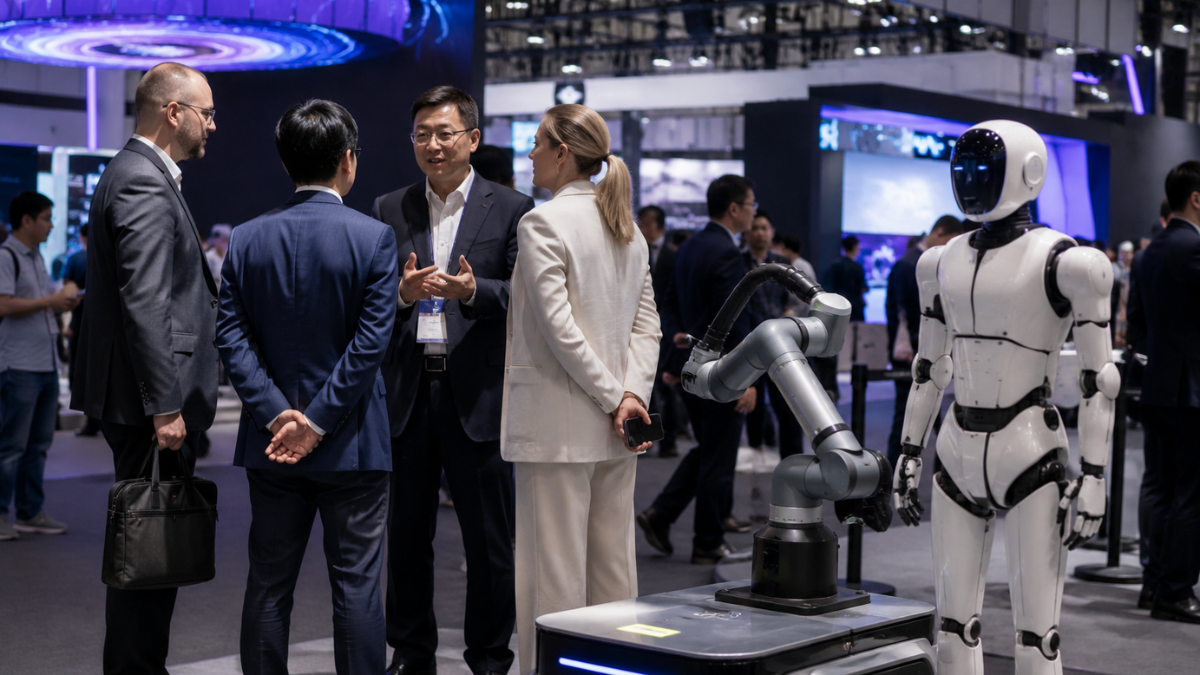
The numbers are striking. This year's conference features a record 100,000 square meters of exhibition space. There are 349 first-release products. 108 chips on demonstration. More than 300 embodied intelligence robots showcasing real-world AI capabilities across various deployment scenarios.
Of the 1,117 total exhibitors, over 200 focus specifically on intelligent computing. That concentration alone signals where the industry thinks the next bottleneck is - not model quality, but compute.
For a sense of how this connects to the broader 2026 digital economy picture, the 2026 Global Digital Economy Conference in Beijing drew similar themes around infrastructure and deployment. And China's AI growth at Davos earlier in the year set the macro framing. WAIC is where those words become products you can actually touch.
Bridging the AI Gap - The Part That Actually Matters Long-Term
Honestly, the most substantive part of Friday's forum wasn't the product releases.
It was the repeated emphasis on equitable access. Chen Jie's statement that the World Artificial Intelligence Cooperation Organization Shanghai 2026 will "bridge the global AI gap" is either a genuine commitment or a useful phrase; only execution will tell you which. But the structure is now in place. The headquarters exists. Twenty-nine signatory nations have a formal mechanism to cooperate. And China's stated plan to provide open-source high-performance large models to the world gives developing nations something concrete to build on - not just a promise.
China's people-centered AI vision has been a recurring theme across 2026 policy announcements, and WAIC's main forum pushed that framing squarely into the international arena. Meanwhile, China's AI industry forecast from the NDRC shows the domestic side of this equation growing fast. The real question is whether the international cooperation layer can keep pace with the domestic one.
What the World Artificial Intelligence Cooperation Organization Shanghai 2026 Actually Signals
The World Artificial Intelligence Cooperation Organization Shanghai 2026 is worth watching not just as a policy milestone but as an infrastructure decision. Headquarters matter. Governance frameworks matter. And the fact that 29 nations chose to anchor this institution in Shanghai - not Geneva, not New York - says something about where the world sees AI's institutional center of gravity shifting.
The emphasis on embodied intelligence, optical computing chips, open-source large models, and AI ethics review pilot programs isn't scattered. It's a coordinated set of moves across technology, standards, and international diplomacy. Whether it all holds together is a separate question. But the architecture here is more serious than previous declarations.
Keep watching the WAIC 2026 floor for product-level signals. The 108 chips and 300-plus robots aren't just conference decor - they're early indicators of what China's AI stack looks like when it hits global markets at scale.