Summary
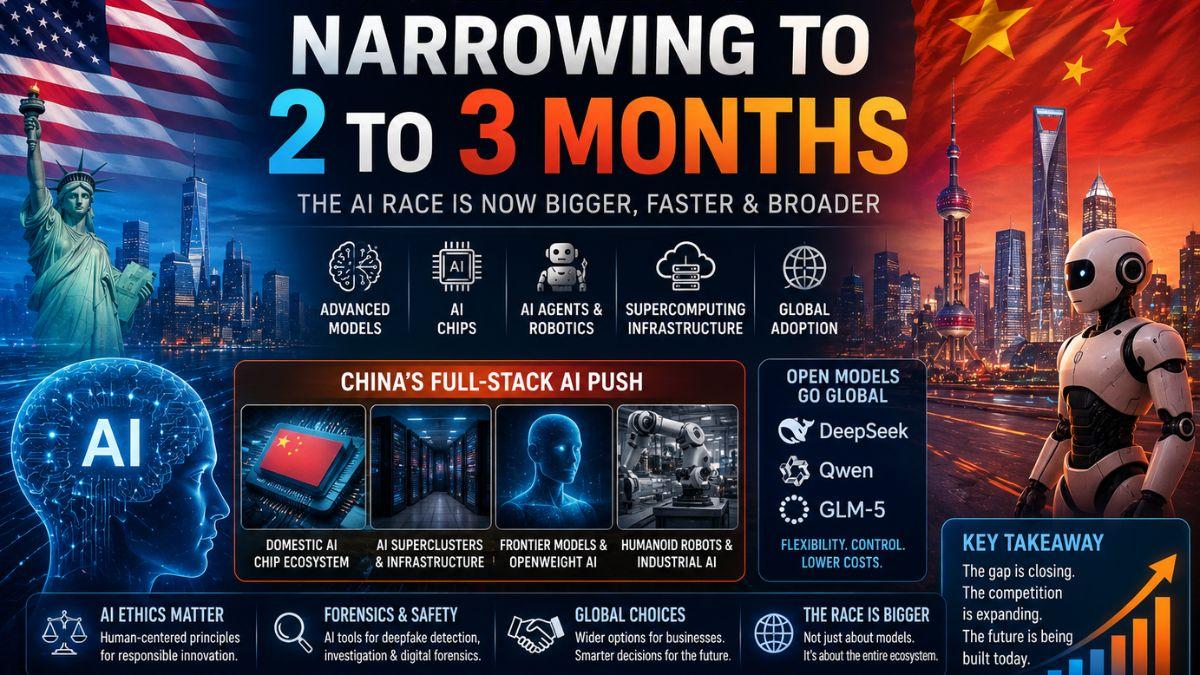
The US China AI tech gap narrowing 2 to 3 months is no longer just a provocative headline. It reflects a faster, messier race in which Chinese companies are advancing models, domestic chips, AI agents, and robotics at the same time.
For you, this matters because AI choices are getting broader. Businesses that once looked almost exclusively to US providers now have openweight Chinese models, lower-cost deployment paths, and new hardware options to consider.
That doesn't mean the US has lost its lead. It hasn't. But the US China AI technology gap 2 to 3 months 2026 estimate shows how quickly the frontier is moving.
Key Points
- The AI gap is shrinking: Chinese frontier models are getting closer to leading US systems in several areas.
- Models are only one part of the race: Chips, computing capacity, cloud infrastructure and robotics are becoming equally important.
- Openweight models are changing adoption: Qwen, DeepSeek and Kimi give developers more freedom to deploy and modify AI systems.
- China is building a wider AI ecosystem: Domestic chips, models, agents and robotics are developing alongside one another.
- The US still has major advantages: Advanced semiconductor access, research capabilities, computing infrastructure and established global AI companies remain important strengths.
- Businesses have more choices: Companies can now compare US and Chinese models based on cost, performance, hosting, security and compliance rather than simply choosing the most familiar provider.
- AI sovereignty is becoming a bigger issue: Countries such as South Korea are looking for ways to avoid becoming completely dependent on foreign AI platforms.
- Safety cannot be ignored: As AI spreads into agents, robotics and media generation, privacy, transparency, reliability and accountability become more important.
- The real test is commercial use: A strong benchmark result means little if a model cannot deliver reliable performance at a reasonable cost.
- The race is becoming full-stack: The biggest advantage may ultimately belong to the ecosystem that connects models, chips, data, infrastructure and real-world deployment most effectively.
US-China AI tech gap narrowing 2 to 3 months as models improve
Gartner's Gartner report key AI trends China 2026 points to a clear shift: China is entering the top tier of frontier AI development while commercial adoption keeps expanding. The race is no longer limited to benchmark scores. Distribution, hardware access, developer ecosystems, and real-world deployment now matter just as much.
Moonshot AI's Kimi K3 is part of that story. The Kimi K3 Moonshot AI parameter benchmarks OpenAI discussion centers on its reported 2.8 trillion parameters and its competitive results against leading US systems. Put plainly, the Moonshot AI unveils Kimi K3 openweight model with 2.8 trillion parameters narrative has attracted attention because openweight access can make experimentation cheaper and faster.
The US China AI tech gap narrowing 2 to 3 months claim should still be treated carefully. Benchmark parity doesn't automatically equal parity in chips, cloud capacity, reliability, safety testing, or enterprise support. Those differences can be painful in production.
You can follow the policy tensions around this progress through the ongoing US-China AI feud and the broader AI hegemonism feud.
From models to factories: China's full-stack AI push
The bigger development is the China AI ecosystem semiconductors models robots. China is trying to build the whole chain, from accelerators and cloud infrastructure to foundation models, AI agents, humanoids, and industrial automation.
US restrictions have made that effort more urgent. In response, Chinese firms have pushed domestic alternatives, creating a China domestic AI chip accelerators supply chain that reduces dependence on imported high-end processors. It still faces constraints, especially around advanced manufacturing tools and scale, but progress is tangible.
China's work on China's 3D AI chips, AI chip purchase limits, and China's AI chip race shows why hardware has become inseparable from model development.
Then there is compute. China's AI supercluster signals the kind of infrastructure needed to train and serve advanced systems at scale.
Why Chinese open-weight models are gaining global users
DeepSeek V4 Qwen GLM 5 open source adoption is accelerating because companies want flexibility. They may prefer to run a model in their own environment, fine-tune it for a niche workflow, or avoid being locked into one API provider.
That helps explain why global corporate adoption of Chinese AI models projected to jump significantly has become a serious market forecast rather than a fringe prediction. China's open-source AI has given developers more options, while Chinese AI competition is putting pricing and release cycles under pressure.
Openweight models like DeepSeek V4 and Qwen accelerate global enterprise AI adoption, but they aren't effortless. You still need evaluation, data controls, security reviews, and teams that can operate the model well.
Simple access is not the same as simple deployment.
Robots, agents, and the practical AI economy
The China humanoid robot industrial AI agent deployment push may prove more consequential than another benchmark chart. AI agents can handle repetitive digital tasks, while industrial robots and humanoids aim to bring intelligence into warehouses, factories, retail spaces, and logistics.
This is where China's manufacturing base could become an advantage. A company that can build models, source components, test robots, and deploy them near large industrial customers has a shorter feedback loop.
The same strategy is visible in Meituan's trillion-parameter model and China's AI growth forecast.
South Korea sees opportunity, but also a sovereignty risk
South Korea AI sovereignty frontier AI development is becoming a strategic priority because relying entirely on foreign models can leave countries exposed to pricing shifts, export controls, or restricted access.
South Korea reviews frontier AI strategy to avoid foreign technology dependency while still working with global partners. That balancing act is difficult. Building national capability costs money and takes years, yet doing nothing can weaken local research, language support, and industrial competitiveness.
The US China AI tech gap narrowing 2 to 3 months adds urgency to that decision.
AI ethics and forensics cannot be an afterthought
The seven proposed Generative AI ethics principles human centered safety are human-centeredness, privacy protection, fairness and inclusion, accountability, safety, reliability, and transparency. These shouldn't be treated as brakes on progress. They are practical rules for deciding what systems should do, who answers when they fail, and how users can challenge harmful outcomes.
New risks are appearing just as quickly. AI smart glasses forensics deepfake crime investigation tools can examine device data, captured media, location trails, and traces connected to manipulated or AI-generated content. That matters when deepfakes, covert recording, and synthetic evidence enter workplace or criminal investigations.
What this fast-closing AI race means for you
The US China AI tech gap narrowing 2 to 3 months doesn't mean every Chinese model will suit your organization, or that US providers are suddenly behind. It means your shortlist should be wider.
Compare models on your own data. Check hosting, safety, compliance, cost, and support. And don't ignore hardware or geopolitics, because both can decide whether an AI system remains available when you need it.
The US China AI technology gap narrows to just 2 to 3 months as frontier models advance, but the real contest now spans far more than model intelligence.
GlobalByte Perspective
The US-China AI gap narrowing to just a few months is less about one country overtaking the other and more about how quickly the rules of competition are changing. A few years ago, the discussion was largely about who had the strongest AI model. Today, the race is much bigger: chips, computing power, open models, AI agents, robotics, manufacturing and access to developers all matter.
China's biggest advantage may be that these pieces are developing together. Companies are not only releasing competitive models such as Qwen, DeepSeek and Kimi; they are also working on domestic chips, large computing systems and robots that can put AI into physical industries. That gives Chinese developers and manufacturers a different path to improving their systems.
But the 2-to-3-month figure should not be treated as proof that the US and China are equal in AI. Model benchmarks tell only part of the story. Access to advanced chips, cloud infrastructure, research talent, enterprise software, safety systems and global distribution still separates the two ecosystems in important ways.
What has changed is the speed of competition. Chinese openweight models are giving companies outside China more choices, particularly for organisations that want greater control over deployment and costs. If that adoption continues, US companies may face pressure not only from better Chinese models, but from a growing ecosystem built around them.
For businesses, this is probably the most important takeaway. The sensible approach is no longer to assume that the best AI option will automatically come from one country. Companies should test models against their own workloads, compare costs and reliability, and consider where the technology is hosted and who controls the underlying infrastructure.
The next phase of the AI race won't be decided by a single benchmark. It will be decided by who can turn capable models into reliable, affordable products that people and businesses actually use.