Summary
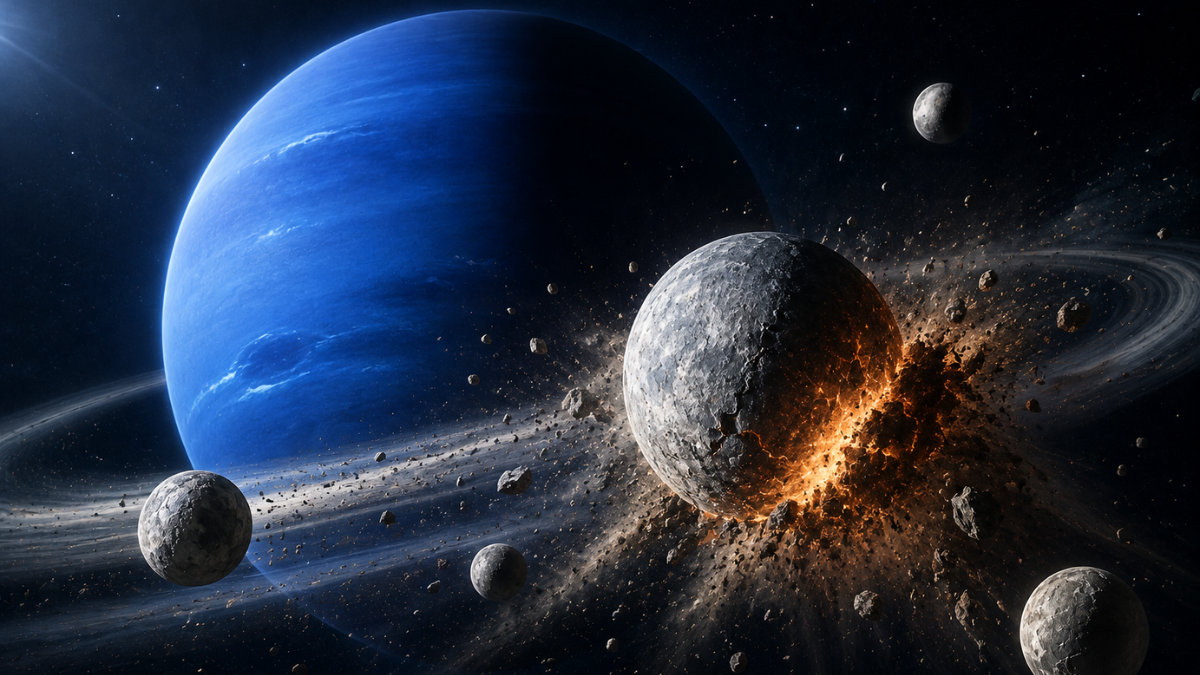
When you look at the outer solar system, you likely envision a collection of orderly, stable planetary architectures. But recent observations from the James Webb Space Telescope (JWST) reveal that Neptune’s satellite system is actually a product of profound violence. By analyzing the composition of Neptune's inner moons, Proteus, Larissa, and Galatea, researchers identified magnesium-rich clay minerals that simply shouldn't exist on such cold, small bodies. These minerals, which require liquid water and rock to form, indicate that these moons are actually re-formed debris from a cataclysmic orbital shake-up. The primary catalyst for this wreckage was the gravitational capture of Triton, a Pluto-sized interloper from the Kuiper Belt. As you consider the implications, you’ll realize this event fundamentally altered the architecture of the Neptunian system, destroying original satellites and leaving behind only a few survivors. This discovery provides you with a rare, direct look at the deep interiors of ancient worlds that were effectively turned inside out during the chaotic early history of our planetary neighborhood.
Introduction & Core News Development
You’re looking at a discovery that fundamentally shifts how you understand the history of our solar system. For decades, you might have assumed the giant planets, Jupiter, Saturn, Uranus, and Neptune, each developed through a relatively steady, orderly accretion of material into stable satellite systems. Yet, data captured by the James Webb Space Telescope has shattered that comfortable narrative for Neptune.
By focusing on the infrared signatures of Neptune's inner moons, Proteus, Larissa, and Galatea, investigators discovered the presence of hydrated clay minerals. These materials are chemically impossible to produce on these small, frozen bodies. They require sustained exposure to liquid water, heat, and rock, conditions that only exist in the deep interior of a much larger, differentiated planetary body. You're Basically, seeing the "guts" of long-dead worlds, brought to the surface by a collision event so massive that it pulverized the original moons of Neptune and allowed them to re-accrete into the smaller, dusty bodies you observe today. It's a stark reminder that what looks stable today is often built on the ruins of an ancient cosmic battlefield. And fast.
Background & Industry Context
To grasp the scale of this celestial demolition, you need to look back roughly 4.5 billion years. During this era, the giant planets weren't where they are today. They migrated, tossing around debris and reshaping the solar system's formation through relentless gravitational scattering. Within this chaotic environment, Neptune captured a massive, Pluto-sized object from the Kuiper Belt: Triton.
In the study of planetary science, you learn that most regular moons form in a disk of gas and dust orbiting their parent planet, resulting in circular, prograde orbits. Triton, but it is a massive outlier. It orbits in a retrograde direction, the opposite of Neptune’s spin. That’s your smoking gun for a captured interloper. As Triton settled into its new, highly eccentric orbit, it acted as a gravitational wrecking ball. While Jupiter and Saturn maintained their orderly families of moons, Neptune’s original, indigenous satellites were caught in a gravitational crossfire. Most were destroyed, smashed into fragments that eventually cooled and gathered into the current inner moon system.
Technical Breakdown & Architecture
When you analyze the composition of these inner moons, you've to account for the specific mineralogy identified by the research team led by Ryleigh Davis. These magnesium-rich clays are remarkably similar to those found on Ceres or within certain carbonaceous meteorites. As an engineer or student of physics, you’ll appreciate the logic: the "where" matters as much as the "what."
Because these moons are too small to maintain the internal heat required to keep water liquid for the eons needed to synthesize clay, the material couldn't have originated on the moons themselves. The only possible source is the interior of a larger, progenitor moon, a world that possessed enough mass to hold in heat and pressure. When the collision occurred, these worlds were Basically, turned inside out.
The JWST’s Near-Infrared Spectrograph (NIRSpec) and Mid-Infrared Instrument (MIRI) allowed the team to distinguish these mineral signatures from the surrounding water ice. This isn't just a surface coating; it’s an integrated part of the moons' crusts, confirming that the material was excavated from the hearts of ancient, destroyed satellites. You can think of it as a cosmic autopsy, where the physical remains of long-gone worlds are spread across the orbits of their successors.
Business Impact & Strategic Implications
While this discovery primarily serves the academic community, it holds significant implications for the future of deep-space exploration and resource identification. When you think about the future of commercial space mining or long-range robotic missions, you must consider the availability of materials in the outer solar system.
Understanding where to find water-bearing minerals, even at such great distances, is a strategic priority. This discovery confirms that cataclysmic events can act as a delivery mechanism, bringing interior, chemically complex materials to the surface of smaller, more accessible bodies. For your future enterprise, recognizing that "garbage" or "debris" in a planetary system might actually contain highly processed, water-rich minerals is a vital insight for mission planning and long-term scientific infrastructure. You don't have to land on a high-gravity world to get to the good stuff.
Industry Perspective & Ecosystem Dynamics
The scientific community views this as a vital correction to the "orderly solar system" bias. As you observe the moon mission trends today, comparing lunar soil data from current probes to the complex chemical analysis provided by JWST shows how far our instrumentation has come.
The fact that Nereid, a distant, highly elliptical moon, managed to survive this event suggests that the "demolition derby" was spatially confined to the inner regions of Neptune’s gravity well. This insight helps you construct more accurate models of how planetary systems evolve. It highlights that the "architecture" you see in a system today isn't necessarily a reflection of its birth, but rather a snapshot of its most recent major catastrophe. You can't take stability for granted. Few saw this coming.
GlobalByte Perspective
When you evaluate this architecture, you must move past the idea of the solar system as a static clockwork machine. Instead, you should view it as a graveyard of failed configurations. To me, the beauty of this discovery is that it turns these tiny, unremarkable-looking moons into high-value scientific sites.
If you were a mission planner, you would see this as a gift. You don't need to drill miles beneath a thick ice shell to reach the "deep interior" of a world; you can land on a moon like Proteus or Galatea and sample the wreckage of a world that existed billions of years ago. I believe this confirms that the "chaos" of the early solar system is actually the best curator of information we've. By destroying those worlds, nature preserved their histories in a scattered, accessible form. You should recognize that in planetary science, destruction isn't just an end; it’s a revealing process that gives you access to the materials that would otherwise remain hidden for the life of the planet.
Future Outlook & Strategic Roadmap
Next, you can expect further JWST observations to clarify the extent of this debris field. Researchers will likely look for similar signatures on other smaller bodies in the outer solar system to see if this "catastrophe" pattern is widespread. As you watch these developments, keep an eye on the interstellar space research community, as they're now beginning to apply these same spectroscopic techniques to bodies far beyond our own neighborhood. The next milestone will be a mission capable of performing flybys of these inner Neptunian moons to confirm these findings through direct, in situ analysis. It's an exciting time to be looking at the edges of our solar neighborhood.
Key points
Your understanding of Neptune has fundamentally changed. You now know that:
- The inner moons you see aren't the original satellites of Neptune but are instead "re-born" from the wreckage of a massive, ancient collision.
- The culprit was Triton, a captured Kuiper Belt object that Basically, reorganized the entire Neptunian system.
- You've a rare opportunity to study the interiors of ancient worlds because they were turned inside out by the sheer force of this impact.
- The presence of clay minerals provides definitive proof of long-term water-rock interaction that could never have happened on the current, frozen surface of these moons.
- The solar system’s history is defined by singular, violent events that dictate the current structure of everything you observe in the night sky.