Dark matter makes up 85% of all matter in the universe. And yet nobody has ever directly detected it. Not once.
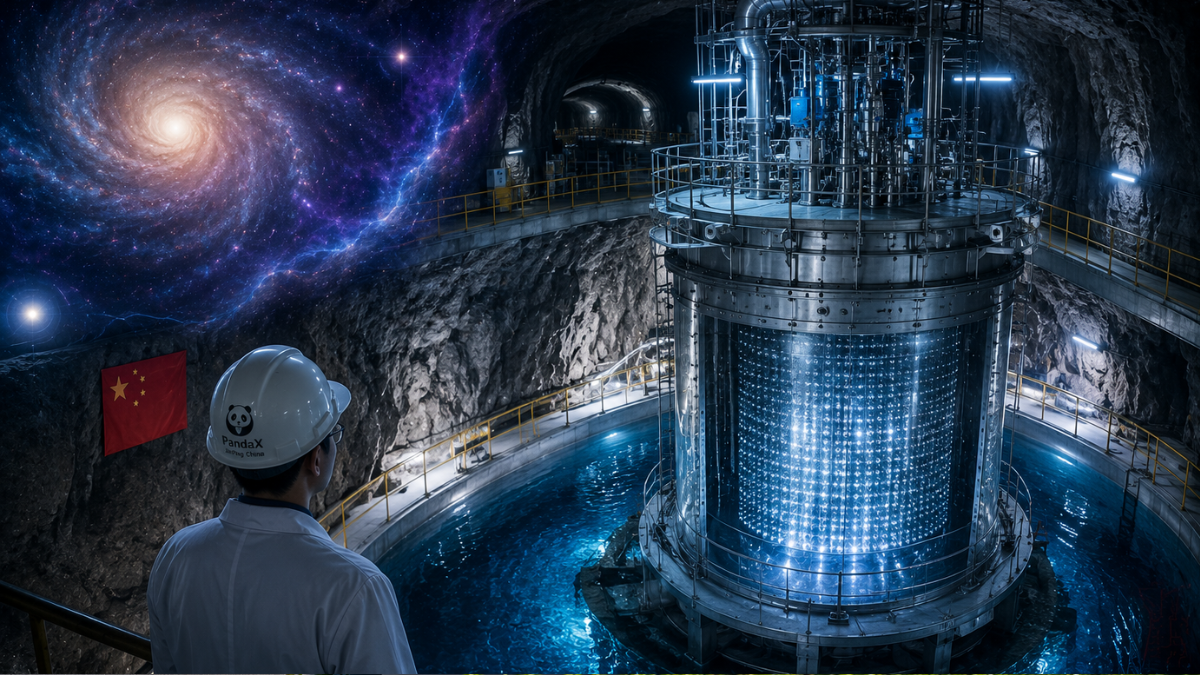
That's not for lack of trying. The PandaX dark matter laboratory liquid xenon detector at Jinping underground - buried 2,400 meters inside a Sichuan mountain - is one of humanity's most ambitious attempts to change that. Run by Shanghai Jiao Tong University since 2009, and anchored by the Tsung-Dao Lee Institute deep earth science research infrastructure, the PandaX project has spent 17 years listening for a particle that physics says must exist but refuses to show itself. After a landmark 2024 detection, the global physics community is paying very close attention.
Why Dark Matter Is So Hard to Find
Modern cosmological observations confirm that an invisible form of matter threads through every galaxy, shaping how the universe evolved from its earliest moments. It doesn't emit light. It doesn't absorb it. And it barely interacts with ordinary matter at all.
That's the core problem. You can't photograph it or catch it with a conventional sensor. The best strategy physicists have found is to go extremely deep underground, fill a tank with ultra-cold liquid xenon, and wait for the one-in-a-billion chance that a dark matter particle knocks into a xenon nucleus and produces a faint flash of light.
Sounds simple enough in principle. In practice, it requires years of engineering, enormous resources, and a willingness to work in some of the most isolated conditions on Earth. But China's frontier science programs have made this one of their defining long-term bets, and the results are starting to justify it.
The Jinping Underground Lab: Why 2,400 Meters Makes All the Difference
The Jinping Mountain deep underground laboratory isn't just China's deepest underground lab. It's the deepest in the world - sitting at 2,400 meters beneath the surface of a Sichuan mountain range, nearly 2,000 kilometers from Shanghai.
Depth is the entire point. At the surface, cosmic rays constantly rain down from space and create so much interference that detecting a rare dark matter interaction would be like trying to hear a whisper during a rocket launch. Inside Jinping, that flux is reduced to one hundred millionth of surface levels. That's not just quieter. That's a fundamentally different experimental environment, and it's why scientists explore the origins of the universe at two thousand four hundred meters depth rather than anywhere more accessible.
The surrounding rock provides natural shielding that no engineered structure could replicate at reasonable cost. It's a geological advantage that other international programs simply don't have.
The PandaX-4T Liquid Xenon Detector: Frozen Xenon and Years of Patience
The current detector - the PandaX four-ton liquid xenon dark matter detector from Shanghai Jiao Tong - holds four metric tons of xenon cooled to approximately -100 degrees Celsius. Getting xenon liquid and keeping it that way requires precision cryogenic engineering that pushes against what's technically possible. It's adjacent in spirit to the ultra-low temperature research advancing across China's physics community - different temperature range, entirely different purpose, but the same culture of demanding precision.
The xenon tank sits inside a 900-cubic-meter high-purity water shield. That water layer blocks stray neutrons and gamma radiation before they can reach the detector and trigger false signals. Simple in concept. Genuinely effective in practice. And PandaX's implementation is among the largest of its kind.
Zhou Ning, a specially appointed scholar at the Tsung-Dao Lee Institute and deputy spokesperson for the PandaX project, described fabricating and commissioning this system during a recent Xinhua "Vibrant China Research Tour." Getting everything assembled 2,400 meters underground is a logistics challenge most labs would find daunting even at the surface.
Seventeen Years, Three Detectors, Two Moments That Changed Physics
PandaX has built three generations of detectors since 2009. For most of those years, the main headline was "still nothing detected" - which is still science. Every null result narrows the theoretical parameter space and forces physicists to revise their models.
Then things shifted.
In 2021, the PandaX dark matter laboratory liquid xenon detector Jinping underground team achieved the world's strongest upper limit for detecting massive dark matter. That pushed the massive dark matter detection international sensitivity limit parameters further than any previous experiment. It eliminated a huge swath of theoretical candidates at once.
Three years later, in 2024, the experiment observed the first direct signs of coherent elastic scattering of solar neutrinos and atomic nuclei - a quantum mechanical process theorized for decades but never experimentally confirmed. The American Physical Society named it one of the top ten physics highlights of 2024. It was the only Chinese achievement on that list.
That second result matters beyond the headline. How coherent elastic scattering of solar neutrinos impacts global cosmological models is now a live research question, and it's a key reason why international particle physics teams track Shanghai Jiao Tong University PandaX data so carefully.
None of this analysis happens without serious computing resources. The team relies on world-class computing power and CAS computing infrastructure to process the enormous datasets a detector of this scale generates over multi-year experimental runs.
PandaX vs LUX-ZEPLIN vs XENONnT
PandaX isn't the only liquid xenon dark matter experiment in the field. LUX-ZEPLIN in the United States and XENONnT in Italy are serious competitors. The PandaX vs LUX-ZEPLIN vs XENONnT experimental sensitivity matrix shifts with every new publication, and all three are genuinely competitive at the current frontier.
Where PandaX has a structural edge is depth. LZ sits at approximately 1,500 meters underground. XENONnT is at roughly 1,400. That extra kilometer of rock translates directly to better cosmic ray shielding and a cleaner signal environment.
Long-term institutional support matters too. CAS-backed research programs and sovereign astrophysics infrastructure funding strategies have given PandaX the kind of stability that multi-decade physics experiments genuinely need. Seventeen years in, that's not a small advantage.
The Neutrino Problem Nobody Saw Coming
Here's what the field is now wrestling with: as detectors get more sensitive, they're running into what physicists call the "neutrino fog." Solar neutrinos - particles produced by the sun - scatter off xenon nuclei in ways that look nearly indistinguishable from a dark matter signal. The 2024 PandaX result was proof this is no longer a theoretical concern.
The astrophysical xenon detector astrophysical neutrinos detection run rate at current sensitivities means the next generation of experiments will need new strategies - ways to tell apart a neutrino scattering event from a dark matter one. That's the next research frontier, and it's driving theoretical and experimental work across the globe.
PandaX will keep running. The broader sweep of China's physics breakthroughs - including superconducting magnet records and deep-earth instrumentation - suggests the infrastructure and talent pipeline are both growing. China's parallel investments in national scientific research missions and China's space science ambitions reflect the same underlying logic: commit to the long timeline, build the right infrastructure, and trust the science.
Seventeen Years Listening for a Whisper
The PandaX dark matter laboratory liquid xenon detector at Jinping underground is still running. Still listening.
Dark matter hasn't shown itself directly. But the 2021 world sensitivity record and the 2024 solar neutrino detection are genuine milestones - results that reshaped what the field knows and where it looks next. The team at Jinping has earned its place in global physics.
If you follow China's scientific discoveries across disciplines, the pattern is consistent: sustained funding, long timelines, and a willingness to work in difficult conditions for as long as the science requires. The PandaX dark matter laboratory liquid xenon detector Jinping underground project is one of the clearest examples of that approach producing real results.
The universe's missing 85% is still out there. And the team is still looking.