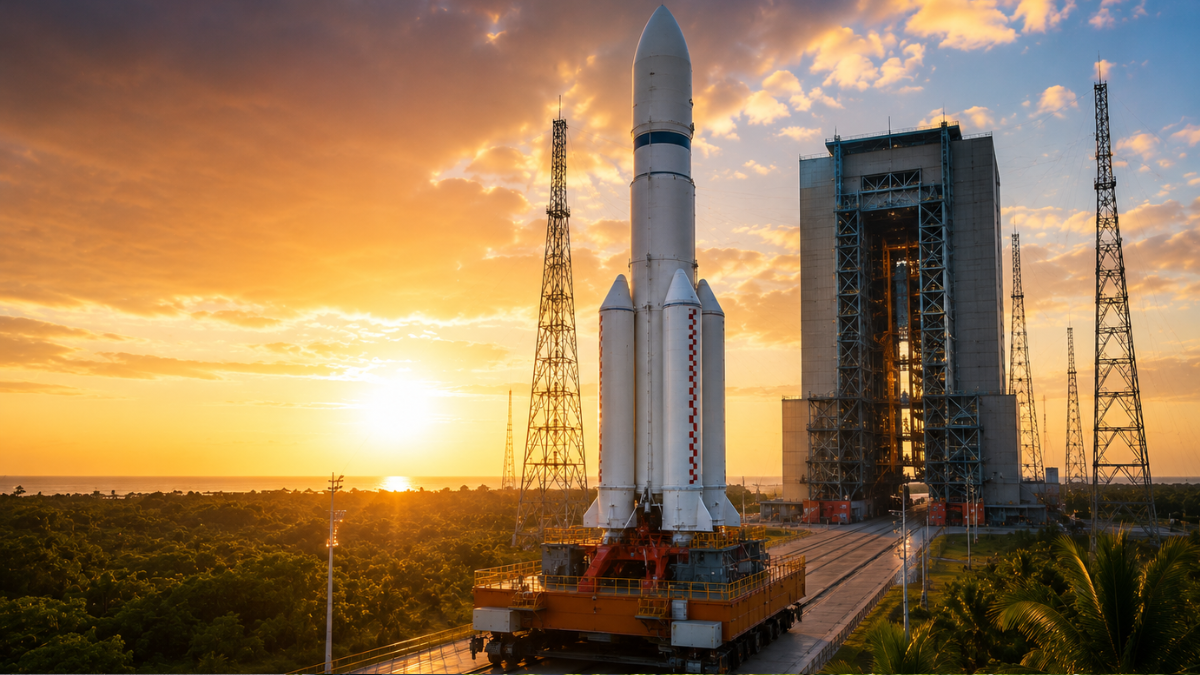
The rocket is at Wenchang. The probe arrived months ago. Now the real work begins.
On July 13, 2025, China confirmed that the Long March-5 Y14 carrier rocket had arrived at the Wenchang Spacecraft Launch Site in Hainan Province to join the Chang'e-7 lunar probe, which had been transported there back in April. The Chang’e-7 lunar probe Long March 5 rocket launch site assembly is officially underway - and a launch window in the second half of 2026 is now on the table.
If you've been tracking China's lunar program, you know this mission is a significant step up from what's come before. Chang'e-7 is targeting the lunar south pole, and it's carrying technology that hasn't been deployed on the moon by anyone, from any country, at this level of ambition.
What's Happening at Wenchang Right Now
The Long March-5 Y14 will spend the coming months going through vertical integration, avionics testing, cryogenic propellant system verification, and communications checks alongside the probe. None of that is fast. None of it should be rushed.
Wenchang is China's heaviest-capability launch facility, purpose-built for rockets in the Long March 5 class. You can see how the pattern of Long March rocket launches has evolved over recent years - the reliability data for this vehicle family is solid at this point.
The fact that the probe arrived in April and the rocket followed in July tells you something about the complexity of staging a mission like this. Launch site integration, where spacecraft and launch vehicle are brought together and tested as a combined system, is where many missions quietly discover problems. Getting this phase right matters more than most public coverage suggests.
The Technology Chang'e-7 Is Trying to Prove
Here's where this gets genuinely interesting. The Chang’e-7 lunar probe Long March 5 rocket launch site assembly is a logistics story, yes - but it's also the visible surface of a mission carrying several technology firsts.
High-precision soft landing technologies on the lunar surface are the baseline. But Chang'e-7 pushes well beyond that. The mission plans to deploy a hopping robot capable of legged movement, designed specifically to access permanently shadowed crater interiors. Wheeled rovers can't do that. The terrain is too steep, too irregular. Lunar legged movements hopping robot permanently shadowed crater access requires a fundamentally different mobility approach from anything previously deployed on the Moon.
Why does that matter? Because those permanently shadowed craters at the lunar south pole are where water ice and volatile resources are most likely preserved. They've never been exposed to sunlight. That's precisely why lunar south pole environmental and resource surveys are the mission's primary scientific objective - the data there feeds directly into long-term lunar base infrastructure planning.
For context on what China's broader scientific ambitions look like beyond the moon, China's deep space exploration agenda - including the Tianwen-2 mission - shows how far this program has scaled in terms of navigation precision and mission complexity.
Four Spacecraft, One Mission
The phrase China uses to describe Chang'e-7's approach - "orbiting, landing, roving and hopping" - isn't marketing. It's describing four physically distinct elements that have to work in coordination.
An orbiter circles above. A lander touches down at the south pole. A rover explores the surrounding surface. And the hopper, the novel element, jumps into crater terrain that nothing else can reach. This comprehensive detection approach of orbiting, landing, roving, and hopping means all four components must communicate with each other and with Earth, often across challenging geometry when the probe operates deep in lunar shadow.
That coordination challenge is enormous. It's part of why orbital computing for space missions has become such a critical research domain - processing capacity close to the source matters a lot when round-trip latency to Earth makes every decision slower.
International Cooperation and the South Pole Race
China has confirmed that Chang'e-7 will involve international cooperation - instruments and agreements tied to partners from other countries. The scientific case is straightforward: data from lunar south pole environmental surveys benefits anyone planning long-duration human presence there. International cooperation in deep space exploration moon missions has expanded significantly across multiple space agencies over the past several years.
That pattern isn't accidental. Water ice, volatile resource prospecting, and extreme cold environment data all feed directly into plans for permanent lunar infrastructure. China's space industry momentum in 2025 and 2026 makes clear this push is accelerating regardless of geopolitical complexity.
The Infrastructure Stack Underneath This Mission
Missions like this don't emerge from a vacuum. The Long March-5 Y14's reliability is built on accumulated test data, and rocket engine test milestones across China's launch sector have pushed durability and performance benchmarks considerably higher in recent development cycles.
Navigation during ascent and deep space transit now runs on precision domestic infrastructure. Beidou navigation for launch operations provides an independent backbone for mission-critical phases, removing dependency on external positioning systems during the most sensitive flight windows.
Ground-side data processing is another piece of this. Beijing's space computing center is part of the pipeline for analyzing instrument data at this scale - AI-assisted analysis of surface surveys and environmental readings from 384,000 km away is not a trivial compute problem.
On the vehicle side, the Long March 10B maiden flight demonstrated where China's next-generation heavy lift is heading, and that lineage matters when crewed lunar surface missions enter the longer-term planning horizon.
And the human capital is being built actively too. The China aerospace engineering pipeline shows how universities are feeding engineers directly into programs at exactly this level of mission complexity.
When Is the Launch?
The official window is the second half of 2026. That's intentionally broad - lunar south pole launch windows are constrained by lighting geometry, communications relay positioning, and thermal conditions at the planned landing site. Miss the window, and you wait months for the next one.
Wenchang launch site spacecraft assembly protocols in the second half of 2026 still have many steps before rollout. A late 2026 launch is realistic. Honestly, a slip into early 2027 for a mission this technically complex wouldn't be shocking either.
Watch propellant loading operations at Wenchang. When that starts, the window is close.
Where This Leaves Things
The Change 7 lunar probe Long March 5 rocket launch site assembly isn't just a news item. It's the beginning of a pre-launch integration campaign that will run most of 2026 before the vehicle ever leaves the ground.
What's being attempted here - hopping into shadowed craters, coordinating four spacecraft elements, conducting resource surveys at the lunar south pole - goes well beyond what any previous Chinese lunar mission has tried. And it sits inside a much larger picture: China's satellite network expansion, maturing computing infrastructure, a growing launch vehicle fleet, and expanding international partnerships all converge on missions like this one.
The South Pole isn't the end goal. It's where you go to find out if a permanent lunar presence is actually viable.