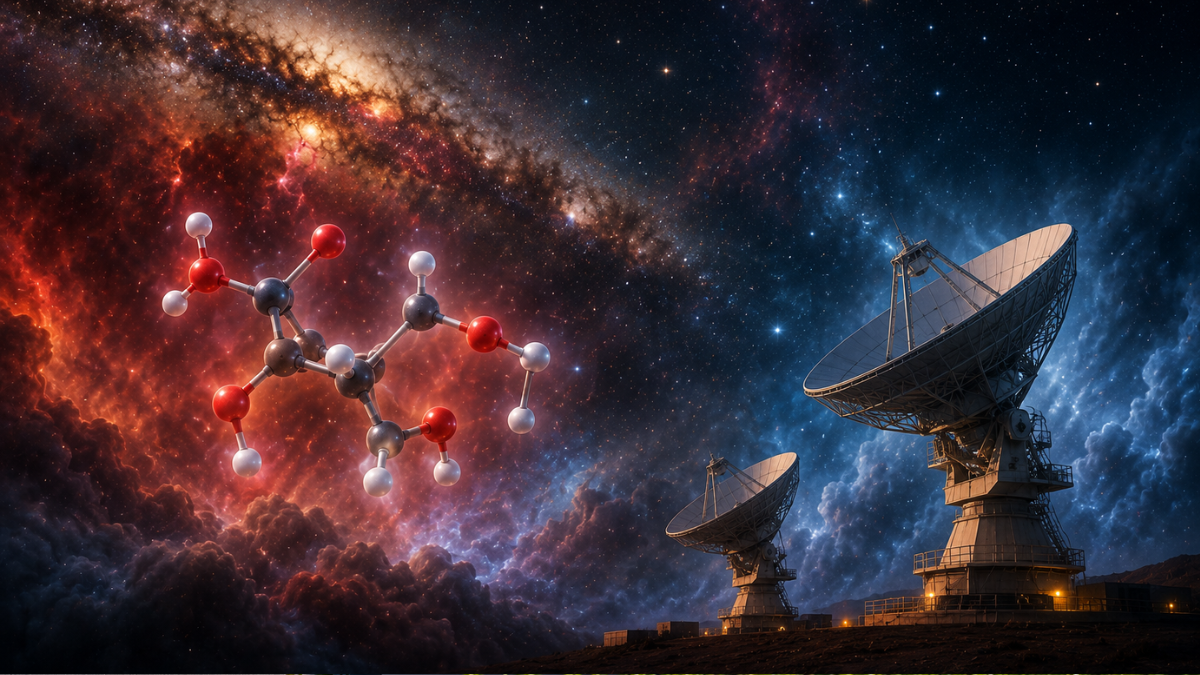
Astronomers just confirmed erythrulose sugar detected in an interstellar space molecular cloud near the center of the Milky Way - and it's the same type of sugar found in raspberries and, somewhat less poetically, self-tanning lotion. Before that sounds minor, here's the thing: sugars aren't just about sweetness. Different types power our cells, contribute to RNA structure, and act as scaffolding for biological systems. Finding a complex one floating freely through the cold, thin gas between stars raises a question scientists have been chasing for a long time - did life's core ingredients drift in from somewhere else, or were they always here?
The results were published in the journal Nature Astronomy.
What Is Erythrulose, and Why Does It Matter?
It's a four-carbon sugar. Simple in structure, but meaningful in what it implies. Erythrulose isn't directly essential to life - that's worth saying upfront - but it can convert into compounds researchers believe were critical for kick-starting biology on early Earth. That puts it firmly in the category of prebiotic chemistry precursors. A molecular stepping stone.
What stands out here is complexity. Among all the complex carbohydrate signatures spotted in interstellar gas clouds so far, erythrulose is one of the most structurally elaborate. Detecting simple molecules in space has been done. But finding something with this level of molecular architecture floating freely through a dense molecular cloud is a different category of finding entirely.
Astrophysicist Erika Hamden of the University of Arizona, who had no role in the research, called it "a pristine example of the stuff that's just floating out in the galaxy." That's a good way to put it.
How Astronomers Detected Erythrulose Sugar in the Interstellar Molecular Cloud
Two dish-shaped radio telescopes in Spain were aimed at a large, dense molecular cloud near the galactic center. Researchers collected spectroscopic data - the unique frequency fingerprints that molecules emit when excited by radiation. Then they compared those signals against controlled laboratory samples of erythrulose.
The match confirmed it.
This type of analysis generates enormous datasets, and verifying spectroscopic signals from deep space is computationally demanding. Technologies like orbital data centers in space are drawing serious attention from the science community partly for this reason - faster data infrastructure could eventually cut verification timelines for studies like this from years to months.
The molecular cloud targeted by researchers sits in a region also crossed by deep space exploration missions, including NASA's twin Voyager probes - the farthest human-made objects from Earth. Even in that vast, frigid corridor, complex organic molecules survive.
Why This Discovery Matters for Astrobiology
Scientists have been building a catalog of interesting space chemistry for decades. They've found building blocks for genetic material in the interstellar medium and gas cloud complex organic molecules record. They spotted a relative of table sugar near the Milky Way's core roughly 25 years ago. And black grains retrieved from asteroid Bennu by NASA's Osiris-Rex mission yielded other sugars, including a key DNA ingredient.
Erythrulose adds to that list. But it also shifts the frame.
Study author Izaskun Jiménez-Serra, an astrophysicist at the Center for Astrobiology in Spain, put it plainly: "The key ingredients for the origin of life could be present in other regions across the galaxy, opening the possibility for life to develop elsewhere in the universe." That's grounded in rigorous Milky Way core cosmic gas cloud spectroscopic analysis data - not speculation.
This find also fits a broader pattern of science revealing more complexity in unexpected places. Much like how scientists discovered a new species of winged cod that rewrote Triassic evolutionary history, erythrulose's detection forces a revision of assumptions about where complex molecular structures can form and persist.
Did Life's Ingredients Come From Space, or Were They Already Here?
Two competing theories address how life's raw materials ended up on Earth. One says comets and asteroids delivered organic compounds from elsewhere. The other says those compounds were already present in the gas cloud that eventually collapsed to form our solar system.
Erythrulose appearing in a molecular cloud supports the local origins side. If complex sugars form naturally in the interstellar medium, the proto-solar nebula had access to them from the start. No cosmic delivery required.
Not a settled answer. But a meaningful shift in the evidence.
Understanding how erythrulose molecule precursors actually convert into biologically relevant compounds is also relevant to lab-side research. Work on cell-free protein synthesis platform technologies is giving researchers new tools to test how space-derived precursors behave under Earth-like conditions - a necessary bridge between cosmic chemistry and actual biology.
What's Next After Erythrulose Sugar Detection in Interstellar Space
Researchers plan to keep searching. Jiménez-Serra's team wants to find more sugars across different galactic regions and trace the conversion pathways that link simple precursors to more complex, life-relevant compounds. Finding erythrulose in one molecular cloud strongly implies similar chemistry exists wherever comparable conditions do.
The observation toolkit is improving fast. Reusable rocket engine test milestones are lowering the cost of placing sensitive spectroscopy instruments into orbit, and the recent Long March rocket maiden flight demonstrated new recoverable launch capabilities that matter for future science missions. Expanding constellations like the satellites in orbit milestone reached by China's Qianfan network are gradually widening what's observable from orbit.
AI-assisted signal processing is changing the picture too. Projects like China Takes AI to orbit point toward a near future where spectroscopic datasets from deep space are matched against molecular libraries far faster than any current method allows.
Supporting infrastructure matters across the board. Nuclear fusion reactor breakthroughs influence the energy systems that power large research facilities, and atmospheric research aircraft maiden flight programs expand the options for high-altitude chemical sensing. And programs building an aerospace science and engineering school are increasingly designed around exactly this kind of multi-disciplinary challenge - training the researchers who'll do this work for the next generation.
The Galaxy Is Better Stocked Than Anyone Thought
The confirmation of erythrulose sugar detected in an interstellar space molecular cloud isn't a minor footnote in space science. It's another piece of evidence that the galaxy contains chemistry compatible with life, woven through the molecular clouds that eventually collapse into solar systems.
The chemical catalog keeps growing. Simple molecules gave way to amino acid precursors, precursors gave way to sugars, and now erythrulose sits near the top of the complexity scale, floating in open space between the stars. Honestly, the pattern is hard to ignore.
Researchers aren't done searching - and the tools they have keep improving. If you want to stay current on what's coming next across science fields, the latest science discoveries section covers breakthroughs across disciplines. Because if this erythrulose find taught us anything, it's that the universe has a habit of hiding complexity in places we weren't quite expecting to look.