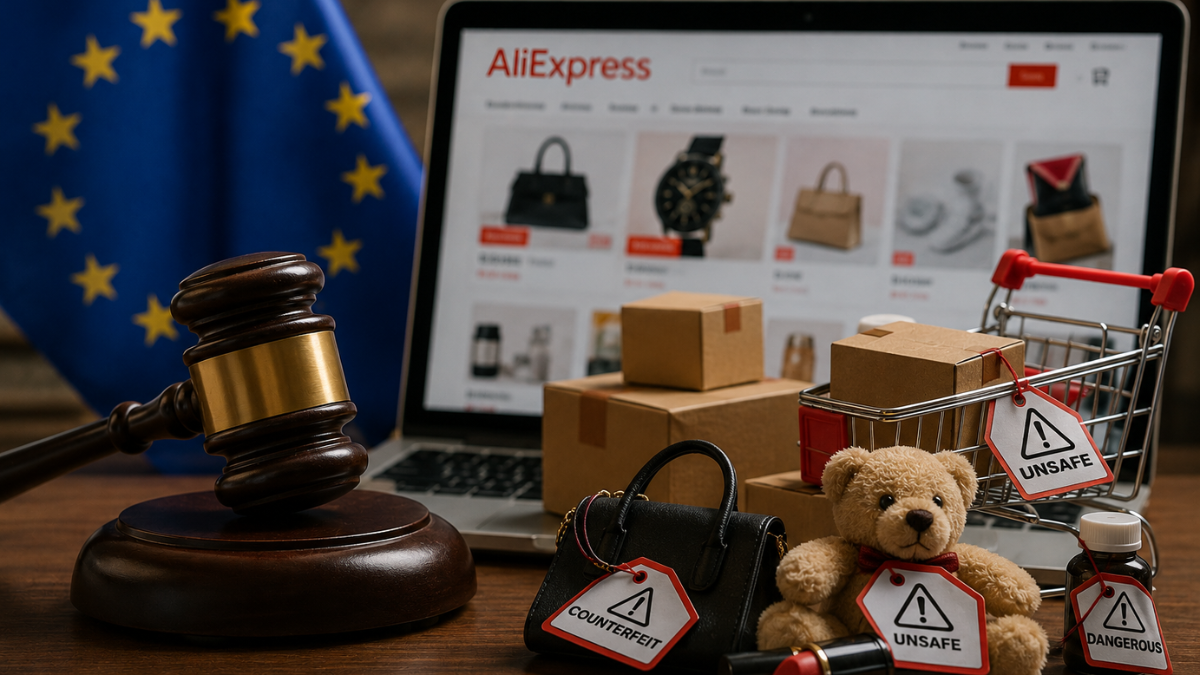
The AliExpress EU Digital Services Act record fine updates are now official. On July 20, 2026, the European Commission confirmed a €550 million ($629 million) penalty against Alibaba's AliExpress - the largest fine issued under the Digital Services Act so far. The charge: a systemic failure to stop counterfeit goods, unsafe toys, and dangerous cosmetics from reaching European shoppers.
And it might not stop there.
What Pushed the EU to Act
The Commission didn't issue this fine out of nowhere. It goes back to June last year, when regulators formally charged the platform with failing to comply with a core DSA requirement - assessing and reducing the risk of illegal product dissemination.
The finding wasn't subtle. Counterfeit goods and dangerous cosmetics stayed live on AliExpress for weeks after being flagged. Unsafe toys for children. Products that never should have been listed at all.
EU tech chief Henna Virkkunen spelled it out plainly: "This is very dangerous for consumers, unfair for companies which are complying with all our rules." She pointed directly to AliExpress's 193 million European users last year, comparing them to Shein's 156 million and Temu's 130 million. Her statement on Shein and Temu consumers was pointed: "One in five Europeans say they shop once a month from Shein, Temu and AliExpress."
That's a significant portion of the continent buying from platforms the EU now considers non-compliant. Worth sitting with that for a second.
Breaking Down the AliExpress EU Digital Services Act Record Fine
The AliExpress EU Digital Services Act record fine wasn't calculated arbitrarily. The Commission laid out exactly what it found wrong - and there's quite a list.
AliExpress hadn't properly evaluated whether it had enough staff to review risks on its platform. Its detection systems were overestimated for effectiveness. The recommender and advertising systems were making things worse, not better, by surfacing illegal listings and pushing them to more users.
Then there's this specific detail: regulators found AliExpress was relying on a single quantitative indicator to measure its entire moderation system. That's a significant limitation in enterprise risk mitigation. You can optimize for one number and still be failing across every other dimension. That's essentially what happened here.
The Alibaba 9988 HK AliExpress DSA non-compliance penalty also reflects a broken penalty policy. Businesses that had been penalized for selling illegal products kept selling illegal products. Nothing changed for them because the consequences weren't real enough.
The Brand Authorization System That Wasn't Working
This deserves its own attention. AliExpress runs a mandatory "brand authorisation" system - built specifically to stop fake products from being sold by unauthorized sellers. Sellers are supposed to prove they're licensed to list what they're selling.
The Commission's finding was direct. It didn't work.
The AliExpress brand authorization system fake products loop was real. Sellers found the system easy to work around. It was understaffed, so reviews lacked any real rigor. And because the penalty policy was weak, sellers who got caught faced limited actual consequences. Some were caught and continued operating.
For anyone tracking Alibaba's compliance landscape more broadly, this kind of gap between policy and enforcement isn't a new pattern. The harder question is whether the remediation plan AliExpress files by October 20 actually fixes the staffing and accountability failures, or just adds more paper to the framework.
AliExpress EU Digital Services Act Record Fine Updates: The October 20 Deadline
Here's where things get consequential for the company.
The AliExpress remedial measures deadline of October 20 is the platform's next real test. AliExpress must propose a credible remediation plan by that date. In December, the Commission reviews whether those measures satisfy the DSA's requirements. If they don't, further penalties follow. The DSA allows fines of up to 6% of global annual turnover - meaning the AliExpress global annual turnover six percent fine risk hasn't gone away with this ruling. It's still sitting there as leverage.
AliExpress pushed back publicly. The company called the fine "disproportionate" and said it "does not adequately reflect our established framework and the significant, proactive enhancements we have made." They're "considering all available options" - which almost certainly includes an appeal to the EU Court of Justice.
Appealing is possible. But it doesn't pause the October deadline.
Where Temu and Shein Fit In
AliExpress is the biggest headline here. It's not the only one.
Temu was fined €200 million last May for DSA violations. Shein is currently under an ongoing investigation. All three platforms - AliExpress, Temu, Shein - are classified as very large online platforms under the DSA, which comes with stricter obligations and higher penalties. The Temu vs Shein vs AliExpress EU user base framing that Virkkunen laid out wasn't accidental. Regulators are treating this as a pattern, not a series of isolated compliance failures.
The broader growth story is relevant context. The surge of Chinese goods flooding European markets brought price benefits for consumers, but it also created regulatory blind spots that are now being addressed aggressively. And broader China-EU trade consultations planned for autumn 2026 will likely touch on exactly this kind of enforcement friction - because a €550 million fine against one of China's largest cross-border platforms doesn't stay in a compliance silo. It feeds into the wider trade relationship.
Why This Fine Points to Something Larger
What you're watching with the AliExpress EU Digital Services Act record fine updates isn't just a company writing a big check. It's the EU making a structural argument about accountability.
Saying "we have systems" is no longer sufficient. Platforms have to demonstrate that those systems actually work in practice, not just on paper. And the standards for that demonstration are getting stricter across the board.
The implications are broader than one fine. For global digital platform governance, this case adds to a growing body of enforcement precedent that other jurisdictions are watching. For companies navigating international tech compliance standards, the AliExpress ruling signals that quantitative metrics alone won't satisfy regulators anymore.
Chinese tech firms facing new listing rules at home are already managing layered governance pressures. Adding DSA exposure on top creates compounded compliance challenges - especially when China's overseas regulatory obligations are also tightening.
China's open trade stance may remain consistent at the diplomatic level. But operational compliance in European markets is a different conversation entirely. The digital security infrastructure requirements that regulators now expect platforms to meet go well beyond surface-level policy documents.
And the speed of market penetration matters here. Chinese air conditioners dominating EU shelves is one example of how quickly Chinese products can reach European consumers. The regulatory apparatus responding to that pace is now running at full speed.
The Fine Is Just the Beginning
193 million European consumers interacting with a platform that couldn't reliably detect counterfeit goods. That's the core issue the EU is responding to - and the AliExpress EU Digital Services Act record fine updates represent the regulatory system drawing a hard line.
Whether AliExpress's October 20 remediation plan satisfies the Commission will tell us a lot about how seriously the company is taking this moment. The fine itself is a cost. The required changes are the real test - and the outcome will shape how every very large online platform handles compliance from here on out.
That's what makes this case worth following beyond the headline number.