Summary
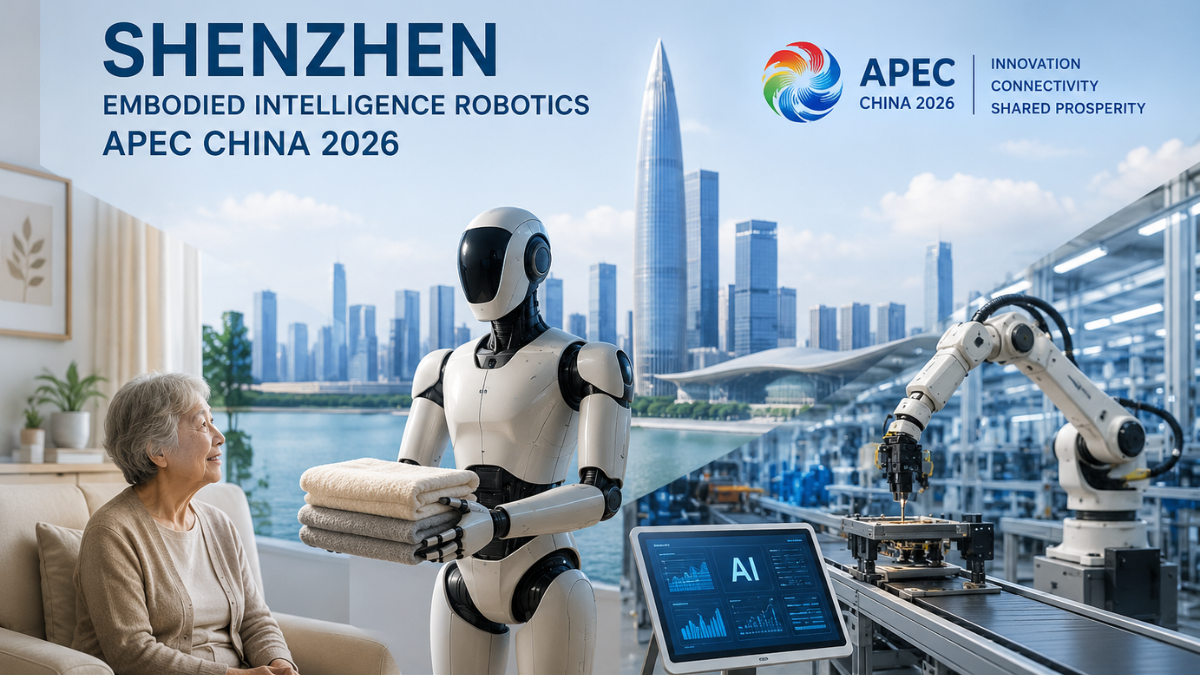
Shenzhen embodied intelligence robotics APEC China 2026 is about much more than robots that can dance on stage. The city is building machines designed to work in real homes, care settings, and factories, while its famously fast hardware ecosystem helps startups turn ideas into physical products at an unusual pace.
That matters across Asia-Pacific. Innovation is one of the three main priorities for APEC China 2026, alongside connectivity and shared prosperity, and Shenzhen offers a very visible example of what regional tech integration can look like when AI software, manufacturing capacity, and practical use cases sit close together.
Key Points
- Shenzhen's robotics push is moving beyond demonstrations, with companies developing robots for homes, elderly care, factories and other practical environments.
- The city's biggest advantage is its dense hardware supply chain, which allows startups to prototype, test and modify physical products quickly.
- "Shenzhen speed" can significantly reduce the time between developing an idea and producing a working hardware prototype.
- Fast prototyping alone is not enough. Safety, reliability, funding, component quality and real customer demand remain major challenges for robotics companies.
- The next stage of embodied intelligence depends on more than humanoid bodies. Robots need AI models, training data, computing infrastructure, dexterous hardware and repeated real-world testing.
- X Square Robots is working on robots designed for more complex tasks that require understanding of objects, environments and human instructions.
- Shenzhen's elderly-care deployments show how embodied AI can be tested in real environments where safety and human interaction matter more than impressive demonstrations.
- SmartMore's IndustryGPT illustrates another side of the ecosystem, bringing AI capabilities into industrial automation and manufacturing workflows.
- Shenzhen's model combines AI research, hardware suppliers, manufacturers, investors and end users within a relatively concentrated ecosystem.
- The city's development aligns with the APEC China 2026 priorities of innovation, connectivity and shared prosperity, particularly through regional technology integration.
- The bigger challenge for the Asia-Pacific region will be creating common standards, safety practices, data frameworks and resilient supply chains as embodied AI moves across borders.
Shenzhen speed starts with the hardware supply chain
What is "Shenzhen speed" in hardware and robotics manufacturing? It describes the city’s ability to help a founder locate components, test a design, contact suppliers, and revise a prototype with startling speed. In some cases, Shenzhen hardware prototyping supply chain 30 minutes is more than a catchy phrase. A team can often find a needed part or a production contact within that window.
That speed comes with a catch. Fast access to suppliers doesn’t guarantee a viable product. You still need reliable components, safety testing, enough capital, and a problem people will actually pay to solve.
Still, the Shenzhen speed hardware supply chain APEC 2026 story is compelling because it shortens the distance between an AI model on a screen and a robot that can move through a messy physical environment. For startups working toward embodied robot mass production, that proximity can save months of coordination.
Shenzhen embodied intelligence robotics APEC China 2026 goes beyond robot performances
You’ve probably seen viral clips of robots dancing, flipping, or copying human movement. Fun? Absolutely. But those demonstrations only reveal part of the picture.
The more difficult goal is building general purpose AI robots dexterous hands Shenzhen teams can use for tasks that change from one minute to the next. Folding clothes, clearing a table, picking up rubbish, and assisting someone with limited mobility all require perception, movement, judgment, and safe interaction.
X Square Robots is working on that harder category. Its machines pair dexterous hands with an AI system designed to understand a room, objects, and human instructions. The company’s X Square Robots World Unified Model open-source approach gives developers a foundation for teaching robots how the physical world behaves, rather than programming every action one by one.
That’s where humanoid robot data and embodied intelligence infrastructure become central. A capable robot needs far more than a polished body. It needs high-quality training data, computing resources, and repeated real-world testing.
From elderly care to everyday assistance
Embodied intelligence robots in elderly care Shenzhen projects are already moving past theory. X Square Robots has deployed robots in Shenzhen elderly-care facilities to support people with disabilities through government-backed programs.
This is not an easy environment to automate. Care settings involve narrow spaces, unpredictable movement, fragile objects, privacy concerns, and people who may need help without feeling managed by a machine.
The Shenzhen Robots in Homes project Asia Pacific has been recognised as a good practice, largely because it treats robots as assistance tools rather than novelty products. If you’re evaluating physical AI solutions, this distinction matters. A useful robot must be safe, understandable, and respectful around people. Flashy demos can wait.
The broader push also connects with a human-centered digital future, where technology is judged by whether it solves daily problems instead of simply showing off technical muscle.
SmartMore IndustryGPT gives factories an AI brain
Robots aren’t the only story. SmartMore IndustryGPT industrial AI Asia Pacific efforts focus on helping manufacturers move beyond machine vision alone.
Traditional systems can inspect an item and flag a defect. SmartMore AI agent industrial automation tools aim to go further by helping machines interpret conditions, reason through a task, and take action. Think of it as giving industrial equipment more context, not just better eyesight.
SmartMore IndustryGPT provides AI brains for over 730 Asia Pacific manufacturers and other global companies. That scale suggests industrial AI is becoming less exclusive. Smaller firms have often struggled to access advanced models, specialist teams, and expensive infrastructure. More accessible AI agents could lower that barrier, although implementation will still be messy in older factories with fragmented data.
For a wider view of robotics in manufacturing, the key question isn’t whether machines will replace every worker. It’s whether AI can reduce repetitive work, spot failures earlier, and make production decisions less reactive.
How Shenzhen embodied intelligence robotics supports APEC goals
How is Shenzhen contributing to APEC China 2026 innovation goals? By showing how an integrated local ecosystem can serve regional markets. Hardware suppliers, AI researchers, manufacturers, investors, and end users all play a role.
APEC China 2026 highlights Shenzhen supply chains as a driver for regional tech integration because the city can turn research into export-ready systems quickly. That has implications for China embodied intelligence industrial AI exports, but also for partner economies that need adaptable automation without building every part of the stack themselves.
The same pattern is visible in China’s expanding self-driving robotics partnership activity, its growing China’s robot race, and the demand signaled by the country’s AI industry growth forecast.
No city can build this future alone, though. Standards, data practices, safety rules, and supply-chain resilience need cross-border conversation. That makes global AI cooperation more than conference language.
Where this is heading
From dancing robots to general-purpose AI, Shenzhen leads an embodied intelligence shift that is becoming more practical, more commercial, and more connected to daily life.
Shenzhen embodied intelligence robotics APEC China 2026 captures that momentum. Its real advantage is not one company or one model. It’s the ability to bring hardware, industrial AI, care applications, and regional markets into the same conversation, then build something tangible from it.
GlobalByte Perspective
Shenzhen's Real Robotics Advantage Isn't the Robot, It's the Ecosystem Behind It
The most interesting thing about Shenzhen's robotics industry isn't the number of humanoid robots appearing in viral videos. It is the ecosystem that allows those machines to move from a concept on a screen to something that can actually operate in the physical world.
A robotics company needs much more than a capable AI model. It needs motors, sensors, batteries, cameras, controllers, processors, mechanical components, software and manufacturing partners. Shenzhen puts many of those pieces within remarkably close reach.
That creates an advantage that is difficult to reproduce simply by investing more money into robotics research.
A startup can experiment with a design, find components, build a prototype, test it and make changes without having to coordinate an entirely distributed supply chain. For physical AI, where hardware and software have to evolve together, that speed can be extremely valuable.
But there is an important reality check.
A robot that can dance, perform martial arts or complete a controlled demonstration is still a long way from becoming a useful household assistant or factory worker. Real environments are unpredictable. Objects move, people behave differently, lighting changes, equipment fails and tasks rarely follow a perfectly scripted sequence.
That is why Shenzhen's movement into elderly care, industrial automation and everyday assistance may ultimately be more significant than its viral robot demonstrations.
If these machines can reliably perform useful tasks around people, the technology begins to have an economic purpose rather than simply a demonstration value.
The same applies to industrial AI. SmartMore's IndustryGPT example shows that the embodied-intelligence story isn't limited to humanoid robots. AI can also make existing industrial systems more capable by helping them interpret information, identify problems, and respond to changing conditions.
The bigger opportunity is regional
For GlobalByte.News, this is where the APEC China 2026 connection becomes particularly interesting.
Shenzhen demonstrates what can happen when AI software, hardware manufacturing and real-world deployment exist within the same ecosystem. That model could have implications well beyond China, particularly for Asia-Pacific economies looking to adopt robotics without developing every part of the technology stack themselves.
However, regional integration will require more than moving robots across borders.
Safety standards, data handling, interoperability, supply-chain resilience and rules for human-robot interaction will become increasingly important as these systems move from controlled labs into homes, hospitals and factories.
Our view: Shenzhen's biggest robotics advantage may not be that it has the most impressive robot today. Its advantage is that it has created an environment where robots can be built, tested, improved and deployed quickly.
And if embodied intelligence becomes one of the defining technologies of the next decade, that ability to move quickly from AI model → hardware → real-world testing → mass production could prove far more valuable than any single robot demonstration.
GlobalByte.News takeaway: The race in embodied AI may ultimately be won not by the company with the flashiest humanoid, but by the ecosystem that can turn intelligent machines into reliable, affordable, and commercially useful products at scale.