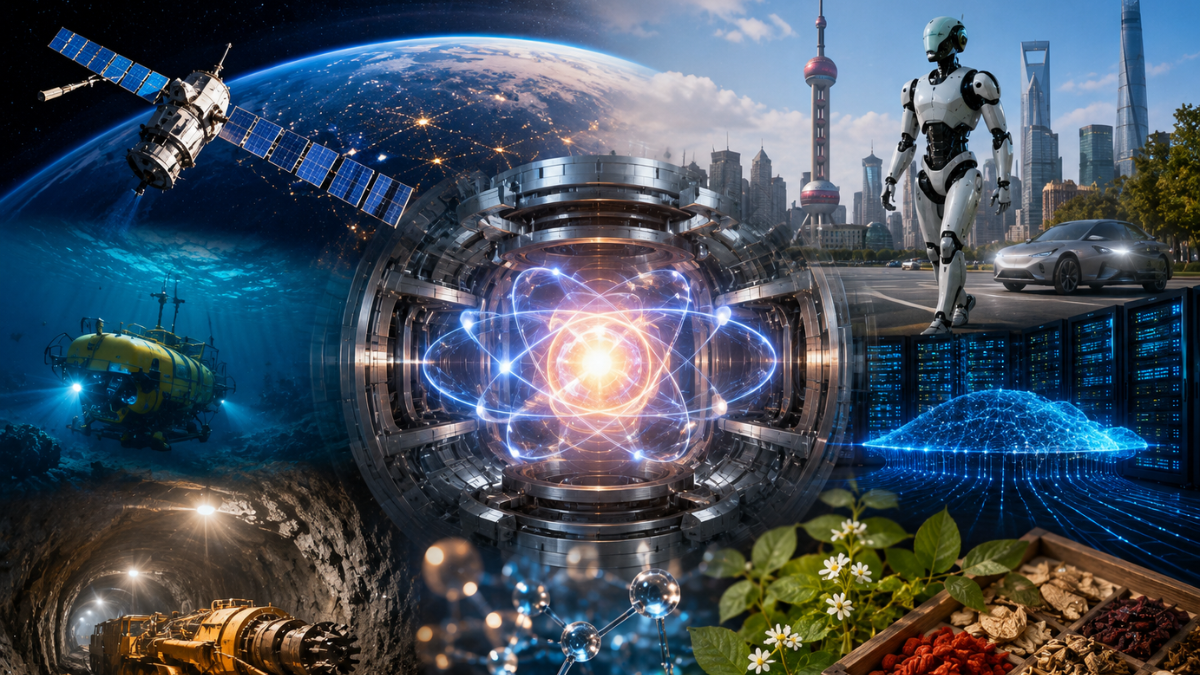
Wednesday's 28th CAST annual conference delivered a document worth understanding if you follow research funding, science policy, or China's long-term technology strategy. The China Association for Science and Technology’s major questions 2026 list names 30 challenges spanning frontier science, engineering, and industrial technology - each selected because it sits at the edge of what current research can solve and because solving it would matter at national scale.
This isn't a funding announcement. It's more upstream than that. But historically, CAST's lists have shaped where researchers and resources actually flow.
Why CAST Has Released Major Science Questions Every Year Since 2018
The China Association for Science and Technology has organized this annual collection and release of major science and technology questions since 2018. Eight years of systematically naming problems that are hard, nationally important, and underserved by current research.
The logic is that naming a problem clearly lowers the barrier for researchers to commit to it. You signal priority. You attract resources toward things stuck in the "too hard for now" category.
This year, four criteria drove selection: frontier relevance, leadership potential, innovativeness, and strategic significance. Problems that scored on all four made the cut. Interesting-but-not-strategic didn't.
Inside the China Association for Science and Technology Major Questions 2026: Frontier Science
Three entries from the frontier science category stand out.
Controlled nuclear fusion - long considered the ultimate global energy solution - has been promised as "30 years away" for decades. That framing is genuinely shifting. Research is now moving closer to achieving sustained fusion reactions, not just brief plasma containment demonstrations. China fusion reactor records from this year show real engineering milestones, not theoretical claims. Placing fusion on this list signals it's being treated as a near-term engineering challenge, not a distant aspiration.
An embodied autonomous intelligence regulation framework is next. The challenge isn't just building better robots - it's creating a unified framework that governs both self-driving vehicles and humanoid robots under one coherent approach while still accelerating deployment. Those goals genuinely pull against each other. China's global AI governance role at the international level is increasingly shaped by how these domestic framework decisions resolve. And Chinese AI companies reshaping competition globally are watching closely - because whoever solves the regulatory puzzle first also controls the deployment timeline.
Then there's the electrolyte microenvironment evolution mechanism. Chen Jun, executive vice-president of Nankai University and a Chinese Academy of Sciences academician, argues that clarifying how ions coordinate at electrode interfaces and in electrolyte bulk solutions could overturn the dilute solution systems framework that foundational electrochemistry theory has relied on for over a century. It would mean rethinking the electrical double layer at electrode surfaces from scratch. And if that holds, it reshapes how batteries, fuel cells, and electrochemical manufacturing all work from the theory level up.
That's a significant claim. But if it holds, the impact is broad.
Engineering Challenges: Deep Sea, Space, and 1,000 Meters Underground
This section of the list gets concrete fast.
Ultra deep coal mining safety technology at depths exceeding 1,000 meters is now a national priority. China's shallower coal reserves are expected to run out within 20 to 30 years. Kang Hongpu, chief scientist at China Coal Technology and Engineering Group and a member of the Chinese Academy of Engineering, described what mining at those depths actually involves: high ground stress, high geothermal temperatures, high water pressure, and intense mining disturbance from the extraction process itself. All simultaneously. None of the existing safety frameworks or equipment scales cleanly from shallower operations.
"The capability to safely and efficiently mine deep coal deposits is of great significance for the sustainable development of the coal industry, ensuring national energy security, and securing a reliable coal supply," Kang said. Coal still carries a significant portion of China's grid. The reliability gap from losing access to shallow deposits is real.
Deep-sea environmental intelligent sensing systems appear as another engineering challenge. At extreme high-pressure depths, the problems aren't just mechanical - power management, data transmission, and long-term calibration all behave differently than at the surface. Each additional kilometer of depth creates non-linear increases in engineering difficulty. It's one of those areas that sounds solved until you actually attempt it at operational scale.
Space computing rounds out the engineering tier. The specific question: what autonomous operation standards should govern large model-driven robots operating in space? The sovereign space ground computing resource network logic configurations required to support that autonomy don't exist as standardized frameworks yet. And given communication latency, real-time Earth-side oversight isn't a workable default for most space operations. State Council AI meeting priorities from earlier this year sketch where AI infrastructure policy is headed to support these kinds of systems.
The China Association for Science and Technology Major Questions 2026 for Industrial Technology
This category covers resource security bottlenecks and a few problems that rarely appear on mainstream technology priority lists.
Traditional Chinese medicine herb quality is one of them. Chen Kai, a Chinese Academy of Sciences member and professor at the CAS Shanghai Institute of Materia Medica, pointed to plant metabolic coordination mechanisms as the key lever. The problem is specific and underappreciated: pushing for maximum yield in herb cultivation often reduces the concentration of bioactive compounds that give herbs their clinical effectiveness. High-throughput plant metabolism parsing pipelines that identify which metabolic pathways control both growth and compound accumulation could break that trade-off.
"It can break the industrial dilemma of high yield but low efficacy in TCM herb production, reduce dependence on wild resources, and ensure the sustainable supply of high-quality medicinal materials," Chen Kai said.
There's an economic angle too. Standardized high-quality herb cultivation creates viable agricultural models in regions where conventional crops underperform. Research in parallel areas - including AI-assisted protein synthesis platform work pushing biological production systems forward - suggests that AI-driven optimization of complex biological processes is accelerating across multiple sectors simultaneously.
Commercial satellite intelligent manufacturing for mega constellations also makes this tier. The economics of satellite internet depend on manufacturing speed and unit cost at scale. That bottleneck isn't solved yet.
How These 30 Questions Connect to China's Broader Research Shift
None of these problems exist in isolation.
Embodied AI feeds the autonomous vehicle and robotics industries. Electrolyte research feeds battery technology and energy storage. For national energy security, deep coal mining breakthroughs are load-bearing - not optional. TCM herb research feeds both healthcare systems and rural development simultaneously. And space computing feeds the satellite infrastructure that increasingly underpins everything else.
The 2026 CAST major questions list is essentially a map of interdependencies. Solve one, and you typically unlock progress in several others.
The emphasis throughout is on disruptive technological innovation and original contributions - not incremental optimization of frameworks that already exist. China's innovation resilience blueprint treats basic research investment as structurally necessary for economic strategy, not decorative. And the China AI industry growth forecast projections depend partly on whether foundational scientific advances actually land. The China AI sector explosive growth analysts are projecting can't run indefinitely on imported scientific foundations. The way AI is empowering Chinese industries at scale actually works requires solving the upstream problems named on lists like this one.
Internationally, the China UN AI accessibility statement co-signed by 65 countries frames the expectation that foundational scientific advances should circulate as shared infrastructure - not proprietary technology alone.
Key Takeaways from the China Association for Science and Technology Major Questions 2026
The list matters because of what follows it - not just what's in it.
When CAST formally names a problem at this level of visibility, funding tends to follow. Researchers orient toward it. The 30 questions in the China Association for Science and Technology major questions 2026 release aren't just descriptions of what's currently hard - they're signals about where serious investment is headed over the next decade.
Controlled nuclear fusion shifting to engineering-challenge framing is significant. Embodied AI getting a unified regulatory-framework question signals that large-scale deployment is being treated as near-term, not eventual. Ultra deep coal mining safety at 1,000-meter-plus depths as a national priority is an honest acknowledgment of an energy constraint that becomes acute within a generation.
The electrolyte, plant metabolism, and space computing entries are the quieter ones worth watching. Five years from now, someone will point back to this list and say: that's where it started.