Summary
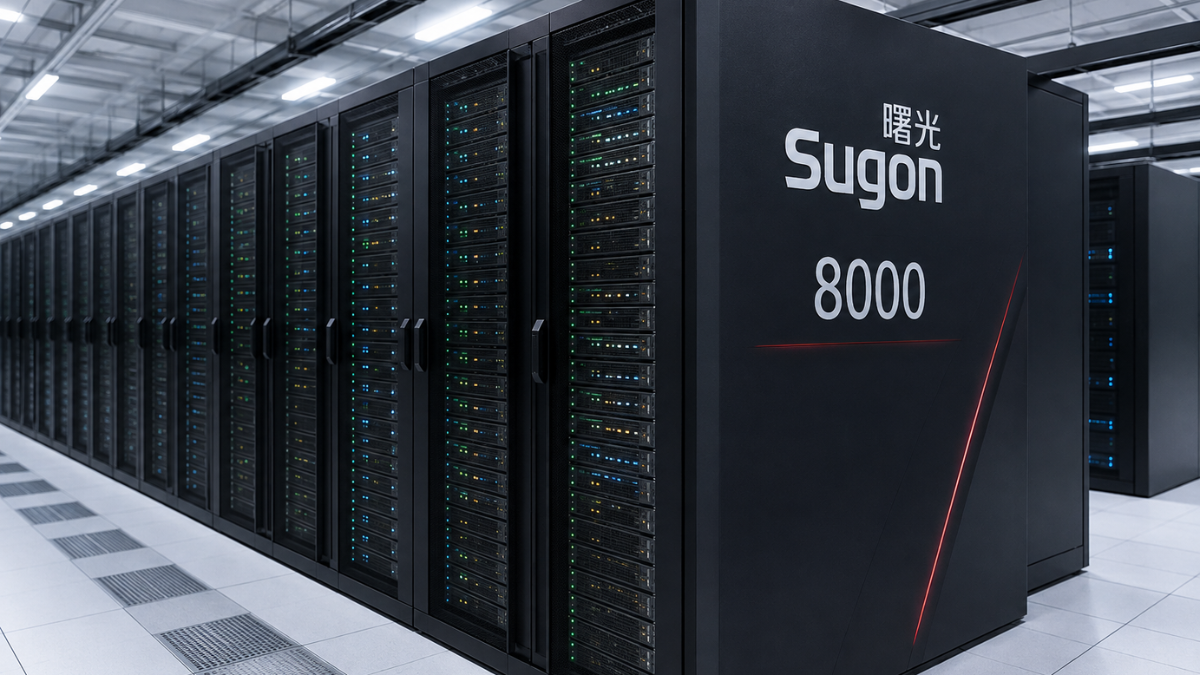
The Sugon 8000 Dengfeng 100000 card AI supercluster China has reportedly entered operation, giving the country a major new platform for AI training, scientific research, and high-performance computing. It is being described as China’s first fully domestic 100,000-card intelligent computing cluster.
That number is huge. But the story isn't only about scale.
According to reports from the Photosynthesis Organization 2026 Intelligent Computing Conference, Sugon 8000, also called Dengfeng, can support more than 300 computing tasks across 26 fields. These include new materials, drug discovery, and large-model development. For researchers facing long simulation cycles or massive training workloads, that matters more than a headline-grabbing card count.
Sugon 8000 Dengfeng 100000 card AI supercluster China reaches a new scale
The Sugon 8000 Dengfeng 100000 card AI supercluster China represents a move toward ultra-large domestic AI infrastructure. Its reported peak capacity is compared with 200 years of continuous human calculation per second, a vivid comparison rather than a standard benchmark, but one that illustrates the intended scale.
This is also being positioned as the China first domestic 100k card AI computing cluster, with hardware, networking, storage, and cooling designed to work as one system. That integration is the hard part. Adding cards is one thing; keeping 100,000 of them communicating efficiently is another.
For perspective, this development sits alongside broader efforts around China's top supercomputer and the evolving Lingcheng supercomputer architecture. Different systems may target different workloads, but all point toward the same race for usable computing capacity.
Why the cluster’s design matters
Sugon says the system uses a high-density rack structure that delivers up to 20 times the compute density of comparable supernodes per computing unit. In plain English, it aims to place far more AI capability in the same physical footprint.
The claimed Sugon high density immersion phase change liquid cooling is central to that ambition. Dense AI hardware produces punishing amounts of heat, and air cooling becomes expensive and awkward at this scale. Immersion phase-change cooling can help control temperatures while reducing the pressure on conventional cooling systems.
There is a real trade-off, though. Liquid cooling infrastructure is more specialized, and maintaining it isn't as simple as swapping a fan in a standard server. Still, for a cluster this large, conventional approaches can become the bigger headache.
The project also fits into China's wider push for a domestic supercomputing platform and more capable AI computing power infrastructure.
scaleFabric RDMA and ParaStor storage
A 100,000-card cluster is only useful if its nodes can exchange data quickly and predictably. Sugon says it uses scaleFabric IB native RDMA interconnection technology to provide high-speed links among the computing cards.
RDMA, or remote direct memory access, reduces the processing overhead involved in moving data between systems. That can make a meaningful difference for distributed large-model training, where chips repeatedly exchange gradients, parameters, and training data. The reported Domestic Chinese GPU cluster scaleFabric RDMA enables 100k card scaling claim is therefore about more than raw network speed. It is about avoiding bottlenecks before they stall the entire job.
Storage matters just as much. The ParaStor distributed storage Sugon 8000 cluster architecture is intended to keep data available across a massive environment, rather than leaving expensive compute hardware waiting for files to arrive.
This is where WAIC supernode advances, a near-memory AI chip, and Chinese 3D chip stacking become relevant. Better chips help, obviously. But system-level design decides whether those chips perform well together.
What workloads can this domestic AI cluster support?
The China 100,000 GPU equivalent AI cluster operational announcement points to practical use cases rather than a lab-only installation. Reportedly, the system already supports research tasks in:
- New-material discovery and simulation
- Innovative drug development
- Large language model training
- Scientific computing
- Industrial AI applications
A China domestic GPU compute cluster large model training environment could reduce dependence on overseas capacity for organizations that need to train or fine-tune models at scale. It may also strengthen the ecosystem around local AI suppliers.
And demand is unlikely to disappear. China's AI growth forecast points to a market that will require more data centers, more chips, and a stronger AI power supply chain.
A significant step for domestic AI capacity
The Sugon 8000 Dengfeng 100000 card AI supercluster China is significant because it combines scale with domestic system design. Its value will ultimately depend on uptime, software compatibility, real-world training performance, and how easily researchers can access it.
Still, the direction is clear enough. China builds 100k card domestic AI infrastructure for drug discovery and LLMs because AI progress now depends on entire computing systems, not just individual chips.