Summary
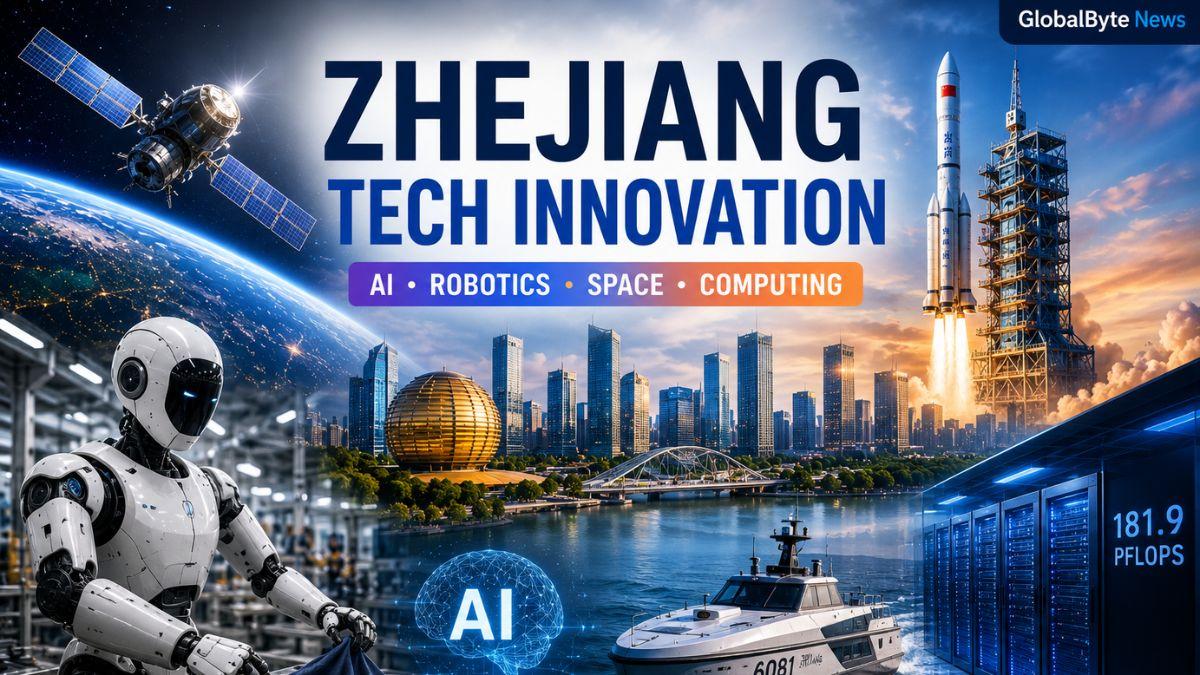
Zhejiang tech innovation breakthroughs AI robotics space computing are no longer confined to research papers or isolated demonstrations. In one province, you can find AI models operating in orbit, humanoid robots being prepared for factory deployment, autonomous vessels learning from rough-sea trials, and regional supercomputers supporting real businesses.
That range matters. It shows how Zhejiang is building a route from early research to commercial production, instead of leaving promising technology stuck in a lab.
For readers tracking Hangzhou AI innovation, Zhejiang offers a useful case study: infrastructure, talent, test environments, and manufacturers are being pushed into the same ecosystem.
Key Points
- Space AI is moving beyond experiments: Zhijiang Laboratory's Three-Body Computing Constellation has already put AI models into orbit and is exploring computing directly in space.
- Humanoid robots are getting closer to factory use: Ningbo's plan for 2,000 customized humanoid robots shows the focus is shifting from demonstrations toward production.
- Zhejiang has a strong industrial base: The province reported 713.1 billion yuan in core AI industry revenue in 2025, with a target of 1.2 trillion yuan by 2030.
- Computing infrastructure is expanding: The Wuzhen Light supercomputing center is reported to have a peak capacity of 181.9 petaflops, supporting companies and research across the Yangtze River Delta.
- Real-world testing is becoming a priority: Autonomous vessels are being tested in difficult sea conditions, while embodied AI systems are being trained for practical tasks such as cooking and logistics.
- The lab-to-market gap is the real test: Zhejiang is trying to connect universities, research labs, manufacturers, pilot platforms and customers instead of treating them as separate parts of the innovation process.
- Manufacturing gives Zhejiang an edge: Advanced technologies can be tested and refined close to the factories and industrial users that may eventually buy them.
- The risks haven't disappeared: High development costs, talent shortages, supply-chain constraints and uncertain commercial demand could still slow the transition from prototype to mass deployment.
Zhejiang tech innovation breakthroughs AI robotics space computing in orbit
Zhijiang Laboratory's Three-Body Computing Constellation is one of the clearest examples. Two new computing satellites are in stable orbit, while researchers verify space-based AI models and expand what satellite computing can do beyond communications and imaging.
The Three-Body Computing Constellation Zhijiang Laboratory space AI project has already deployed 20 artificial intelligence models in orbit. Its longer-term ambition is much bigger - a connected constellation capable of processing data in space, sharing computing tasks between satellites, and running models closer to where data is collected.
That can reduce the need to send every raw dataset back to Earth first. Useful for Earth observation, disaster response, and time-sensitive analysis.
The team reportedly completed a 12-satellite launch mission in 287 days. Fast, yes. But space systems still face ugly constraints: radiation exposure, limited power, difficult maintenance, and costly launches. That reality is why the wider space computing launch race is worth watching, along with the debate around future orbital data centers.
From humanoid robot prototypes to factory orders
At the Ningbo Humanoid Robot Innovation Center mass production workshop, robots are being tuned for flexible garment processing. The plan calls for 2,000 customized devices to enter detailed production planning.
How many customized humanoid robots is Ningbo planning to mass-produce? The stated figure is 2,000.
This isn't just a robot demo for visitors. Clothing work involves soft materials, changing shapes, repetitive motion, and quality expectations that can expose a machine's weaknesses quickly. If the systems work reliably, they could help manufacturers handle highly repetitive tasks. If they don't, downtime gets expensive fast.
You can see the local context in Ningbo intelligent technology, while Unitree's robot race shows how competitive China's humanoid sector has become.
Mass production is the hard part.
China's broader progress in embodied robot production also makes Ningbo's target more meaningful. A robot has to perform outside a controlled lab, around people, clutter, fabrics, tools, and mistakes.
Zhejiang’s tech ecosystem connects space, compute, and industry
Zhejiang scientific technological innovation breakthroughs 2026 are supported by a sizeable industrial base. The province reported 15,637 Zhejiang specialized and innovative SMEs little giant enterprises and core AI industry revenue of 713.1 billion yuan in 2025, up 20 percent year on year.
What is the revenue of Zhejiang's core artificial intelligence industry? It reached 713.1 billion yuan in 2025.
The target is even more ambitious. Zhejiang aims for 1.2 trillion yuan core AI industry revenue milestone by 2030, provided investment, adoption, and technical talent keep pace.
At the Wuzhen Light supercomputing center 181.9 petaflops Jiaxing, computing capacity reaches 181.9 petaflops. The center serves users across the Yangtze River Delta, helping make Wuzhen Light supercomputing center powers Yangtze River Delta regional tech collaborative innovation more than a slogan.
What is the computing power capacity of the Wuzhen Light supercomputing center? Its stated peak capacity is 181.9 petaflops.
That shared capacity matters for companies that need large-scale simulation or AI training but can't justify building their own systems. It also fits into China's expanding AI computing infrastructure and the push for more intelligent computing power.
Zhejiang tech innovation breakthroughs AI robotics space computing reach the production line
How is Zhejiang accelerating breakthroughs in cutting-edge tech fields? By pairing research institutions with pilot-scale testing, industrial partners, policy support, and real deployment scenarios.
That sounds dry. In practice, it means a machine-tool prototype can be stress-tested, redesigned, validated, and prepared for manufacturing without each company building an expensive test platform from scratch.
This is China cutting edge tech integration lab to production line in practical form. Zhejiang is trying to close the stubborn gap between a promising technical result and a product somebody will actually buy.
Shining 3D high precision measurement Xiaoshan Hangzhou is a useful example. Its 3D scanning equipment can capture workpiece shapes within minutes and deliver measurement accuracy up to four micrometers. High-end industrial vision hardware once depended heavily on imports. Localized equipment changes that equation, although global competition and high-end component supply remain real pressure points.
For companies following advanced AI supercomputing and AI-powered industries, Zhejiang's model is less about one headline technology and more about repeatable commercialization.
Sea trials and embodied intelligence create real-world feedback
At Zhoushan Port, the China 100-ton unmanned surface vessel USV 6081 ocean testing program completed long-distance voyage data reviews. The vessel's team is using sea-trial samples to refine autonomous control under severe conditions, including 30-degree roll scenarios.
How did China's 100-ton unmanned surface vessel 6081 perform during trials? It completed long-distance sea trials and generated data used to improve its autonomy in difficult sea states.
Meanwhile, Hangzhou High-tech Zone is developing a National Artificial Intelligence Application Pilot Base Embodied Intelligence where cooking and logistics robots can be tested in realistic environments. What role does embodied intelligence play in Hangzhou High-tech Zone? It gives AI systems a place to learn physical tasks where messy conditions, not ideal demos, decide whether the technology is useful.
And that feedback loop is crucial.
Why Zhejiang’s innovation model is attracting attention
How does Zhejiang bridge the gap between laboratory research and mass production? It builds pilot platforms, coordinates universities and industry, funds concept verification, and creates places where prototypes can fail before a commercial launch.
The province is also pulling in research institutions from Beijing and Shanghai while developing local platforms such as Zhijiang Laboratory and Yongjiang Laboratory. Zhejiang creates full-chain innovation ecosystem attracting top talent and research institutes because it combines research capacity with a deep manufacturing network.
What is the Three-Body Computing Constellation developed by Zhijiang Lab? It's a planned network of computing satellites designed to process data and run AI models in orbit.
The story isn't frictionless. Scaling hardware is capital-intensive, skilled engineers are scarce, and a successful prototype doesn't guarantee a profitable product. Still, Zhejiang accelerates cutting-edge technology breakthroughs from space computing to humanoid robotics by treating those obstacles as part of the development process.
Zhejiang tech innovation breakthroughs AI robotics space computing point to a broader shift: science policy is being judged less by announcements and more by whether research reaches factories, ports, hospitals, and infrastructure. Keep an eye on China's space industry, because the same lab-to-market race is playing out far beyond Zhejiang.
GlobalByte Perspective
Zhejiang’s real advantage may not be any single breakthrough. It is the way the province connects research with manufacturing, computing infrastructure and real-world testing. Space-based AI, humanoid robots, autonomous vessels and high-performance computing are very different technologies, but Zhejiang is building the same path for all of them: develop, test, improve and move toward commercial use.
The most interesting part is what happens after the prototype. A humanoid robot has to work around real factory conditions. An autonomous vessel has to deal with rough water. AI systems need enough computing power to become useful to businesses. Even space-based computing has to prove that processing data in orbit offers a practical advantage.
That makes Zhejiang worth watching. China has plenty of technology projects, but the harder challenge is turning them into repeatable businesses. Zhejiang's manufacturing base, research institutions and testing platforms give it a better chance of closing that gap.
There are still plenty of hurdles. Building advanced hardware is expensive, skilled engineers are limited, and a successful demonstration does not automatically create a profitable product. But if Zhejiang can keep shortening the distance between research and production, its biggest contribution may be the innovation system itself, not any single robot, satellite or supercomputer.