Summary
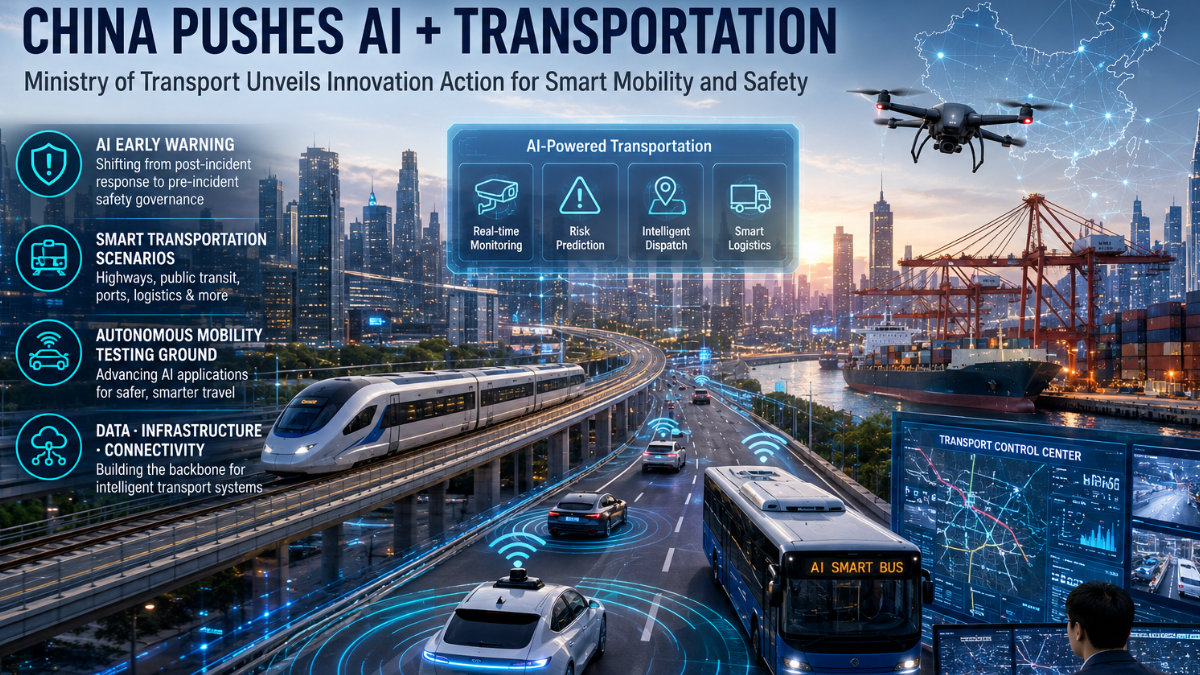
The China Ministry of Transport Artificial Intelligence plus Transportation application is moving from policy language into real transport scenarios. At a special briefing on August 20, officials outlined an innovation action focused on typical AI use cases across the national transport system.
That matters because transport is more than roads, ports, railways, and vehicles. It is a constant stream of real-world data, split-second decisions, safety risks, and economic activity. If AI works here, it has to work under pressure.
According to the Xinhua News Agency Ministry of Transport AI press release, the ministry wants deeper AI adoption across transportation. The goal is practical application, not AI for the sake of a flashy demo.
Key Points
- AI is moving into real transport operations, not just pilot demonstrations.
- Pre-incident warning is becoming a major focus for transport safety.
- Applications could cover highways, public transit, logistics, ports and emergency response.
- Autonomous transport will depend on AI + infrastructure + accurate positioning + connectivity working together.
- The biggest challenge is likely to be data integration and reliability, not simply AI capability.
- China is treating transportation as a large-scale testing ground for physical AI.
- The success of the programme will ultimately be measured by fewer risks, better efficiency and more reliable services.
Why China Ministry of Transport Artificial Intelligence plus Transportation matters
Xu Wenqiang, director of the Science and Technology Department at the Ministry of Transport, described transportation as both a main artery of the national economy and a huge real-world testing ground for AI. That description is telling.
Factories can test automation in controlled spaces. Transportation can't. A traffic signal failure, a dangerous road condition, a delayed freight route, or a poorly timed warning can affect thousands of people fast. This is why China sees transportation as a main battleground for large-scale AI deployment.
The wider China smart transportation AI integration policy 2026 is tied to a larger push to connect data, infrastructure, vehicles, and public services. For readers tracking the broader AI transportation strategy, this action gives the policy a more concrete operational focus.
Simple. AI needs places where it can prove itself.
From post-incident response to early warning
One of the clearest themes from Xu Wenqiang's comments was safety. The ministry wants AI early warning safety governance transportation China systems to shift from reacting after an accident to identifying risk before one happens.
That could include detecting hazardous driving patterns, forecasting congestion, flagging weather-related dangers, monitoring infrastructure conditions, or identifying unusual traffic behavior in real time. AI in traffic management safety pre incident early warning is not about removing human judgment. It is about giving traffic operators and transport authorities a better chance to act early.
China shifts transport safety governance to pre incident early warning using artificial intelligence because the old model has a hard limit: once an incident occurs, the damage may already be done.
Does that actually solve every safety problem? No. Bad data, uneven local deployment, privacy concerns, and false alerts are real flaws. A warning system that cries wolf too often will eventually be ignored. Still, China leverages artificial intelligence for real time early warning in transport safety systems because even a few minutes of extra visibility can make a difference.
China Ministry of Transport Artificial Intelligence plus Transportation scenarios
The China Ministry of Transport announces Artificial Intelligence plus Transportation typical application scenarios as a way to turn broad ambitions into testable projects. Instead of treating AI as one giant national program, the ministry can support use cases that fit particular networks, regions, and operational problems.
Possible areas include:
- Smart highways that monitor traffic flow, road damage, and dangerous conditions
- Public transit systems that adjust routes or capacity based on passenger demand
- Ports and freight corridors using predictive scheduling and automated inspection
- Logistics platforms that improve vehicle dispatching and cargo visibility
- Autonomous transport testing ground AI application programs for controlled trials
- Emergency coordination tools that help agencies respond faster during disruptions
The Ministry of Transport press conference highlights AI role in smart highways and traffic management, but the opportunity is broader than roads. China smart logistics intelligent transport infrastructure could connect rail, waterways, trucking, warehousing, and last-mile delivery into a more responsive network.
And that’s where the difficult work begins. Integration across separate operators, provinces, vehicle types, and data standards is rarely neat.
A testing ground for autonomous transport and smart mobility
China Ministry of Transport AI policy roadmap for autonomous driving and smart mobility will likely depend on controlled, measurable testing before applications spread further. A China autonomous transport testing ground AI application can help authorities assess how vehicles, infrastructure, mapping, communications, and safety oversight perform together.
You can see the same pressure building in China’s self-driving ecosystem and the wider automotive AI race. Autonomous mobility is not only a vehicle problem. It depends on roads, signs, communications, location services, charging access, and regulatory rules.
Accurate location data will matter too. China’s Beidou positioning network could support vehicle positioning and fleet coordination, especially where transport systems need reliable local data.
What new application scenarios could look like
What new application scenarios is China's Ministry of Transport launching for AI? The briefing focused on typical scenario innovation rather than publishing a single consumer-facing product list. That gives authorities room to test high-value applications across safety, operations, logistics, and infrastructure.
Think of a city traffic center using smart-city edge AI to process video or sensor data closer to the road. Or a freight network using predictive tools to reduce idle time at ports and warehouses. Or public transport agencies matching service levels to demand instead of relying on fixed assumptions.
China’s digital economy cities offer another useful reference point. Transport AI works best when data governance, computing capacity, communications, and public services improve together.
The infrastructure behind the policy
How China Artificial Intelligence plus action plan transforms smart logistics and public transit will depend partly on infrastructure that passengers may never notice. Sensors, 5G connections, cloud platforms, mapping systems, charging networks, and local computing all sit behind the visible service.
The AI computing infrastructure supporting these systems has to handle large volumes of real-time data. Meanwhile, the industrial internet transition shows why transport cannot be treated as separate from manufacturing and supply chains.
Electric mobility is part of the picture as well. An EV charging buildout changes travel patterns, grid demand, and fleet planning. China’s smart energy infrastructure will have a role in making those systems more coordinated.
Where this goes next
The China Ministry of Transport Artificial Intelligence plus Transportation application is best understood as a long-term deployment effort, not a single announcement. Its success will depend on whether projects reduce risk, improve reliability, and create useful results for passengers, logistics operators, and transport agencies.
How China accelerates deep integration of AI and transport to power national economy will come down to execution. Better warnings are useful. Faster logistics are useful. Smarter public transit is useful. The technology only earns its place when those benefits show up in the real world.
GlobalByte Perspective
China’s “AI + Transportation” push is interesting because it moves the conversation away from AI demonstrations and toward infrastructure that people actually depend on every day. Roads, ports, freight networks and public transit generate huge amounts of real-time data, but they also leave very little room for mistakes.
The most important shift is the move toward early warning instead of post-incident response. If AI can identify dangerous traffic patterns, road hazards, congestion or infrastructure problems early enough for operators to act, its value becomes much easier to measure.
But the difficult part won't be building another AI model. It will be connecting thousands of sensors, vehicles, transport operators and regional systems while keeping the information accurate and reliable. A false warning in a traffic system can be almost as problematic as no warning at all.
Our view: China’s transport AI strategy could become more significant than the flashy autonomous-driving demonstrations we see today. The real test will be whether these systems can quietly make transportation safer, faster and more predictable at scale.