Summary
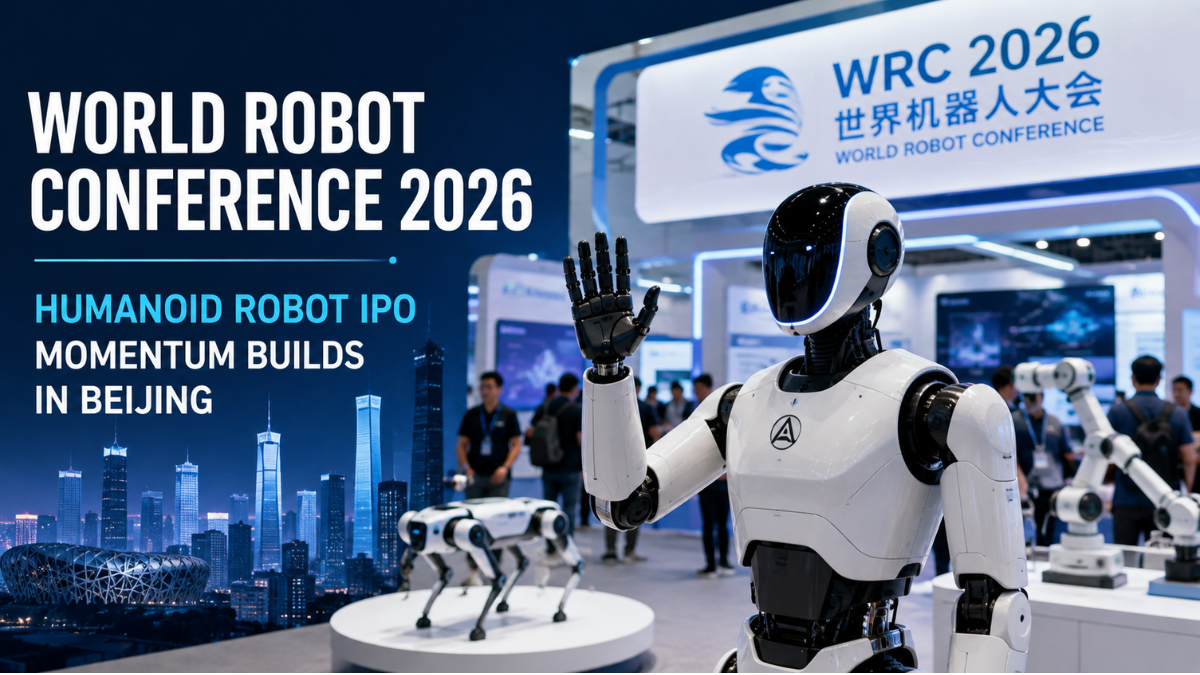
The World Robot Conference 2026 Beijing humanoid robot IPO story is bigger than a crowded exhibition hall. It is a snapshot of where China’s robotics industry is headed: toward public markets, factory floors, AI training facilities, and eventually, perhaps, everyday commercial use.
More than 300 companies gathered in Beijing to show customers and investors that humanoid robots are no longer just glossy prototypes doing choreographed demos. They are being tested for sorting, delivery, manufacturing, and data collection. Progress is real. So are the limitations.
For anyone watching automation, the World Robot Conference offered a clear message: China wants to turn its robot-making momentum into a major industrial advantage.
Key Points
- 300+ companies are participating in the Beijing conference.
- More than 2,000 robotics products are being exhibited, with 150+ new offerings.
- Unitree's Shanghai IPO debut triggered huge investor interest.
- Lumos Robotics and Chery's AiMOGA are among companies considering listings.
- Robotera says its parcel-sorting system operates at around 85% of human effectiveness.
- Global humanoid shipments reportedly reached 19,100 units in the first half of 2026.
- Some estimates suggest 50%–70% of Chinese humanoids are being used in AI data factories rather than external commercial operations.
- China's government is actively supporting robotics through industrial policy, research, standards and pilot programs.
- The robotics race is increasingly becoming part of the US-China technology competition.
- Mass adoption is still likely years away, with some narrow industrial applications expected to scale earlier.
What is happening at the World Robot Conference 2026 in Beijing?
The World Robot Conference Beijing 2026 exhibits include more than 2,000 displays and over 150 newly launched products, according to Beijing authorities. The event runs through Sunday and brings together robot makers, component suppliers, software firms, investors, and government representatives.
That scale matters. A conference can be full of concepts that never leave the booth, but this one arrives while Chinese manufacturers are actively raising capital, building production capacity, and looking for paying customers.
You could see robots designed for logistics, service work, industrial operations, and embodied AI research. Some were polished. Others still looked like engineering projects in search of a practical job.
Beijing itself is a fitting venue. The city has been building its reputation through Beijing's digital economy leadership, while Beijing's digital economy conference has also helped put its smart-tech ambitions in front of a global audience.
So, how many companies are participating in Beijing World Robot Conference? More than 300. The headline number is impressive, although the real test comes after the lights go down and orders need to be delivered.
The World Robot Conference 2026 Beijing humanoid robot IPO wave
Investor excitement was impossible to ignore. Unitree, one of China’s best-known humanoid robot makers, reportedly saw its shares rise nearly six-fold on its Shanghai trading debut after retail demand for the offering surged.
The Unitree Shanghai stock market IPO debut has become a reference point for smaller robotics companies considering their own route to public funding. You can follow the background through Unitree's STAR Market IPO, which explains why the listing carries weight beyond one company.
How did Unitree stock perform on its Shanghai trading debut? It surged almost six-fold, showing just how heated investor interest has become.
Lumos Robotics IPO stock market listing plans are also under discussion, while Chery AiMOGA Robotics IPO plans have emerged as another sign that manufacturers want access to growth capital. Public listings can fund factories, talent, supply chains, and years of product iteration. They also bring pressure. Once a company is public, a slick stage demonstration is no longer enough.
China's capital markets are changing too. China's capital-market listing rules and China's A-share AI growth provide useful context for why robotics firms see a more receptive investor base now.
Robotera's parcel-sorting machine shows the promise, and the gap
One of the more practical demonstrations came from Robotera. Its humanoid parcel-sorting robot used a torso mounted on a wheeled tripod base, an arrangement that may not look as futuristic as a walking android but makes sense for a controlled logistics setting.
The company says its system can run continuously for roughly 900 to 1,000 hours and perform at about 85% of a human worker’s effectiveness.
How effective are Robotera humanoid parcel sorting robots compared to humans? Based on the company representative’s stated figure, about 85%. That is encouraging, but it also means the robot may still need human oversight, careful task design, and a strong financial case before a warehouse replaces people at scale.
That distinction gets lost in hype. A robot that works reliably in a predictable lane is valuable. A general-purpose machine that can handle every messy exception in a real warehouse is much harder to build.
Why China humanoid robot market mass adoption is still distant
The China humanoid robot market mass adoption story has not fully arrived. Robots are already delivering food in hotels and performing selected assembly-line tasks, yet broad deployment outside pilots remains limited.
The hard problem is not making a robot move. It is making it work safely, cheaply, repeatedly, and with little intervention in environments that were designed for people.
Zhiyuan's mass-production milestone shows that output can rise quickly. But production volume and commercial usefulness are not the same thing.
How long will it take for humanoid robots to reach large scale adoption? Chery AiMOGA Robotics executive Zhang Guibing suggested the technology could need around a decade to mature before adoption accelerates. That estimate feels plausible. Costs must fall, software needs to improve, and businesses need proof that the machines can generate returns beyond a controlled pilot.
And, frankly, robots still have awkward failure modes. They can be slow, expensive to maintain, dependent on clean environments, or unable to recover when something unexpected happens.
Global shipments are rising, but data factories tell a different story
Smart Analytics Global humanoid robot shipments data shows global shipments nearly quadrupled to 19,100 units in the first half of 2026, with Chinese manufacturers leading the market.
How many humanoid robots were shipped globally in the first half of 2026? About 19,100 units.
That sounds like a commercial breakout. It isn't quite that simple.
Analyst Georg Stieler estimates that 50% to 70% of Chinese humanoid robots made this year may be deployed in Chinese humanoid robot data factory training operations. In those facilities, robots collect the physical-world data needed to train AI systems rather than completing revenue-generating work for external customers.
Why are Chinese robot makers building data factories for AI training? Humanoid AI needs large amounts of real interaction data: gripping, walking, sorting, opening, carrying, failing, and trying again. Simulations help, but physical data teaches systems about friction, object variation, timing, and all the irritating little things that make the real world difficult.
This is a sensible investment in future capability. Still, it means shipment figures alone can exaggerate the level of current customer adoption.
If you want the broader commercial angle, physical AI solutions offer a useful view of where businesses may find value first.
China’s robot boom looks a lot like its EV expansion
How does China's robotics expansion compare to its electric vehicle boom? The pattern is familiar: many entrants arrive fast, competition intensifies, prices come under pressure, and a smaller group of leaders may eventually emerge stronger.
Zhang Guibing described the flood of new companies as a positive force because it pushes firms to improve their technology and capabilities. He has a point. Competition can speed up component development, manufacturing know-how, and product iteration.
But the China robotics boom mirrors EV market growth in another, less comfortable way. Not every company will survive. Cost competition can improve affordability for customers while putting margins under severe strain for manufacturers.
The sector will likely produce winners, failures, mergers, and a fair bit of overpromising. That is how fast industrial markets tend to behave.
US China AI robotics technological rivalry is getting more physical
The US China AI robotics technological rivalry is moving beyond chips and language models into factory automation, humanoid hardware, sensors, actuators, and the data required to train machines in physical spaces.
China has clear strengths in manufacturing scale and supply-chain depth. The United States remains influential in advanced AI research, software, chip design, and venture-backed robotics development. Neither side has a guaranteed lead.
Government support also matters. The China Ministry of Industry and Information Technology robotics policy direction was reinforced when Vice Minister Xin Guobin described robotics as an important force in economic and social development and pledged continuing support.
What role does China's government play in supporting the robotics sector? It helps set industrial priorities, supports research and adoption, shapes standards, and creates a policy environment that encourages investment. China’s humanoid identification framework, including China's humanoid robot ID rule, is one example of how regulation is becoming part of the market’s next phase.
The race is not only about who builds the most human-looking robot. It is about who can build useful machines at scale.
What to watch after the Beijing show
The World Robot Conference 2026 Beijing humanoid robot IPO momentum will be easier to judge by a few practical signals:
- Repeat orders from logistics, manufacturing, and service customers
- Lower hardware costs without major reliability losses
- Evidence that robots are leaving data factories for paid work
- New listings from Lumos Robotics, Chery AiMOGA, and other startups
- Better safety, identification, and deployment standards
- Partnerships with major manufacturers, including signals such as Samsung's humanoid manufacturing signal
Consumer-facing use cases are worth watching too. A machine like KAIST's self-dressing robot points toward assistance applications that could matter far beyond warehouses, especially in care settings.
The Beijing conference showed progress, not a finished market
The World Robot Conference 2026 Beijing humanoid robot IPO narrative is exciting because it combines technical ambition with real industrial momentum. China’s makers are building more machines, attracting more capital, and competing harder than ever.
Yet mass adoption will depend on boring things: reliability, cost, integration, safety, and measurable productivity. The companies that solve those problems will matter far more than the ones that put on the flashiest demonstration.
For now, Beijing has made one thing clear. Humanoid robotics is becoming a serious business race, even if the finish line is still years away.
GlobalByte Perspective
The World Robot Conference 2026 shows that China’s humanoid robot industry is moving beyond flashy demonstrations. With more than 300 companies and over 2,000 products on display, the bigger story is the push toward manufacturing, real-world testing and public-market investment.
Unitree’s strong Shanghai debut has added another layer to that story. Investors are clearly interested, but a hot IPO does not prove that humanoid robots are already a mature business. Companies still have to show that their robots can work reliably, save money and attract repeat customers.
The data-factory trend is also worth watching. A large share of Chinese humanoid robots may currently be used to collect physical training data rather than perform commercial work. That could help improve embodied AI, but shipment numbers alone shouldn't be treated as proof of mass adoption.
GlobalByte Perspective: China has clearly built momentum in humanoid robotics, but the next phase will be about proving usefulness rather than showing off. The companies that win may be the ones with reliable robots, lower operating costs and real customers, not simply the most impressive-looking machines.