Summary
The Lumos Robotics IPO, fresh funding and industrial factory robots story is becoming more interesting for a simple reason: the company is trying to move the conversation around robotics away from impressive demonstrations and toward something much harder to fake, whether robots can actually make factories more efficient.
Lumos Robotics, founded in Shenzhen in 2024, is considering another fundraising round and plans to start preparing for a possible stock-market listing next year, according to founder and CEO Yu Chao. The company says it has raised about 1 billion yuan, or roughly $147 million, across seven funding rounds. Mitsubishi Electric is its largest outside shareholder and is working with Lumos on robotics solutions for manufacturing.
That combination matters.
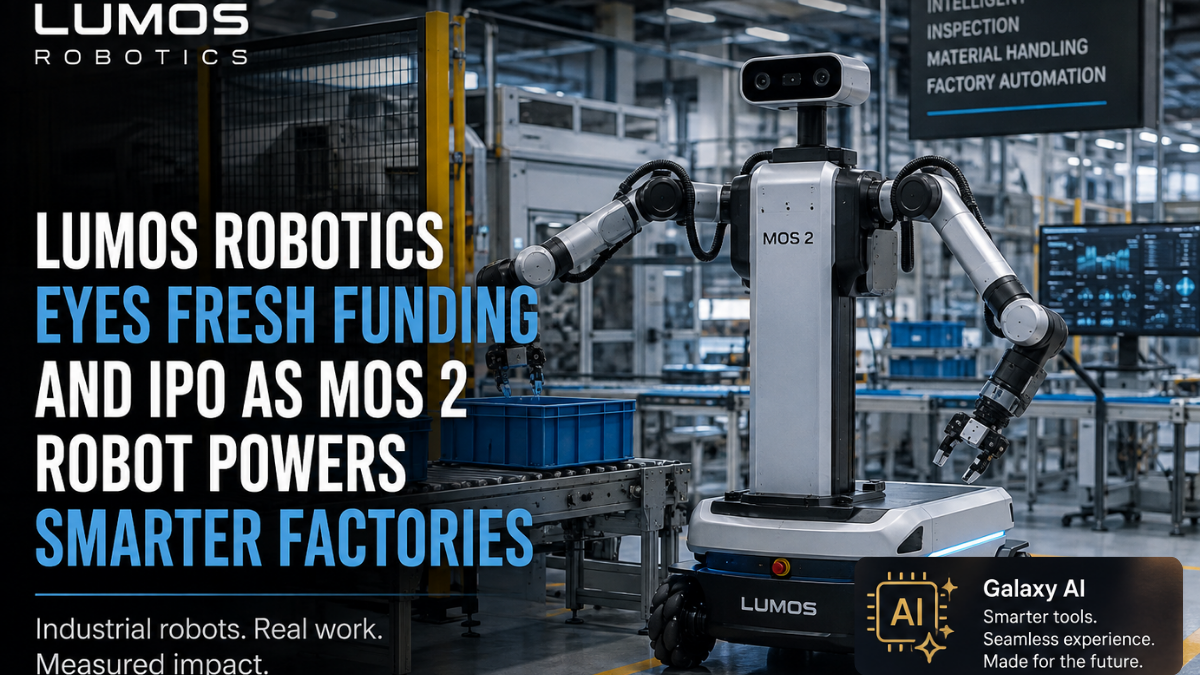
Lumos does build bipedal robots, but its commercial focus is currently much more practical. The company is putting significant attention behind MOS 2, a wheeled dual-arm robot designed for industrial work such as quality inspection and material handling. Lumos describes the machine as a heavy-duty mobile manipulation platform with a 50kg maximum dual-arm payload, 275 TOPS of edge computing and hot-swappable batteries.
It is not the kind of robot that will necessarily dominate social media.
Inside a factory, that may not matter.
Key Points
- Lumos Robotics is preparing for a potential IPO as it looks to raise more capital for industrial robot deployments, AI models and hardware development.
- The company has reportedly raised around 1 billion yuan across seven funding rounds, with Mitsubishi Electric among its key strategic investors.
- Its MOS 2 wheeled dual-arm robot is focused on factory tasks such as inspection and material handling rather than simply showcasing humanoid capabilities.
- Lumos says it has already accumulated around 700,000 hours of robotics data, which could become an important advantage for training embodied-AI systems.
- The company has deployed around 30 MOS robots and is targeting roughly 300 deliveries this year, according to figures reported by GlobalByte.
- Mitsubishi Electric's partnership gives Lumos access to established industrial automation expertise and potential manufacturing customers.
- Lumos is also working with JD on product development, sales, delivery and international expansion.
- The company plans to expand into Europe and the Middle East, with Japan and South Korea also being considered.
- Lumos says its Prime R0 model recently ranked highly on the MolmoSpaces embodied-AI benchmark, although real factory performance remains the more important test.
- The biggest challenge is no longer proving that robots can perform demonstrations. Lumos needs to prove that factories will repeatedly pay for them.
Why Lumos Robotics is considering an IPO
The Lumos Robotics IPO fresh funding plan comes at a time when China's robotics industry is moving into a more demanding phase.
For several years, much of the attention around humanoid and embodied AI focused on what robots could demonstrate. Running, jumping, climbing stairs and performing choreographed tasks made for great videos. But factories have never really cared about any of that on its own.
They care about uptime.
They care about output.
And, eventually, they care about whether the robot costs less to operate than the problem it is replacing.
That is the direction Lumos appears to be taking. Yu Chao told GlobalByte that additional funding would primarily support industrial deployments, hardware development and AI models, including computing infrastructure. The company plans to begin moving toward a possible listing next year.
An IPO could give Lumos more money to scale those efforts, but it would also raise the standard by which the company is judged. Investors will eventually want evidence that deployments can turn into repeat orders and predictable revenue rather than remaining expensive pilot projects.
That is where Lumos' industrial strategy becomes more important than the IPO headline itself.
MOS 2 is a different kind of robotics bet
The Lumos MOS 2 factory robot is deliberately different from the humanoids that dominate most robotics headlines.
Instead of putting two legs underneath a human-shaped body, Lumos uses an omnidirectional wheeled base with two arms. The company's specifications list a 30kg rated dual-arm payload and a maximum payload of 50kg, along with 3D LiDAR, force sensors, cameras and up to eight hours of stated runtime depending on configuration.
That design makes sense for a factory.
Factories already have floors designed for machines with wheels. There is no obvious requirement for a robot to walk like a person when the job involves moving between workstations, inspecting equipment or handling materials.
Lumos also says MOS 2 can support different end effectors, graphical task orchestration, remote teleoperation and local AI inference. In other words, the company is trying to make the platform flexible enough to handle more than one type of industrial workflow over time.
That could become important as customers become less interested in buying a robot for one isolated demonstration and more interested in getting several jobs out of the same machine.
Mitsubishi Electric's involvement is more important than it looks
The Mitsubishi Electric Lumos Robotics partnership may be one of the strongest signals that Lumos is serious about industrial deployment.
In March 2026, Mitsubishi Electric announced that it had invested in Lumos through its Chinese manufacturing technology group and would collaborate with the company on humanoid-robot solutions for the Chinese manufacturing market. Mitsubishi specifically linked the partnership to the development of unmanned factories and the challenge of labor shortages.
That gives Lumos something many young robotics companies don't have: a relationship with an established industrial automation company.
It also gives Mitsubishi a way to work with newer embodied-AI technology without having to build the entire robotics stack internally.
The relationship therefore works both ways.
Lumos gets industrial expertise, customer access and credibility. Mitsubishi gets exposure to a younger robotics platform that could become useful as factories move beyond traditional fixed automation.
That is a much more meaningful relationship than simply having a large company appear on a startup's investor list.
Lumos has already moved beyond the laboratory
According to Yu Chao, Lumos has deployed around 30 MOS robots in inspection and material-handling applications, with about five more deployments expected shortly. More than 10 additional customers are at different stages of deployment or proof-of-concept testing.
The company has also shipped dozens of MOS robots domestically and expects to deliver around 50 more over the following month, with a target of roughly 300 deliveries this year. These figures were provided by Lumos.
Three hundred robots is not mass adoption.
But it is enough to start generating something far more valuable than a showroom demonstration: operating experience.
Every deployment exposes the system to different layouts, objects, lighting conditions, production processes and unexpected situations. That experience becomes especially useful if Lumos can feed it back into its AI models.
And that leads to one of the more interesting parts of the company's strategy.
The 700,000-hour data advantage
Lumos says it has accumulated around 700,000 hours of robotics data from deployed machines.
That number deserves attention because data could become one of the biggest competitive advantages in embodied AI. Software companies can train models on huge amounts of digital information relatively quickly. Robots have a much harder problem because their training data comes from the physical world, where collecting useful examples takes time, hardware and real deployments.
Lumos says it is using information from deployed robots to train new skills and shorten development cycles.
If the company can keep increasing deployments, the strategy creates a potentially useful feedback loop: more robots create more real-world data, more data improves the models, and better models make the robots easier to deploy.
That sounds simple.
It isn't.
The data has to be useful, properly collected and connected to actual improvements in robot performance. But if Lumos can make that loop work at scale, it could become considerably more valuable than simply selling hardware.
The company says its robots can reduce factory costs
One of Lumos' more interesting claims comes from an inspection project developed with Mitsubishi Electric.
Yu Chao said Lumos reduced the cost of the solution to below 350,000 yuan, compared with an estimated 500,000 yuan to 1 million yuan for previous solutions, while achieving a cycle time comparable to a human worker.
The numbers underline why Lumos is attracting attention from industrial customers, although the final economics will depend on how consistently the robots can deliver similar results across different factory environments.
Still, the economics explain exactly how Lumos wants customers to think about its robots.
The question isn't whether the machine looks impressive.
The question is whether a factory can spend less money, maintain similar output and reduce dependence on difficult-to-fill labor positions.
That is the calculation that could ultimately determine whether industrial embodied AI becomes a real market.
One task today, multiple tasks later
For now, commercially deployed MOS robots generally perform specific tasks rather than jumping between completely different jobs.
That is not necessarily a weakness.
Industrial automation has traditionally worked precisely because machines are designed around predictable processes. The challenge comes when companies want one machine to handle several different jobs without needing extensive reprogramming every time.
Lumos has demonstrated multi-task operation internally, and Yu Chao expects robots capable of reliably handling multiple industrial tasks at scale within roughly two to three years.
If that timeline proves accurate, the economics of factory robotics could change.
A robot that performs one job for an entire shift has value.
A robot that can inspect equipment in the morning, move materials later and switch to another production task when demand changes has a different kind of value.
But getting there requires better perception, manipulation, planning and reliability. That is exactly why Lumos is putting so much emphasis on data and embodied-AI models.
Lumos is building more than just robots
Another part of the company that is easy to overlook is its broader embodied-AI ecosystem.
Lumos' current portfolio includes general-purpose humanoids such as LUS 2 and NIX S3, industrial platforms including MOS 2, Touch R1 and LUD, data-collection systems such as FastUMI and Ego, and its own motor technology. The company also operates a data marketplace.
That suggests Lumos isn't thinking of itself purely as a robot manufacturer.
It is trying to control several layers of the stack: hardware, data collection, models, industrial applications and the infrastructure required to train and deploy embodied AI.
That could give the company more ways to make money if the industry grows.
It could also make the business significantly more complicated.
Building robots is already difficult. Building the tools that train them, deploying them into factories and maintaining the entire system is another challenge altogether.
JD partnership could help with commercial scale
Lumos has also expanded its commercial ecosystem through a strategic partnership with JD.
The companies announced the agreement in July 2026, saying they would work together across robot-product innovation, industrial solutions, marketing, sales, delivery and global expansion.
That is important because industrial robotics does not scale simply by manufacturing more units.
A customer needs installation.
The robot has to work with existing equipment.
Employees may need training.
Software needs updates.
Maintenance and spare parts need to be available.
And someone has to provide support when the machine inevitably encounters a situation that wasn't covered during testing.
A partner with an established logistics and commercial network could therefore be useful as Lumos tries to move beyond early industrial customers.
Lumos is preparing for overseas expansion
The Lumos Robotics overseas expansion Europe Middle East plan is another part of the company's next phase.
Yu Chao told GlobalByte that Lumos intends to make a larger overseas push next year, initially looking at Europe and the Middle East, with Japan and South Korea also under consideration.
Those markets offer obvious opportunities.
Europe has a large manufacturing base and growing interest in automation. Japan has decades of experience with industrial robotics and long-standing labor challenges. The Middle East is investing heavily in advanced industrial technology.
But exporting robots is not the same as exporting consumer electronics.
A machine operating in a Chinese factory may need changes for another country's safety requirements, factory systems, connectivity standards and working environment. Lumos will also need local service teams and partners capable of handling installations and maintenance.
That could become one of the company's biggest expenses as it expands.
A new benchmark result adds another piece to the story
Lumos has also been pushing its AI capabilities.
In June 2026, the company announced that its Prime R0 model ranked first on the MolmoSpaces zero-shot embodied benchmark, particularly in single-arm fine manipulation and dual-arm coordination. Lumos presented the result as evidence of progress toward more general industrial robot capabilities.
It is an interesting technical milestone, but it should be kept in perspective.
A benchmark can show that a model performs well under a defined test.
A factory is much less predictable.
The real test remains whether that model can help a robot perform useful tasks reliably, repeatedly and safely in production environments.
That distinction is going to matter more as the robotics market becomes crowded.
China's robotics industry is entering a different phase
Lumos' strategy also fits a wider shift happening across China's robotics industry.
At the 2026 World Robot Conference in Beijing, more than 300 companies were showcasing over 2,000 robotic exhibits, according to GlobalByte. But the focus is increasingly moving toward practical applications such as manufacturing, logistics and other commercial tasks rather than demonstrations alone.
That change is important.
China has become one of the most aggressive markets for humanoid and embodied AI development, but the number of companies entering the field also means investors and customers have more choices.
Eventually, the market has to separate companies that can build robots from companies that can build robotics businesses.
Lumos is clearly trying to position itself in the second category.
The biggest risk isn't whether Lumos can raise money
Lumos has already attracted significant capital, including backing from Mitsubishi Electric, and it has begun putting robots into real industrial environments. The company also has a growing product portfolio and plans for overseas expansion.
The harder question is whether all of those pieces can produce a sustainable business.
Industrial robotics can have long sales cycles. A proof-of-concept does not automatically become a large order. A robot that performs well in one factory may require substantial customization in another. And overseas expansion can increase costs long before it generates meaningful revenue.
Competition is another problem.
China's embodied-AI sector is becoming increasingly crowded, with companies racing to develop humanoids, industrial robots and the software needed to operate them. The companies that survive won't necessarily be the ones with the biggest funding rounds or the most impressive demonstrations.
They will be the ones that customers keep buying from.
What the potential IPO really tells us
The Lumos Robotics IPO is interesting, but it shouldn't be interpreted as proof that the company has already won anything.
If Lumos moves toward a public listing next year, investors will have a chance to examine its deployments, revenue, margins, customer concentration and spending much more closely.
That could actually be healthy for the company.
The robotics industry has spent a lot of time talking about what embodied AI could become. Public markets eventually force companies to explain what the technology is doing today.
For Lumos, that means the story will increasingly move from prototypes to economics.
How much does each robot cost?
How long does deployment take?
How much does the customer save?
How often does the robot fail?
How quickly can Lumos train it for another task?
And most importantly, does the customer order another one?
Those are not exciting questions for a product launch.
They are extremely important questions for a robotics company.
Final Thoughts on Lumos Robotics IPO and Factory Robot Strategy
The Lumos Robotics IPO, fresh funding and industrial factory robots story is ultimately about a much bigger change in the robotics market.
Lumos isn't abandoning humanoids. It is simply putting more commercial weight behind machines that can address specific factory problems today. Its MOS 2 platform, Mitsubishi Electric partnership, reported 700,000 hours of robotics data, planned overseas expansion and growing industrial customer base give it several pieces of a potentially strong business.
But none of those things guarantee success.
The next stage will be about reliability, economics and scale.
If Lumos can turn factory deployments into repeat orders and use the resulting data to make its robots better and cheaper to deploy, the company could become one of the more interesting players in China's embodied-AI market.
If it cannot, the IPO will only highlight the same problem facing much of the industry: impressive robots are relatively easy to demonstrate, but building a profitable robotics business is considerably harder.
GlobalByte Perspective
The most important part of Lumos' story isn't the possible IPO. It is the company's decision to compete where robots have to prove their value every single day.
A humanoid robot can attract attention for a few minutes at a conference. A factory robot has to keep working after everyone has gone home.
That is where China's robotics race is heading now. Less spectacle, more deployment. Less focus on what a robot can demonstrate, and more focus on what it can reliably deliver.
For Lumos, the real milestone won't be the day its shares eventually reach the market.
It will be the point when factories start ordering its robots because they cannot afford not to have them.
GlobalByte Take: The robotics race is moving from “Who has the most impressive robot?” to “Who can build a robot that businesses will keep paying for?” Lumos is betting that industrial reliability, data and cost efficiency will decide the answer.