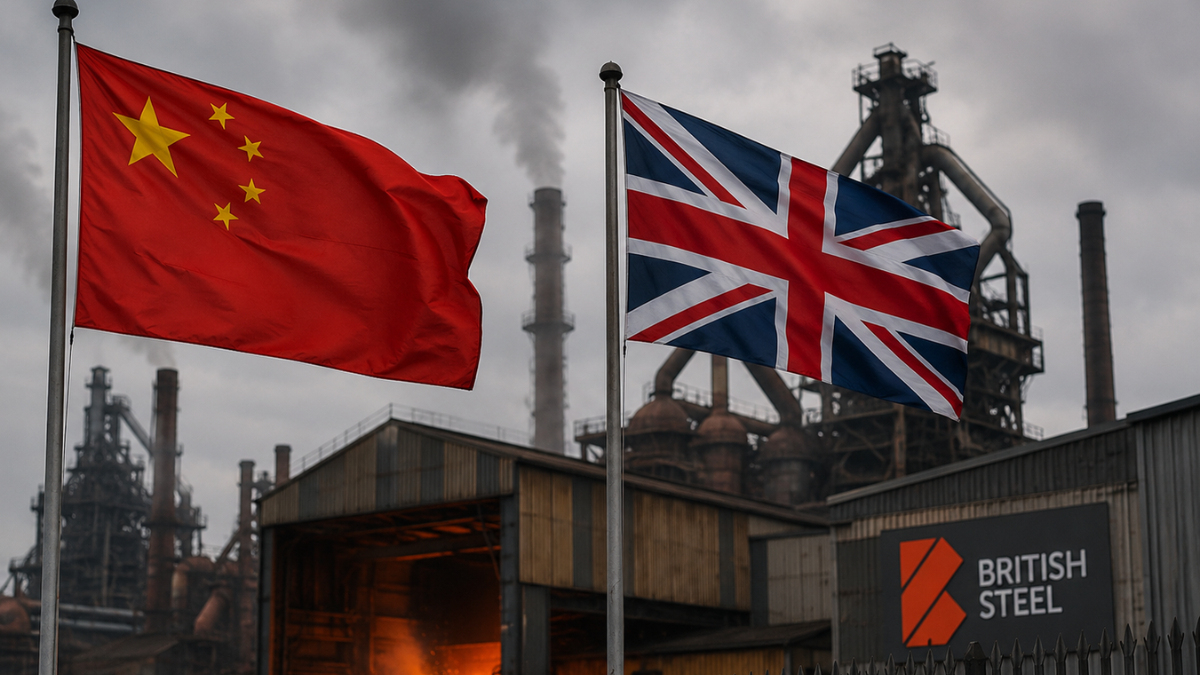
The Jingye Group British Steel nationalization compensation dispute escalated sharply this past weekend. China's Jingye Group - the steel company that pulled British Steel back from the brink in 2020 - issued a public demand for compensation from the UK government on Sunday, calling the nationalization a breach of international investment rules and a direct blow to London's credibility as a destination for foreign capital.
It's a messy situation. And it's getting messier.
How British Steel Ended Up Here
British Steel's Scunthorpe plant has been making steel for over 130 years. That's not a footnote - it's the last site in the UK still capable of producing "virgin steel" from raw materials, which makes it strategically significant in ways that go well beyond industrial economics. The plant employs around 2,700 people. Its origins trace to the UK's development of improved steelmaking technology during the Industrial Revolution.
Jingye Group stepped in as owner in 2020, when British Steel was heading toward collapse. The company - headquartered in Pingshan, Hebei province - says it invested continuously in the site. But by early 2025, Jingye was signaling it might close the blast furnaces entirely.
That threat is what forced the UK government's hand.
Why the UK Nationalized - and Why Jingye Objects
The UK Department for Business and Trade announced full nationalization on July 17, 2026. The justification: protecting the United Kingdom’s virgin steelmaking capacity is a national interest issue, not just an economic one. The blast furnaces supply materials critical to major construction projects and the defense industry. Letting them go cold wasn't acceptable.
Jingye's response was swift - and very public.
In a WeChat statement, the company said the move "tarnished the credibility of the British government," spooked international investors, and caused "great losses" to its operations. It formally initiated negotiation procedures under relevant bilateral investment agreements, with international arbitration explicitly reserved as an option. The Jingye Group bilateral investment agreements and international arbitration pathway is now active, even if the full legal strategy remains unspecified.
One line stood out: "The UK was only willing to provide almost zero compensation." The UK, for its part, said an independent evaluation will determine what - if anything - is owed.
Honestly, "independent evaluation" and "almost zero compensation" aren't mutually exclusive. Both sides know that.
The Numbers Behind the Jingye Group British Steel Nationalization Compensation Dispute
No specific figures have been publicly confirmed by either side. What's clear: the gap is large.
Jingye's language throughout - "great losses," "significant contribution," "zero compensation" - signals a company that feels its investment has been wiped out without acknowledgment. It held the plant for six years. The 2020 acquisition was framed as a rescue mission. Whether an independent evaluation supports a meaningful payout or a minimal one will likely determine whether this heads to arbitration or settles quietly. But given the public statements already made, a quiet settlement is getting harder to imagine.
What Beijing Said - and Why It Escalates Everything
The Chinese Foreign Ministry weighed in on Saturday. Not with subtlety.
"The way the UK handles the issue will directly influence how Chinese investors view the British investment environment and the credibility of the British government," it said. Beijing urged London to "earnestly respect market principles and the spirit of contract" - and made clear China backs Jingye's right to pursue legal remedies.
That's a significant escalation beyond a corporate dispute.
For observers tracking broader China-UK economic cooperation dynamics, this framing matters. Beijing is treating the case as a benchmark - how London handles Jingye's compensation claim will be cited the next time any Chinese firm considers a major UK investment. It also lands against a backdrop of active China trade investment talks across multiple fronts. Beijing doesn't compartmentalize these issues. What happens in one market gets factored into the calculus for others.
What International Investors Are Taking Away
Here's the tension. The UK's rationale for nationalization is defensible - governments can and do protect sovereign industrial assets, especially ones tied to defense supply chains. That's a recognized right.
But compensation terms are what define whether a nationalization is a legitimate state action or effective expropriation. The Jingye Group British Steel nationalization compensation dispute is being watched not just by Chinese firms, but by any international investor holding assets in industries where national security arguments can apply.
China overseas investment rules have tightened at home, meaning Chinese outbound investors are already navigating home-side restrictions alongside host-country political risk. A near-zero compensation outcome in a case this visible would sharpen that calculation significantly.
Chinese capital market shifts and recent China manufacturing outlook data both suggest Chinese firms have expanding domestic options - which means the threshold for accepting unfavorable terms abroad has gone up. Chinese firms in European markets are already recalibrating where they place their bets. This dispute accelerates that rethink.
The Jingye Group British Steel Nationalization Compensation Dispute: What Comes Next
This isn't going to resolve quickly. Arbitration is possible. A negotiated settlement is possible too - if both governments decide a protracted public legal fight costs more than a fair payout.
But the precedent question won't disappear regardless of how this specific case ends.
China's global industrial ambitions continue - but the risk calculus for Chinese capital in politically sensitive Western assets is visibly shifting. China's economic resilience strategy in 2026 is built around diversifying exposure, not concentrating it in markets where nationalization can happen with minimal compensation. Chinese factory sector performance at home has improved enough that outbound industrial investments need to clear a higher bar. And China-Europe industrial partnerships are increasingly gravitating toward green tech and AI - sectors where national security justifications for nationalization are harder to make stick.
British Steel might be the moment that crystallizes that pattern. Not just for Jingye, but for where Chinese industrial capital flows next.