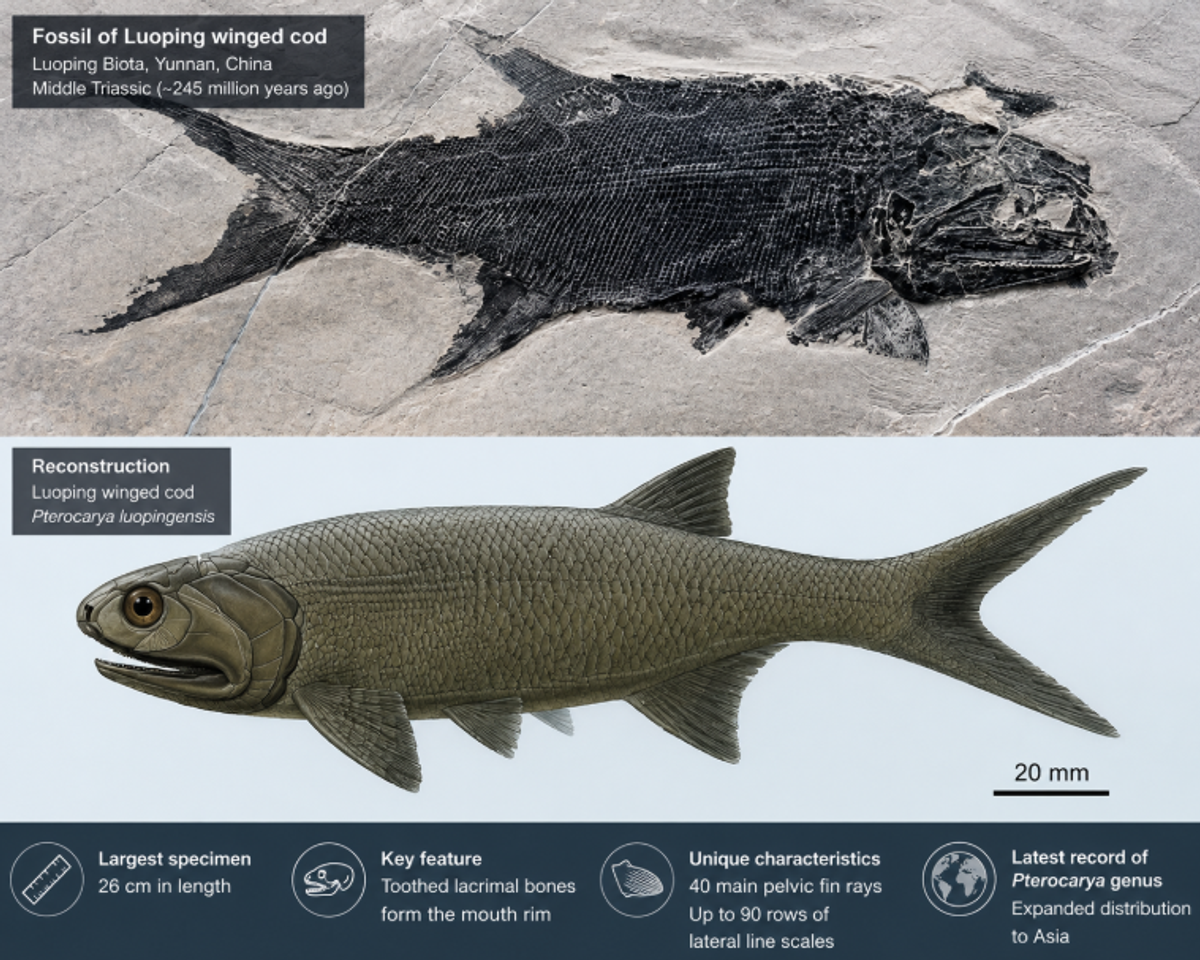
There's a lot that can hide inside ancient rock. And every now and then, a research team cracks something open that genuinely changes what you thought you knew about prehistoric life on Earth. That's exactly what happened in Yunnan Province, China, where paleontologists have confirmed a new species of winged cod discovered in Yunnan's Luoping Biota - a fossil site that keeps delivering surprises.
The findings were published on June 30 in the international academic journal Mesozoic. If you follow latest science discoveries across disciplines, this one deserves your attention. It doesn't just fill a gap in the fossil record. It reorganizes part of it.
What Was Pulled Out of Luoping - and Why You Should Care
Luoping County sits in Qujing City, Yunnan Province. To most people, it's unremarkable. To paleontologists, the Luoping Biota is one of the richest Middle Triassic fossil sites anywhere on the planet, and researchers have been systematically working through it for years.
The team - led by Xu Guanghui, a researcher at the Institute of Vertebrate Paleontology and Paleoanthropology, Chinese Academy of Sciences - recovered five specimens of the new species, now formally named the Luoping winged cod. The largest individual measured 26 centimeters in length. That might not sound impressive by modern standards, but for a fish living roughly 244 million years ago, it's a substantial animal. Five specimens. Well-preserved. That's an unusually strong evidentiary base for a new species description.
The Luoping winged cod fish discovery Yunnan also came with something rare: clarity. The fossils weren't fragmented or ambiguous. They clearly displayed the identifying hallmark of the winged cod group - toothed lacrimal bones that form part of the rim of the mouth. No guesswork required.
The Features That Separate This Species From Everything Else
Here's where the skeletal morphology of winged cod species gets genuinely interesting. The Luoping winged cod isn't just a new member of an established club. It has traits that don't match any other known winged cod species.
Three in particular stand out. First, the species has more periorbital bones than any previously described winged cod - a structural difference that researchers noticed immediately. Second, it carries 40 main pelvic fin rays. Third - and this is the striking one - it has up to 90 rows of lateral line scales.
Ninety rows.
The lateral line is a sensory system that lets fish detect movement and pressure changes in the water around them. A fish with that many rows of lateral line scales was operating with an unusually detailed environmental awareness. What that actually meant for the animal's behavior is still an open question. But as a diagnostic feature, those 90 rows leave no room for confusion about whether you're looking at something new.
Understanding the identifying features of winged cod with toothed lacrimal bones has been central to this kind of species differentiation work. This discovery deepens that understanding considerably.
What the Luoping Find Actually Tells Us About Middle Triassic Fish Evolution
Before this discovery, the genus Pterocarya - the winged cod group - was primarily known from European and North American fossil records. Finding a new species of winged cod discovered in Yunnan changes that picture in two concrete ways.
First, it expands the fossil record of genus Pterocarya to Asia. That's a significant geographical extension - the kind that forces researchers to revise distribution maps and reconsider migration and survival pathways. Second, it confirms that the genus's lifespan extends to the early Middle Triassic. That's a timeline extension, and it matters for how paleontologists model the group's evolutionary arc.
Doctoral student Ren Yi, first author of the Mesozoic paper, described it directly: "This new species represents one of the latest fossil records of the genus Pterocarya globally. Its discovery not only enhances our understanding of the fish diversity of the Luoping Biota, but also further demonstrates that Luoping, Yunnan, was a refuge for this ancient Triassic fish."
That word "refuge" carries specific meaning in paleontology. It implies that while Pterocarya was declining or disappearing elsewhere during the early Middle Triassic, conditions in Yunnan were stable enough to support a thriving population. This new species is evidence of that stability - not just a data point, but an argument.
This kind of patient, methodical output reflects a broader pattern in China's scientific research - one that's producing results at an increasing rate globally.
The Institutional Backing Behind the Discovery
Research like this doesn't happen by accident. The project was supported by the National Natural Science Foundation of China paleontological research fund, the National Science and Technology Basic Resources Survey Project, the Stable Support Project of the Institute of Vertebrate Paleontology and Paleoanthropology, Chinese Academy of Sciences, and the Yunnan Luoping Biota National Geopark Administration.
That's a layered funding network. And it's reflective of how seriously China has built out its scientific infrastructure in recent years. Chinese scientific innovation is accelerating across sectors - and paleontology, while slower-moving than semiconductor research, benefits from the same underlying investment logic.
Ren Yi being credited as first author as a doctoral student is worth noting too. It signals the kind of research culture the Institute is building: one where early-career scientists take lead roles on significant, internationally published work.
Yunnan as a Living Window Into Ancient Ecosystems
The Luoping Biota isn't interesting because of any single find. It's interesting because of what it collectively represents - a detailed snapshot of an ecosystem that rebuilt itself in the aftermath of the end-Permian mass extinction, which wiped out an estimated 90-plus percent of marine species.
The new species of winged cod discovered in Yunnan fits into that recovery story. The ancient Triassic fish refuge in Yunnan, China gave species like Pterocarya a place to survive and - apparently - diversify, while their relatives elsewhere didn't make it. Enhancing understanding of fish diversity in Middle Triassic Luoping biota has been a slow process, but discoveries like this one are accelerating it.
Researchers are increasingly combining traditional specimen analysis with AI-driven research methods to cross-reference morphological data across multiple fossil sites - though the hands-on work of identifying and describing a new species is still irreplaceable.
China's Growing Place in Global Paleontological Science
You can't really discuss a discovery like this without acknowledging the wider context. China's growing economy has channeled substantial resources into scientific institutions over the past two decades, and the output is visible. China's expanding industries include research and development as strategic priorities - not side projects.
The Institute of Vertebrate Paleontology and Paleoanthropology, operating under the Chinese Academy of Sciences, sits squarely within that investment landscape. And Chinese technological breakthroughs in data analysis are beginning to intersect with paleontological research in ways that would have seemed far-fetched even ten years ago. China's tech investment hubs are increasingly adjacent to the computational infrastructure that supports large-scale fossil data analysis.
The result is a research ecosystem that's producing internationally significant science more consistently than it ever has before.
What You Now Know That Scientists Didn't a Month Ago
The new species of winged cod discovered in Yunnan adds something concrete and verifiable to the global fossil record. Five well-preserved specimens. A species with unique skeletal features - 40 pelvic fin rays, up to 90 lateral line scale rows, additional periorbital bones - that don't match anything previously described. A genus whose geographical range now provably extends to Asia. A timeline that now stretches further into the Middle Triassic than paleontologists previously confirmed.
Honestly, that's a lot for one paper.
The Pterocarya genus is a little less mysterious than it was a few weeks ago. But the Luoping Biota is clearly still holding things back. There's more to find.