Two companies. One title. And a product launch that landed two days before China's most significant AI regulation went live.
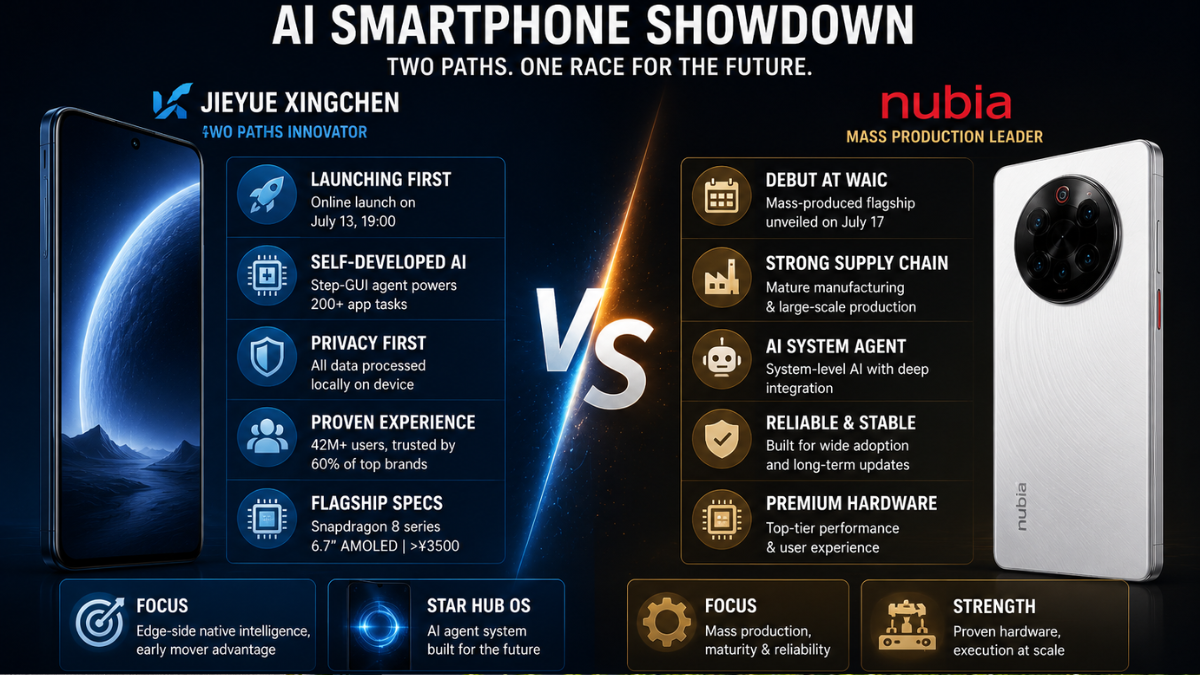
The StepFun agentic AI smartphone Star Hub OS Nubia WAIC first launch competition is less a PR war and more a signal that large model companies have outgrown the cloud. On July 13th, StepFun (Jieyue Xingchen) held a live product event revealing a self-developed terminal brand, the Star Hub OS intelligent agent system, and a complete device built in deep partnership with Huaqin Technology. Four days later, ZTE's Nubia debuted its own mass-produced AI agent flagship at the WAIC World Artificial Intelligence Conference - also claiming "world's first."
Both can't be right. But honestly, the race for that title matters less than what drove both companies to sprint toward it at the same time.
What StepFun's Agentic AI Smartphone Reveals About Today's Mobile AI Gap
Nearly every "AI smartphone" currently on the market is just a regular phone with a chatbot bolted on. The AI lives inside one app and can't leave. So if you ask your phone to "compare flight prices and book a taxi," you're still switching apps yourself. The AI answered your question. You did the work.
That's the exact problem StepFun's agentic AI smartphone and Star Hub OS are built to fix - not a better assistant, but a phone where AI actually executes tasks across your apps without you babysitting every step. The MWC Shanghai mobile AI signals from earlier this year pointed exactly here: system-level agents replacing in-app Q&A. And anyone who's been tracking the AI agent competition landscape saw this category forming months ago.
StepFun's Star Hub OS vs Nubia WAIC: Two Launch Strategies, One Title
Here's where things diverge sharply.
StepFun came in as a model-first company building outward into hardware. Their Step GUI - a cross-application graphical agent - already had 42 million cumulative mobile installations before this phone existed. Star Hub OS runs a dual-core architecture: an Android sandbox layer for full ecosystem compatibility, plus an AI-native kernel where Step GUI processes everything locally. Screen recognition, command decomposition, task execution across 200+ mainstream apps - none of it leaves the device. The hardware specs land in mid-range flagship territory: 6.7-inch AMOLED, Snapdragon 8 series, priced above 3,500 yuan.
Nubia took the reverse route. ZTE's manufacturing supply chain, ByteDance's Doubao large model engine integrated from outside, and years of hardware-level tuning in heat dissipation and battery management. Nubia president Ni Fei was explicit: this is a fully mass-produced device, not a concept prototype.
So the "first" argument splits into two definitions. StepFun says "first" means a native edge-side architecture built by a model company with an independent terminal brand. Nubia says "first" means the first AI agent phone at genuine mass-production consumer scale. Both are defensible - which is exactly why neither side is backing down.
StepFun's real weakness here is distribution. Native AI algorithms and compliant architecture are genuine advantages, but terminal channels and supply chain depth take years to build. Nubia has those, but its AI layer is dependent on an external model engine, which limits how tightly the whole stack can be optimized.
The July 15 Compliance Architecture Nobody Talks About Enough
The launch timing wasn't coincidental.
China's "Interim Measures for the Administration of Human-like Interactive Services of Artificial Intelligence" took effect July 15th - two days after StepFun's event. The rules set hard limits on autonomous AI interaction, user data collection, and anthropomorphic behavior. Under the old cloud architecture - where user dialogue and screen activity get uploaded for processing - compliance with these rules would require expensive, time-consuming redesigns.
Star Hub OS sidesteps most of that friction. Local on-device processing means user data never leaves the phone. Built-in mandatory disclosure popups notify users whenever the agent is running autonomously. Agent permissions tier into three controllable levels - basic query, light interaction, and full autonomous execution - so users can cap what the AI can do without losing the core experience.
That's structural compliance, not retrofitted compliance. With agentic AI security becoming a genuine concern as agent permissions expand at the system level, this architecture matters more than most product coverage acknowledges. The embodied intelligence infrastructure challenge - getting large models to run reliably on edge devices without latency penalties - is something StepFun has been iterating on through its existing mobile deployments. Star Hub OS is the hardware expression of that accumulated work.
Why AI Labs Are Building Phones Instead of Just Licensing Models
ByteDance's Doubao phone opened the door. But the logic behind it took a moment to become obvious.
Before, AI companies sold model licenses to phone manufacturers. Hardware stayed in the hands of terminal makers, and algorithm optimization was always constrained by someone else's system layer. Own the full stack - model, OS, hardware scheduling - and the latency and stability problems become solvable in ways they simply weren't before.
This puts real pressure on Apple and Samsung. Their current flagship AI features are mostly cloud-based assistants. When domestic manufacturers start shipping GUI agent autonomous operations at consumer scale, on-device AI stops being a differentiator and becomes a baseline expectation.
The investment momentum is clear. Wuhan AI agent investment is flowing at the billion-yuan level. Physical AI solutions 2026 projections position hardware as the next primary battleground. The WAIC AI innovations on show this week confirm the acceleration is real and fast. The China AI sector growth backdrop - bolstered by major AI supercluster launch investments - has built the compute foundation that consumer-facing AI hardware needs underneath it.
The Chinese AI companies global competition picture increasingly points to a single conclusion: whoever wins the agent phone category domestically will carry a structural architecture head start internationally.
What Analysts Are Actually Saying
Lu Ran, chief consumer electronics analyst at Topology Industry Research, put it plainly: StepFun has the native AI algorithm advantage and compliant underlying design, but it's still building out terminal channels and overall supply chain experience. Nubia has manufacturing depth, but its AI layer is integrated from outside. Neither path is clearly superior yet.
The Science and Technology Innovation Board Daily's July 10 report called this a "significant turning point" - not just a product launch, but a structural shift in how AI value gets captured. Large model companies are moving from licensing to full-stack ownership. That's a different game than anything the consumer electronics industry has seen before.
The China AI entrepreneurs conference coverage and open-source AI adoption data both point the same direction: the AI stack is compressing downward from cloud to edge, and the companies that own both layers will define what the next phase of mobile looks like.
What This Race Actually Tells You
The StepFun agentic AI smartphone Star Hub OS Nubia WAIC first launch debate will keep running in the tech press for weeks. But the more durable question is which architecture wins over time - native model-first, or hardware-first with AI integrated from the outside.
StepFun has a compliance advantage, algorithmic depth, and 42 million existing mobile installations behind Star Hub OS. Nubia has manufacturing scale, distribution channels, and hardware maturity. The July 13th launch gives StepFun the narrative. Mass production gives Nubia the market access.
Your next phone might not be built by a phone company. The StepFun agentic AI smartphone - with Star Hub OS and Step GUI at its core - is the clearest argument yet that this shift isn't a roadmap item anymore. It's shipping.