Summary
China’s AI weather forecasting models Typhoon Dolphin forecasts have put a spotlight on a shift meteorologists have watched for years. When a dangerous storm is moving toward land, speed matters. A forecast that arrives hours earlier can change evacuation routes, fishing decisions, flight schedules, and flood preparations.
China’s systems are becoming serious contenders. Fengwu, Pangu, and Fuxi can generate medium-range forecasts far faster than traditional numerical models, while matching or beating them on selected accuracy measures.
That doesn't mean the old models are obsolete. Far from it.
Key Points
- AI weather forecasting is becoming operational, not experimental. China’s Fengwu, Huawei’s Pangu and Fudan’s Fuxi are increasingly being tested alongside conventional forecasting systems.
- Speed is AI’s biggest advantage. AI models can produce forecasts much faster than physics-based supercomputer models, giving authorities more time to prepare for extreme weather.
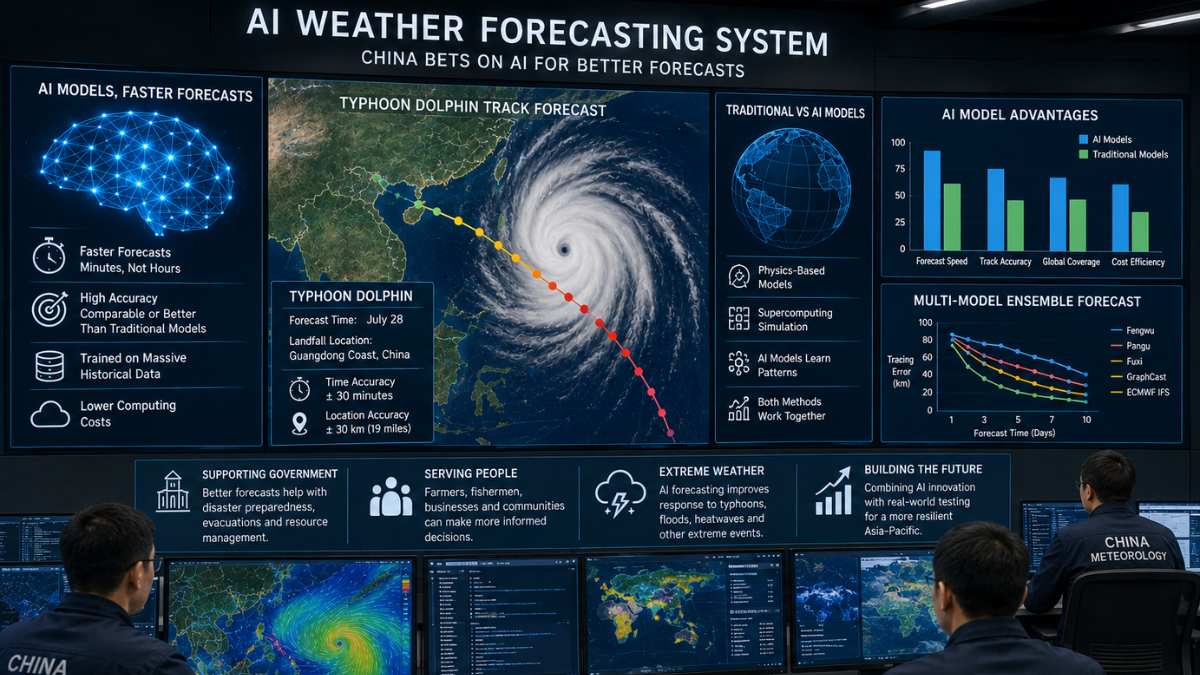
- Typhoon Dolphin highlighted the practical value. Fengwu reportedly predicted the storm’s mainland landfall five days ahead to within about 30 minutes and 30 km, according to Techwind CTO Sun Zhi.
- China is building a strong domestic AI weather ecosystem. Research institutions, technology companies, meteorological agencies and expanding computing infrastructure are all contributing to the effort.
- AI isn't winning every forecasting battle. Storm-track prediction is improving rapidly, but AI models still struggle more with storm intensity, particularly when atmospheric and ocean conditions become highly complex.
- Traditional forecasting still matters. Physics-based models remain important because they simulate the underlying atmospheric processes rather than relying entirely on patterns learned from historical data.
- The likely future is hybrid forecasting. AI can provide fast predictions while conventional models and human meteorologists provide additional validation and physical context.
- Extreme weather makes faster forecasting more valuable. Better forecasts can support evacuation planning, flood preparation, fisheries, transport, agriculture and emergency response.
- Computing infrastructure is becoming part of the weather race. Large datasets, advanced AI models and high-performance computing all require substantial infrastructure, making China’s broader AI-computing push relevant to meteorology.
China AI weather forecasting models Typhoon Dolphin showed their value
During Typhoon Dolphin, China AI weather forecasting models Typhoon Dolphin efforts ran alongside the physics-based systems used by weather agencies. The headline result was impressive: Techwind CTO Sun Zhi said Fengwu forecast the storm’s expected mainland landfall time and location, five days ahead, to within 30 minutes and 30 kilometres.
For communities in a storm’s path, that kind of precision isn't academic. It can help emergency teams position supplies before roads flood, warn ships before conditions deteriorate, and reduce the chaos that comes with a late change in the projected track.
The broader Typhoon Dolphin path forecast China AI weather story also connects with tools already being used closer to the ground. Local forecasting agencies are testing systems such as Shanghai AI typhoon monitoring to make alerts more responsive when fast-moving weather leaves little room for error.
Simple. Effective. Freeing up valuable time.
Why AI forecasts arrive faster than traditional models
Why are AI weather models faster than supercomputer numerical physics models? Traditional numerical weather prediction begins with equations describing atmospheric physics. It processes observations, simulates pressure, wind, humidity, temperature, and countless interactions across the atmosphere, then runs those calculations on massive supercomputers.
AI takes another route. It learns relationships from huge weather archives and generates likely future conditions from current data.
That makes China AI weather prediction vs numerical models less of a winner-takes-all contest and more of a practical partnership. Numerical models explain the physical processes. AI can produce a forecast in minutes or seconds, rather than requiring a lengthy high-performance computing run.
The computing race behind this work is enormous. China’s research capacity is supported by advances in supercomputing architecture, the reported performance of the LingSheng supercomputer, and expanding AI computing infrastructure.
But lower cost and faster output don't automatically mean a better warning. A model can get the track right while still missing how violent the storm will become.
China AI weather forecasting models Typhoon Dolphin and the leading systems
The Fengwu AI weather forecasting model Shanghai AI Lab developed is among China’s most visible projects. Huawei Pangu weather model Fudan Fuxi AI research also represents a wider domestic push to make forecast models faster, more accessible, and useful at operational scale.
Developers say Fengwu outperforms Google GraphCast across 80 percent of weather variables. That Fengwu AI model GraphCast comparison accuracy claim has attracted attention because GraphCast is already one of the best-known systems in the field.
Globally, the competitive set includes Google GraphCast GenCast Nvidia FourCastNet ECMWF AIFS. Each project approaches forecasting a little differently, but all are chasing the same prize: useful predictions that arrive early enough for people to act.
Why are global tech companies racing to build AI weather forecasting tools? Because weather touches almost everything. Agriculture, insurance, transport, energy generation, fisheries, public safety, and supply chains all depend on it. Better forecasts have obvious commercial value, but they also carry real public value when severe weather is approaching.
China bets on AI weather forecasting systems as extreme weather intensifies, and the required hardware is becoming part of the story too. From China’s AI supercluster to a heterogeneous computing platform, the infrastructure can support larger training datasets and faster model experiments.
The flaw AI models haven’t solved
AI vs conventional weather forecasting extreme weather performance still has a weak point: storm intensity.
AI typhoon track prediction landfall accuracy can be excellent, especially when models recognize familiar patterns in historical data. Yet intensity depends on fine-scale interactions between ocean heat, wind shear, moisture, terrain, and the storm’s internal structure. Those details are hard to learn perfectly from past records.
And, honestly, this is where conventional physics models remain essential. They may be slower, but they model the mechanisms that make storms strengthen, weaken, or change character unexpectedly.
How China leverages historical archives to train medium range AI weather models is central to their speed. Still, archives only contain the past. Rare climate events, unfamiliar combinations of conditions, and long-term changes can expose gaps in a system trained on what has already happened.
Better observations will help. Data from an atmospheric research aircraft and a marine-monitoring satellite can improve the information fed into both AI and numerical forecasts.
What this means for disaster planning
How do AI weather models help in flood preparation and evacuations? They give authorities more time to run scenarios, update warning maps, and communicate risk before a storm reaches the most dangerous stage.
China AI meteorological forecasting models 2026 are likely to be used as a fast first pass, with forecasters comparing AI output against traditional systems before issuing official warnings. That hybrid approach makes sense. It gives you speed without asking anyone to blindly trust a black box.
Future capacity may even extend beyond Earth-based data centres through space-based computing and more affordable AI computing power. For now, though, the most useful progress is much less flashy: clearer storm tracks, earlier alerts, and decisions made before the rain starts.
Where AI weather forecasting goes next
China AI weather forecasting models: Typhoon Dolphin results show why this technology is attracting so much attention. AI can generate highly useful track forecasts at remarkable speed, helping forecasters and emergency planners act earlier.
Still, the future isn’t AI replacing meteorologists or physics models. It’s a blended system where trained experts compare fast AI guidance with conventional simulations, real-world observations, and local knowledge. When the next typhoon forms, that combination may be what turns a good forecast into a useful one.
GlobalByte Perspective
The real breakthrough in AI weather forecasting isn't that machines are replacing meteorologists. It's that they are giving meteorologists something they have always needed: more time.
China’s progress with Fengwu, Pangu and Fuxi shows how quickly AI is moving from research laboratories into practical forecasting. The biggest advantage isn't simply whether an AI model can beat a traditional system on a particular accuracy benchmark. It is the combination of speed, computing efficiency and increasingly competitive accuracy.
Typhoon Dolphin illustrates why that matters. When a storm is approaching land, an extra few hours of useful information can have consequences far beyond a weather app. Emergency agencies can adjust evacuation plans, ports can prepare, airlines can respond to disruption and communities can get more time to act.
But there is an important reality check. A fast forecast is only valuable if people can trust it. AI models still have limitations, particularly when predicting storm intensity and unusual weather events that don't closely resemble conditions in their training data. That's why replacing traditional numerical models entirely would be premature.
For GlobalByte, the more interesting story is therefore the convergence of AI and conventional meteorology. The strongest forecasting systems may not be the ones that eliminate physics-based models, but those that combine AI's speed with traditional models' understanding of atmospheric processes.
And as extreme weather becomes a bigger economic and humanitarian risk, this isn't merely a competition between Chinese and Western AI models. It is becoming a race to deliver reliable information early enough for humans to do something with it.