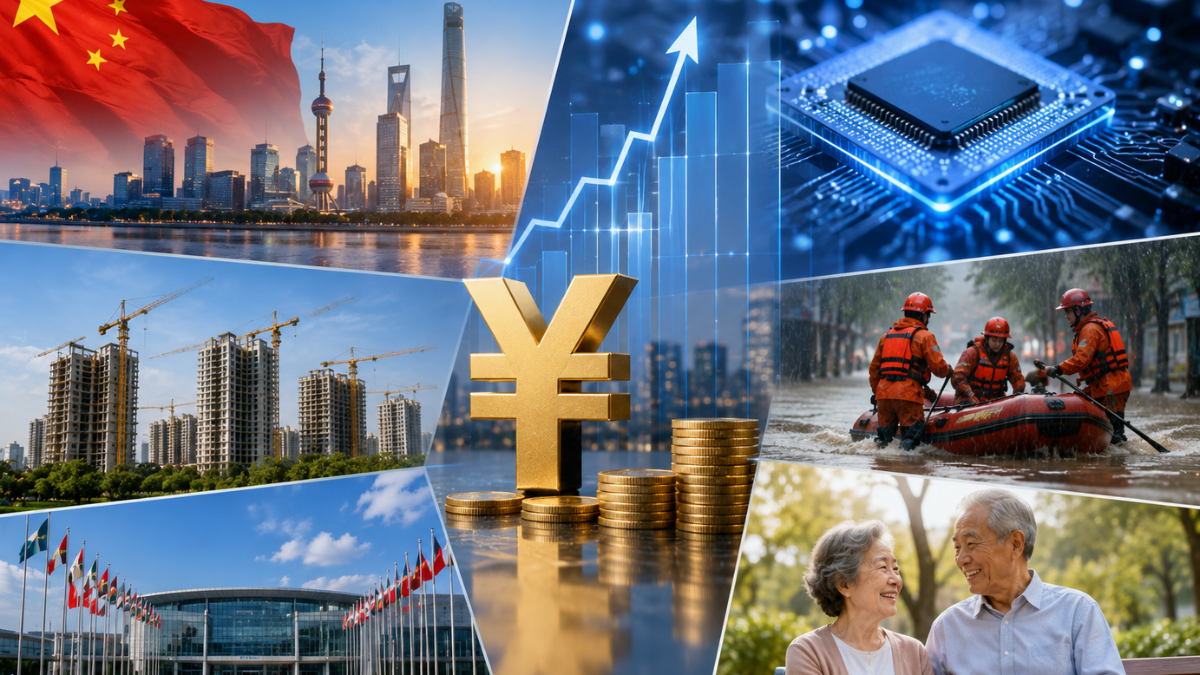
The China National Bureau of Statistics’ economic data for the first half of 2026 dropped this morning - and it's worth more than a quick scan. GDP at 4.7%. Integrated circuit output hitting records. A property market that's healing, slowly and unevenly. A new Five-Year Plan anchored around elderly care. And an AI governance summit opening in Shanghai this week that's already pulling heads of state.
There's a lot here. Let's get into it.
GDP at 4.7%: Stable, Not Spectacular - But That's the Point
China's first-half GDP reached 69,570.4 billion yuan, growing 4.7% year-on-year at constant prices. If you've been tracking the June PMI expansion signals, this confirms the direction rather than surprising you.
4.7% is respectable. Not blazing. But for an economy at this scale, under current global conditions, stable is what markets needed to see. The macroeconomic resilience indices analysts track are holding up better than many predicted heading into 2026 - and high-tech manufacturing industrial value added metrics are doing a lot of the load-bearing work.
Honestly, the factory activity data story is more complicated than the headline numbers suggest. It almost always is. But the trend line is real, and industrial sector outperformance against macroeconomic headwinds is the pattern worth tracking.
The Chip Numbers Are the Real Story This Morning
Let's be direct: the integrated circuit output growth figure is the standout data point in today's release.
Industrial enterprises above designated size posted 23.1% growth in the first half, reaching 279.8 billion units total. Average daily output exceeded 1.5 billion chips. Sovereign semiconductor daily output at that level is significant - and that number doesn't fully register until you sit with it for a moment.
Sub-micron level wafer manufacturing scale expansion has been building for several years, and you're seeing the output volumes reflect that investment now. High-end manufacturing and digital economies aren't abstract growth drivers for 2026 - the production data makes them concrete. Hu Qimu and analysts at institutions like the Maritime Silk Road Institute have been pointing to high-tech industrial clusters as a key pillar of economic optimization, and this morning's numbers support that view.
The China innovation industrial transition reshaping global supply chains provides the right structural frame for what you're seeing here. The China capital market listing rules that shifted in 2025 made it easier for semiconductor firms to raise capital - and that decision is now showing up in output volumes.
Property Prices: Better Than a Year Ago, Still Not Fixed
The NBS commercial residential building sales price trends across tier cities in June tell a careful story. First-tier cities saw prices rise month-on-month. Second- and third-tier cities fell or stayed flat. Across all three tiers, year-on-year declines continued to narrow.
That last part matters most. Narrowing declines aren't recovery - but they're the step that comes before recovery. First-tier markets look like they've found something close to a floor. Whether that stability moves down through second- and third-tier cities over the next two quarters is the real question.
Directionally improving. Don't get ahead of the data, though.
Elderly Care Is Now a National Consumption Priority
The State Council approved the 15th Five-Year Plan for Expanding Consumption - and its most consequential element is the explicit focus on expanding consumption related to elderly care. That's not framed as social welfare policy. It's framed as a consumption engine.
Corporate governance guidelines for companies looking at entering emerging aging demographic markets are going to need to take this signal seriously. China's population is aging fast, and the plan positions elder care products, services, and platforms as a major domestic demand category to develop. The State Council trade and climate targets discussions earlier this year already flagged this sector as a priority - this Five-Year Plan is the formal policy follow-through.
It connects to the 618 festival consumer spending data from June too - consumer demand exists; it just needs the right channels. And for a deeper read on how domestic consumption fits the overall strategy, the China economic resilience blueprint from Summer Davos laid it out clearly.
Shanghai Is Hosting the AI World This Week
Kazakh President Kassym-Jomart Tokayev arrived at Shanghai Hongqiao International Airport on July 15. He's there for the 2026 World Artificial Intelligence Conference and High-level Meeting on Global Governance of Artificial Intelligence, running July 17-20.
Why are global leaders attending the World Artificial Intelligence Conference rather than sending deputies? Because this is a working policy forum, not a trade expo. Digital transformation, practical cooperation, multilateral frameworks, and how multilateral frameworks coordinate global artificial intelligence governance systems are substantive agenda items - not ceremonial ones. The Hi WAIC ecological open platform smartphone app gives observers a useful window into the conference ecosystem and China's AI product positioning.
Premier Li Qiang’s growth signals from Summer Davos pointed to AI as central to China's second-half economic strategy. WAIC is where that strategy gets demonstrated publicly. And the NDRC AI industry forecast for 2026 is worth reading before the conference opens - ambitious projections, but the chip output numbers make them look more plausible than they did six months ago.
Trade Relationships Are Being Actively Managed
Two items worth keeping in view.
The China-EU trade investment consultation mechanism meeting is confirmed for autumn 2026, with cross-border e-commerce trade structures and digital economy optimization on the working agenda. And the conversation around China-UK economic cooperation trade remains active, with strategic alignment policies for digital transformation between trading partners being worked through in parallel.
The Lujiazui Forum finance signals from earlier this year pointed to the same theme: stable trade relationships and rapid domestic tech capacity aren't in competition. They're complementary.
Typhoon Bavi and the Emergency Response
Not everything in this morning's briefing is about growth. Typhoon Bavi (No. 9) hit Jilin Province hard, prompting a Level IV national emergency response on July 15 from the National Disaster Prevention, Mitigation and Relief Committee. The NDRC urgently allocated 30 million yuan from the central budget for post-typhoon flood recovery.
A reminder that resilience isn't just macro indices - it's also how fast systems respond to shocks.
What the China NBS Economic Data First Half of 2026 Actually Signals
The China National Bureau of Statistics economic data for the first half of 2026 paints a picture that's more nuanced than any single number captures. 4.7% GDP growth holds the headline. But 23.1% integrated circuit output growth, a slowly stabilizing property market, an elder care consumption framework, and a major AI governance summit all add up to something more directional.
Mao Shengyong's NBS spokesperson briefing in July will add sectoral depth to these figures - worth following if you track macro trends closely. And the China National Bureau of Statistics economic data first-half release overall suggests an economy moving steadily in the directions it's been trying to go, even against headwinds.
Watch the property sector and the autumn trade consultations. Those are the next meaningful inflection points for H2.