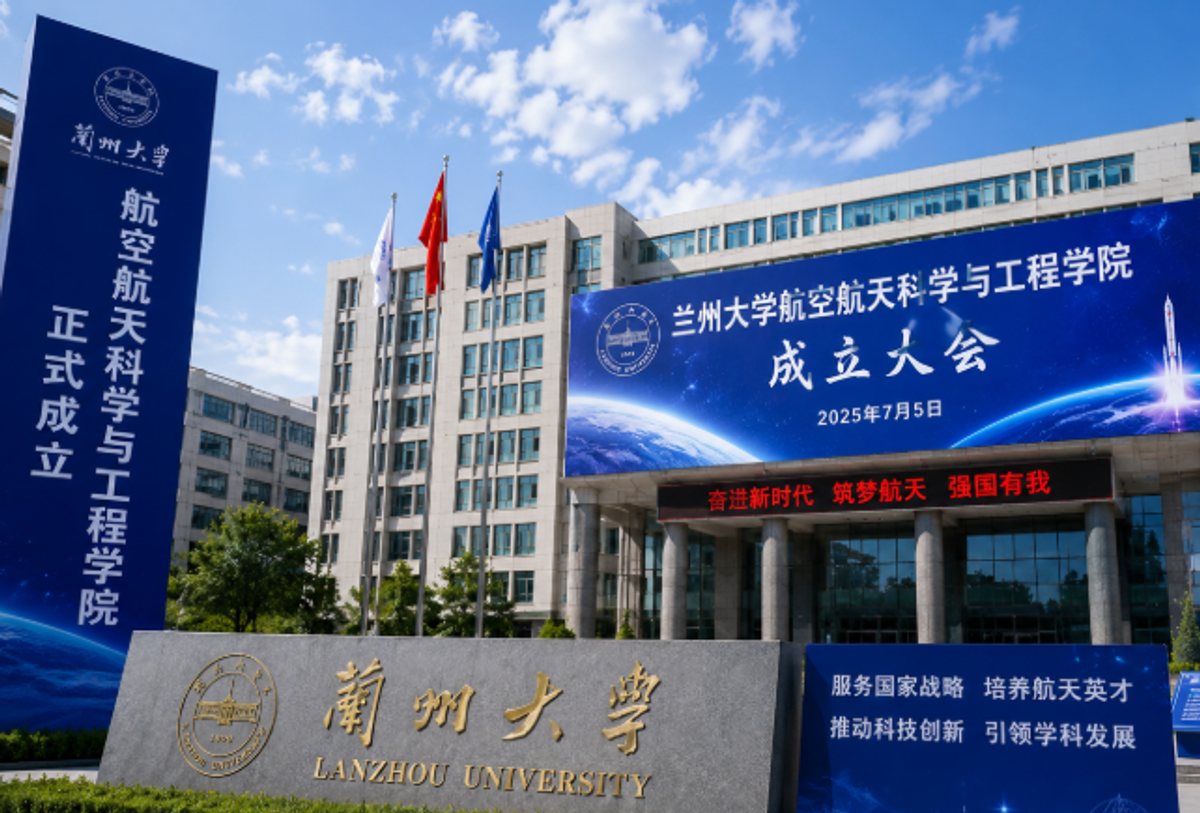
On July 5, 2026, Lanzhou University establishes School of Aerospace Science and Engineering, marking the launch of the first aerospace college in Northwest China co-built by a university and a national-level aerospace research institute. The partner is the Lanzhou Institute of Space Technology Physics - better known as the Aerospace 510 Institute - one of the backbone units in China's national space technology system. If you've been tracking how China is building its engineering talent pipeline, this one is worth reading closely.
The announcement moved quickly through academic and industry circles. Prospective students, aerospace professionals, and policy observers all took notice. Honestly, not hard to see why.
Why Northwest China Needed This Aerospace College Now
China's space sector isn't growing at a measured pace - it's accelerating. The 15th Five-Year Plan explicitly named aerospace a core national strategic priority, and "building a strong aerospace nation" is now a listed key task. The low-altitude economy carries official strategic emerging industry status. Demand for engineers who can work across spacecraft systems design, space physics, propulsion, and materials is outpacing what most existing programs can supply.
Lanzhou University is the only key comprehensive university under direct Ministry of Education oversight that sits west of the Hu Huanyong Line. The university already holds strong foundational programs in physics, mechanics, nuclear science, materials science, and information science. But strength in basic science doesn't automatically produce mission-ready aerospace engineers. That translation requires something more.
The Lanzhou University School of Aerospace Science and Engineering is organized around two core tracks: deep space exploration and the low-altitude economy. Both map directly to where China's aerospace investment is concentrated right now. This also fits within China's innovation-led economic blueprint, where aerospace is increasingly positioned as a driver of technology-led growth, not just national prestige.
How the 510 Institute Partnership Bridges the Aerospace Innovation Gap
Most aerospace programs at Chinese universities run primarily on internal resources. The persistent weak point is the gap between academic knowledge and field-level engineering practice.
The co-construction model here works differently.
Lanzhou University and the 510 Institute have adopted a "five commonalities" framework: jointly shouldering the national aerospace mission, co-building first-class interdisciplinary disciplines, co-cultivating outstanding engineers, sharing all research platform resources, and jointly developing the future of the university-institute relationship. The goal is to dismantle barriers that normally keep universities and research institutes operating alongside each other rather than together.
In concrete terms: both institutions share large-scale instruments, public testing platforms, literature databases, and engineering training facilities. Two national key laboratories anchor this arrangement - the Vacuum Technology National Key Laboratory and the Space Environment and Material Interaction laboratory - both open to researchers from either side through designated open projects. That's not just access. It's a structural invitation to build joint research programs.
This mirrors how shared infrastructure has driven progress elsewhere. The way China's domestic supercomputing platform advanced by pooling previously siloed institutional capabilities offers a useful parallel - shared access genuinely accelerates what duplicated access can't.
Faculty exchange runs both ways. Senior engineers from the 510 Institute teach regularly at the university and supervise student projects. University faculty access the institute's engineering environment and ongoing national missions. Students get direct mentorship from engineers working on active programs, not just academics who've studied them.
What Students Actually Get from This Program
This is where Lanzhou University establishes School of Aerospace Science and Engineering with a structure that genuinely differs from a standard aerospace major.
At the undergraduate level: Aerospace Science and Technology. Graduate programs split into two first-level interdisciplinary tracks - Space Science and Technology and Low-Altitude Technology and Engineering - together spanning deep spacecraft R&D, deep space exploration missions, low-altitude aircraft development, and commercial applications.
Three specialized training formats run alongside the standard degree paths:
- Integrated undergraduate-master-doctoral programs for students committing early to research careers
- A chief engineer special class built around systems-level thinking and the skills major mission leadership actually demands
- A customized degree-plus-field model where coursework and practical projects connect directly to specific national programs - the space station, lunar exploration, commercial aerospace
That last format deserves more attention than it usually gets. Embedding field engineering into degree requirements, rather than appending internships after graduation, fundamentally changes what a graduate can do on day one. Given how quickly technical expectations are rising - China's reusable rocket engine test results show how far propulsion engineering has shifted in a short window - field-tested graduates are exactly what the sector needs.
Closing the Loop from Lab to Launch
Yang Yongping, Academician of the Chinese Academy of Engineering and President of Lanzhou University, put the core logic plainly: bridge the innovation gap between university basic research and institute engineering applications.
That gap is costly. Universities generate fundamental research that doesn't always translate into deployable engineering solutions. Research institutes develop engineering expertise that rarely loops back into academic knowledge creation. The usual result is parallel activity that never quite connects.
The innovation chain here runs as three stages - basic research from 0 to 1, engineering development from 1 to 10, industrial transformation from 10 to 100. Both institutions contribute across all three. Intellectual property and commercial benefits are distributed based on actual contribution from each side, not institutional seniority.
Lanzhou University's existing depth in nuclear science is one reason this model has traction. Fusion reactor breakthroughs in China show how advanced materials and energy science research translates directly into applied technology - the kind of cross-disciplinary knowledge that aerospace engineering increasingly depends on.
For Gansu's commercial aerospace industry chain, the practical payoff is a local pipeline for talent and technology transfer that the region hasn't had before. Western China has historically exported trained talent eastward. A capable local school changes that equation.
China's Aerospace Push and Where This School Fits
The Lanzhou University establishes School of Aerospace Science and Engineering announcement is part of a national effort to align human capital with the pace of China's space ambitions.
China's space computing push signals how deeply computing and space technology have merged. Modern spacecraft are information processing platforms as much as engineering structures. The growing orbital data center battleground is reshaping the skills aerospace engineers actually need, and traditional programs haven't caught up. China's investment in capacity like China's Lingsheng supercomputer signals how seriously computational infrastructure is being built as part of the space strategy.
On the operations side, missions like the Long March 4B satellite launch demonstrate how fast China's launch cadence is growing - and how that growth is increasing demand across every aerospace specialty.
The competition for engineers is fiercer than it looks from the outside. Chinese AI companies reshaping global competition have made the talent market across China's high-tech sectors more competitive than ever. Aerospace programs that don't offer clearly differentiated value will lose prospective students to AI, semiconductor, and software career paths. The chief engineer class and degree-plus-field model are direct responses to that pressure.
A Real Shift for Aerospace Education in Western China
When Lanzhou University establishes School of Aerospace Science and Engineering, it addresses a structural problem that has limited western China's aerospace development for years. Talented students relocated eastward for serious training. Local industry imported engineers. Basic research at the university ran parallel to engineering practice at the 510 Institute with no real connection point.
This school is designed to close all three gaps at once.
The timing matters too. China's AI sector' explosive growth and the broader technology push are making engineering talent the strategic resource of this decade. Getting aerospace education right - not just having it - is more consequential than it's ever been.
The first cohorts are still being admitted. Full results are years away. But for students considering aerospace in western China, the landscape changed meaningfully on July 5, 2026.