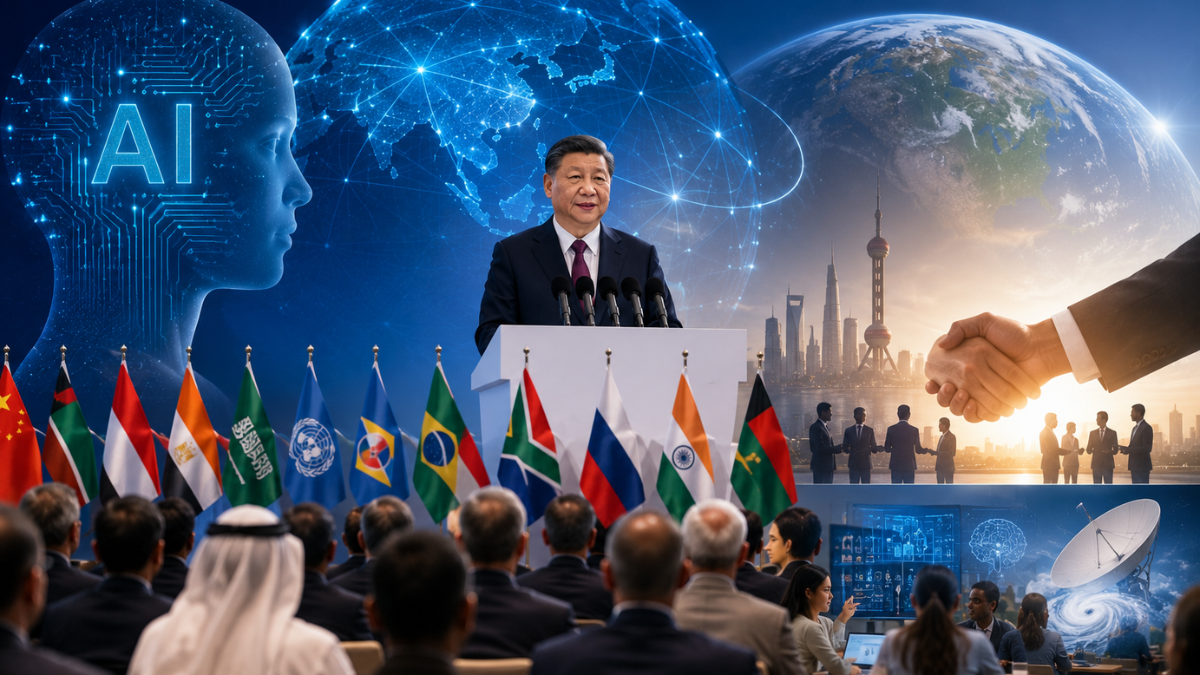
July 17, 2026 might be one of those dates worth remembering. Not because of dramatic headlines or geopolitical theater - but because of something structural. The World Artificial Intelligence Cooperation Organization WAICO formally launched in Shanghai today, backed by concrete pledges from President Xi Jinping that could reshape how developing nations access AI infrastructure, training, and climate early warning systems for the next decade.
Here's what happened and why it matters.
What Is WAICO and Why Does It Matter?
The World Artificial Intelligence Cooperation Organization WAICO isn't another forum or soft-power talking shop. It's designed as an intergovernmental organization for international AI cooperation - the first of this scope and binding nature. Twenty-nine nations signed the founding agreement at the World Artificial Intelligence Conference WAIC Shanghai 2026, held at the Shanghai World Reception Hall, with Chinese Foreign Minister Wang Yi overseeing the ceremony.
United Nations Secretary-General Antonio Guterres attended in person. That detail matters - it signals WAICO enters the multilateral space with immediate legitimacy, not just a Chinese-backed imprimatur.
The choice of Shanghai as the permanent home is deliberate. This city's contribution to Shanghai AI economy signals has been building for years, and anchoring a founding international AI body here positions it as more than a domestic tech hub.
Xi Jinping's Three Pledges at WAIC 2026
At the high level meeting on global governance of artificial intelligence, President Xi didn't just announce WAICO's formation. He attached specific, time-bound commitments to it. Three of them.
Pledge 1: 5,000 AI Training Opportunities for Developing Nations
China will provide 5,000 training opportunities in AI-related fields for developing countries over the next five years. That's part of a broader push on global AI capacity building initiatives China has been building toward since its joint commitments - laid out through China AI cooperation with 65 nations at the UN.
Five thousand slots across five years sounds modest. Do the math per region, though, and you start to see the pipeline potential - especially when paired with sovereign regional AI training infrastructure frameworks across SCO and BRICS member states.
Pledge 2: Regional AI Application Cooperation Centers
China will establish dedicated international AI application cooperation centers for ASEAN, the Arab League, the African Union, CELAC, the SCO, and BRICS countries. Six regional blocs. That's essentially most of the non-Western world covered under one structural initiative.
These aren't aid projects. They're operational hubs connecting local governments to Chinese AI platforms and expertise. Chinese open source AI in Africa has been gaining traction informally for years - these centers formalize what's already been spreading.
Pledge 3: The Mazu Intelligent Meteorological Early Warning System
This is the one that deserves far more attention than it's getting.
China has pledged to bring the Mazu intelligent meteorological early warning system to 30 countries. The Mazu AI Agent for Urban Multi-Hazard Early Warning platform is a cloud-based system built on autonomous climate data processing microchips and satellite feeds - specifically designed to meet the multi-hazard alert zero-gap and universal MAZU standard, aligned with the United Nations early warnings for all initiative cloud solution.
What that means practically: a country with limited climate infrastructure gets real-time flood, storm, and drought alerts without needing to build national systems from scratch. The Djibouti 2.0 meteorological early warning solution showcased at the WAIC forum is the working model. High throughput international climate model coordination pipelines handle the processing. Local authorities just receive the alerts.
Thirty countries. That's not a pilot. That's a rollout.
Why the Global South Is Taking Note
The cynical read writes itself - China launching a multilateral AI body it'll inevitably have outsized influence over. Fine. But that framing misses the practical reality for most developing nations right now.
Most of the Global South is watching global AI governance debates unfold between the US, EU, and China - without a meaningful seat at the table. WAICO, at minimum, creates that seat for 29 founding members. Whether the governance rules that emerge are equitable is a legitimate question. But representation in the room is step one.
And the Mazu system addresses something Western AI platforms simply haven't prioritized: climate disaster prevention for countries with the lowest resilience and the least institutional capacity to build their own systems. That's a real gap. It's being filled.
China's Broader AI Context in 2026
WAICO doesn't emerge from a vacuum. It's the multilateral layer sitting over a domestic AI expansion that's been accelerating hard. The China AI industry growth forecast from the NDRC shows a sector growing faster than comparable economies, and AI empowerment across China at the industrial level has reached the point where the country has genuine capability to export technology, not just develop it.
Premier Li's AI agenda at Summer Davos tied domestic AI growth explicitly to international cooperation - WAICO is where that becomes institutional. And China's AI leadership push through its major tech firms provides the private-sector backbone these government frameworks depend on.
The governance side is covered too. The trusted AI digital security summit in Beijing produced advanced technical frameworks for testing sovereign AI cloud systems - exactly the kind of corporate governance guidelines for managing transnational AI capacity building that WAICO will need to operationalize. Bilateral progress on things like China Finland AI cooperation on green tech shows China building a multi-directional network, not just a southern one.
MWC Shanghai AI innovation earlier this year foreshadowed a lot of what formally landed at WAIC 2026. Threading it all together is what China frames as a China people-centered AI future - an explicit commitment that AI's benefits should reach people, not just institutions.
Whether that framing reflects genuine values or strategic messaging, the infrastructure being built around it is concrete.
What the World Artificial Intelligence Cooperation Organization WAICO Means Going Forward
WAICO's formation is structurally significant in a way most summits aren't. It's an intergovernmental organization with founding signatories, a Shanghai secretariat, and specific operational commitments attached to it. Not aspirational language. Not a communiqué that expires in six months.
The Mazu deployment in 30 countries, the 5,000 China five thousand AI training opportunities developing countries commitment, the regional cooperation centers - these will either deliver results or they won't. And the scrutiny will be intense, because 29 governments signed their names to this. That's accountability, at least on paper.
Watch this space.