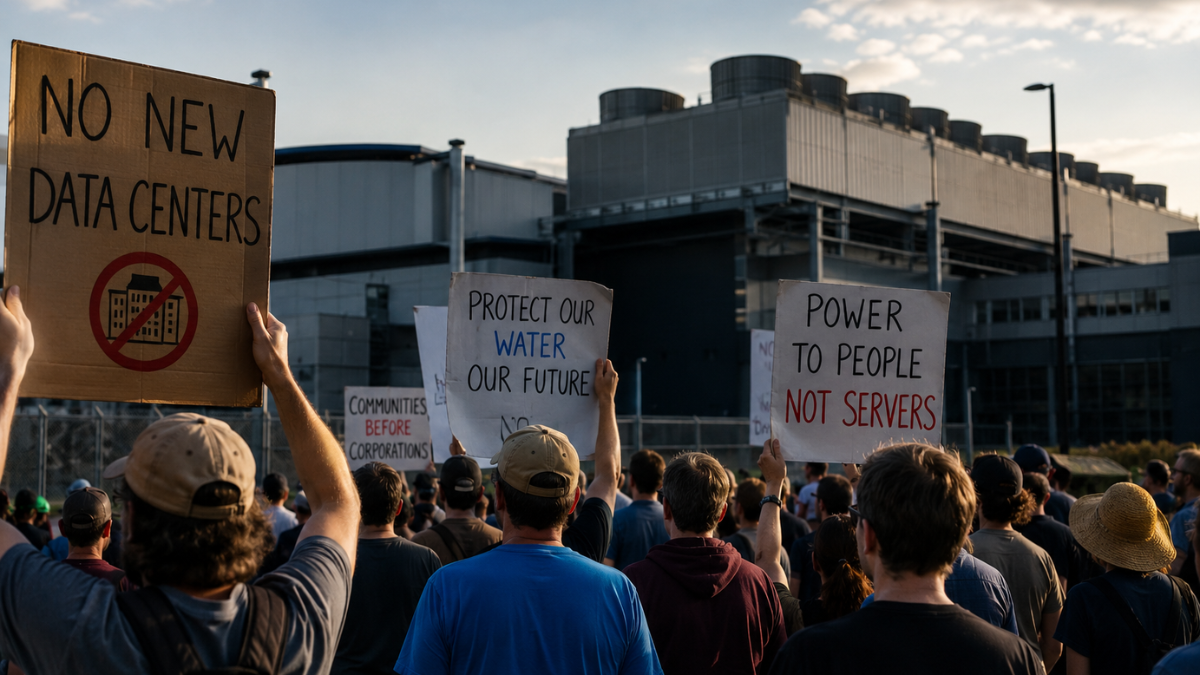
Something big is happening this Saturday. The HumansFirst national data center protests - with locations and updates confirmed across at least 125 U.S. cities - mark the first fully coordinated national effort to push back against the AI infrastructure boom that's been reshaping local communities over the past year.
This isn't a fringe issue. It's parents in Texas, retirees in the California desert, and first-time activists in Georgia who never expected to be organizing rallies. The June Reuters/Ipsos poll on public approval of data center construction explains why it's spread so fast: only 14% of Americans would support a data center being built in their community to power AI projects for companies like Meta, Amazon, Microsoft, or Elon Musk's xAI. One in seven. That's the real reason why Americans are protesting against AI data center expansion - because almost nobody wants this in their backyard, and they're done staying quiet.
Who Is HumansFirst and What Are They Actually Asking For?
HumansFirst is a grassroots group co-founded by Amy Kremer, previously a prominent leader in the modern Tea Party movement. The Amy Kremer HumansFirst data center movement comparison to the Tea Party is her own framing - she sees the same kind of energy: ordinary people, suddenly activated, pushing back against institutions that stopped listening.
But she's clear that this one crosses party lines. "They just woke up one day and found out they're going to have this monstrosity in their community, and they don't want it," Kremer said.
The main demands of the HumansFirst anti-data center group aren't anti-technology. They want:
- Transparent permitting processes - no backroom deals, no NDA-wrapped approvals
- Real environmental and resource protections
- Community benefits, specifically well-paid union jobs
- Actual developer accountability when promises don't materialize
Kremer has publicly criticized the blanket moratorium approach - like the data center moratorium New York adopted - calling it too blunt. She's also taken shots at Republicans for giving Big Tech a "free pass." Rare to see both parties called out on the same issue, in the same breath, by the same person. The broader vision HumansFirst is pushing lines up with what some call a people-centered digital future - where technology deployment gets shaped by communities, not just corporate roadmaps.
Where the Protests Are: The Full Locations Breakdown
Here's the breakdown of HumansFirst national data center protest locations and updates as of Friday, July 18:
- Texas - 16 protests (leading all states)
- Georgia - 11
- California, Florida, Pennsylvania - 7 each
- Total: 125+ cities nationwide
Why is Texas seeing the highest number of data center protests? Because it's been one of the most aggressively developed markets in the country. The Texas data center protests count, and locations list has expanded throughout the week, driven in part by first-time organizers like Eva Cardona, a 31-year-old self-described "political nomad."
"I've been hearing about unregulated AI and the rapid growth was alarming me," Cardona said. "I wanted to do something more hands-on than just your standard Facebook post."
That could have come from almost anyone in this movement. It's that universal.
The Water Argument Nobody Can Ignore
Out in Imperial County, California, 54-year-old Ivan DelSol is helping lead a desert protest with a very specific grievance. A proposed data center project there could draw 260 million gallons of water per year from the Colorado River. That's the data center environmental impact water usage Colorado River activists keep returning to - and it's genuinely hard to argue against.
"It's dystopian that you would use this much fresh water for AI," DelSol said.
The industry responds that its water use is small compared to agriculture. And the global conversation around data center cooling demand is genuinely complicated - cooling infrastructure supply chains are now reshaping international trade. But in drought-stressed regions, "we use less than farms" isn't an answer. How much water do artificial intelligence data centers use per year? In places like Imperial County, enough to turn a manageable situation into a crisis.
Power Bills, NDAs, and a Trust Deficit That's Getting Worse
There's another grievance that cuts across every protest city: how AI infrastructure buildout increases local power bills. Massive facilities strain local grids, and those costs get distributed to residents - often without warning and sometimes without any public process.
Why are local officials signing NDAs with tech data center developers? That's the question HumansFirst keeps pressing. Towns and counties across the country have greenlit major projects while their officials signed non-disclosure agreements with developers, despite resident pushback and minimal regulatory review. The pattern of big tech data centers and local community non-disclosure agreements has become one of the movement's sharpest talking points.
It also feeds into a wider conversation about global AI governance - who makes the rules when infrastructure scales faster than regulation. The UN AI accessibility statement - signed by 65 countries - signals that this accountability debate isn't staying local.
Understanding the Scale of What's Being Built
To understand why community groups are angry, you need to understand why companies aren't slowing down.
The AI supercluster launch activity happening globally - including 100,000-card compute clusters coming online in China - illustrates the scale of the infrastructure race underway. AI computing infrastructure growth is accelerating across multiple continents simultaneously. Companies are moving fast because the global competition is real and the pressure is intense.
Communities bear the costs. Companies capture the gains. That asymmetry is exactly what's putting people in the streets.
Whether AI and green energy infrastructure integration can eventually resolve some of this is an open question. China's first green electricity AI data center - running entirely on renewables - proves the alternative is technically feasible. Critics, though, point to the timeline gap: data centers go up now, clean power arrives later. Maybe. Some researchers are even exploring the orbital data center battleground as a longer-term option - moving compute off the ground entirely and sidestepping land, water, and grid issues. Interesting in theory. Doesn't help anyone's electricity bill this month.
What Comes Next
Reporting from Reuters journalists Valerie Volcovici and Lisa Baertlein helped document just how coordinated and bipartisan this movement has become. Even Georgia - which has actively courted data center investment - has 11 protests scheduled. The Data Center Coalition, the industry's main lobbying group, didn't comment on the protests. Its standing position: data centers are "committed to being responsible neighbors." That framing hasn't been calming anyone down.
AI clusters and climate targets are increasingly being linked in policy conversations globally, a sign that governments are starting to treat infrastructure expansion and environmental accountability as inseparable issues.
Can state governments issue a moratorium on data center approvals? Yes - New York has. Will data center regulations affect the expansion of Big Tech companies? Almost certainly, if the political pressure keeps compounding. How will data center opposition impact the upcoming midterm elections? Kremer is betting it'll be defining. Given that only a third of Americans approve of the current pace of construction nationally, she may not be wrong.
The HumansFirst national data center protests - locations and updates still coming in as of Friday night - have made one thing clear: community resistance to AI infrastructure has officially gone national.