Summary
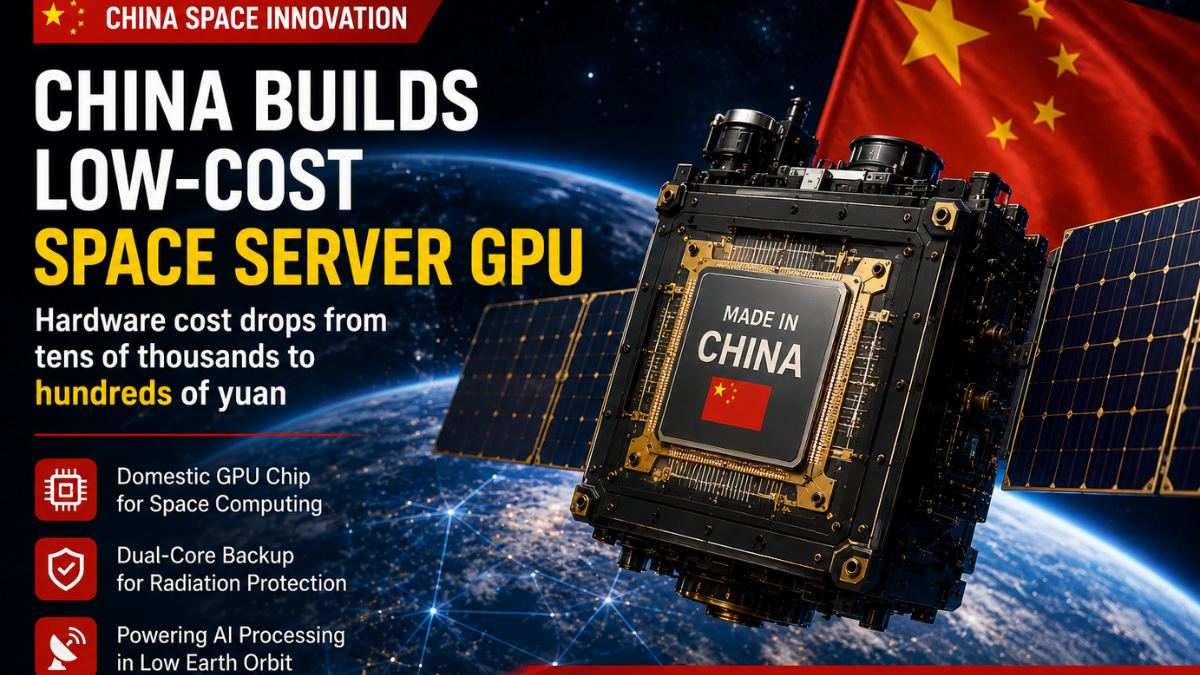
China domestically produced space server GPU hardware cost has reportedly dropped from tens of thousands of yuan to several thousand, and in some cases several hundred yuan. That is a striking claim, especially for hardware designed to survive launch, radiation, vacuum, and years of operation far above Earth.
The announcement came during the Space Computing Power Industry conference Beijing held on August 12. Attendees discussed a familiar problem: AI needs more computing power, but ground-based data centers need huge amounts of electricity, land, water, and cooling equipment.
Space could change part of that equation.
A domestically produced space server aerospace GPU chip was presented alongside a fully local space server with a backup operating core. If the technology performs as described in orbit, the falling China domestically produced space server GPU hardware cost could make satellite-based AI processing far more practical.
Key Points
- China is developing domestically produced space server hardware, including aerospace GPUs and locally built computing systems.
- Reported aerospace GPU costs have fallen from tens of thousands of yuan to several thousand yuan, and in some cases several hundred yuan.
- The lower hardware cost could make it more practical to deploy larger numbers of computing nodes in orbit.
- A reported dual-core server design provides a backup processing core if radiation interferes with the primary system.
- Orbital AI could allow satellites to process images and sensor data in space instead of sending everything back to Earth.
- Potential applications include satellite imagery, weather analysis, disaster monitoring and communications management.
- Space-based computing still faces major challenges involving launch costs, radiation, thermal management, power, communications and long-term reliability.
- Solar power and the space environment offer potential advantages, but cooling electronics in a vacuum remains a serious engineering challenge.
- The development fits into China’s wider push toward domestic AI chips, computing infrastructure and low-Earth-orbit satellite networks.
- The biggest question is no longer whether computing can be placed in orbit, but whether it can be made reliable and affordable enough to operate at meaningful scale.
Why China domestically produced space server GPU hardware cost matters
Space hardware has never been cheap. Radiation-resistant processors, custom boards, thermal controls, and launch qualification can push the price of a single computing node far beyond what you would pay for equivalent hardware on the ground.
That price barrier may be shifting.
The reported space computing power hardware cost hundred yuan target suggests that domestic aerospace GPU development is reducing one of the industry’s nastiest constraints: specialized chip pricing. You can see why supply chains matter by following developments in domestic GPU supply, where access to locally developed accelerators is becoming a strategic issue well beyond satellites.
Lower component costs do not make launches cheap, of course. That’s the obvious flaw in breathless headlines about orbiting servers. A low-cost GPU still needs reliable integration, testing, launch capacity, communications links, and fault management. But cheaper compute hardware can improve the economics of deploying many smaller nodes rather than betting everything on a few expensive spacecraft.
What is a fully domestically produced space server?
A fully domestically produced space server is built around locally developed components and software, including its processor or GPU, server electronics, and operating environment. The goal is independence from foreign supply disruptions while giving designers tighter control over mission-specific hardware.
At the Beijing event, the reported server used a dual core onboard operating system space server design. One core handles normal work; the other is ready to take over if radiation or particle interference disrupts the active system.
That distinction matters because a satellite cannot wait for an engineer to reboot it manually.
The server’s design also connects with the broader rise of a domestic supercomputing platform and localized server memory across China’s compute stack. Chips are only part of the picture. Memory, operating software, packaging, and system integration all affect whether a platform can operate independently.
China domestically produced space server GPU hardware cost and orbital AI
A space AI computing node low Earth orbit constellation processes data closer to where it is collected. Instead of sending every image or sensor reading to Earth, a satellite can identify useful information in orbit and transmit a smaller, more valuable result.
Simple. Effective. Potentially expensive to operate at scale.
A spaceborne GPU edge computing satellite constellation could support tasks such as image classification, weather analysis, disaster monitoring, or communications management. The argument behind a low Earth orbit satellite data center solar power model is straightforward: satellites receive strong solar energy for much of their orbit, while space offers a cold external environment compared with a crowded city data center.
Still, “cold space” is not a magic cooling system. Heat must be moved away from electronics through radiators, and that is difficult in a vacuum. There’s no air to carry heat off a chip. That’s why discussions of orbital data center economics need to include launch, thermal engineering, maintenance limits, and downlink capacity, not just free sunlight.
How radiation protection keeps AI processing online
On orbit AI computing power radiation fault tolerance is not optional. High-energy particles can flip bits, corrupt memory, freeze software, or cause a processor to behave unpredictably.
The announced dual-core setup reportedly switches to its backup core within milliseconds when interference occurs. That gives the system a way to continue AI processing without waiting for a ground command, which is particularly useful when a satellite is outside direct contact.
This is how space radiation protection allows reliable AI computing in low Earth orbit: redundancy, error detection, protected memory, isolated functions, and rapid recovery all work together. The dual core onboard operating system protects space servers by giving mission software a fallback path when the primary core is affected.
There’s a bigger hardware story here too. Work on domestic AI chip stacking and China's memory localization could eventually influence how compact, power-conscious orbital systems are built.
Why put data centers in low Earth orbit?
Ground AI infrastructure is hungry. It needs land, grid connections, cooling systems, backup power, and a steady supply of water or other cooling resources. Space computing aims to overcome ground-based energy and heat bottlenecks by moving selected workloads into an environment powered by sunlight and separated from crowded terrestrial infrastructure.
That said, not every workload belongs in orbit. Training giant foundation models will likely remain a ground-based job for some time because of hardware density, communications needs, and repairability. Processing satellite imagery where it is captured? That’s more plausible.
Commercial spaceflight satellite internet computing is driving interest because expanding constellations already need onboard processing. China accelerates space computing infrastructure with low Earth orbit satellite constellations as companies and research groups test where distributed orbital compute actually makes sense. Related investment in AI data center infrastructure shows that Earth-based efficiency is still moving forward too.
A new-quality productivity push, with real limits
The conference framed space computing as a space computing new quality productivity breakthrough. In practical terms, that means policymakers see orbital computing as a potential growth sector spanning chips, satellites, launch services, software, AI, and communications.
Beijing's space computing push reflects that wider ambition. So do advances in AI supercluster hardware, supernode computing systems, and AI infrastructure revenue. Space and ground computing will develop together, not as rivals.
The China domestically produced space server GPU hardware cost story is promising, but hundreds-of-yuan hardware does not equal hundreds-of-yuan missions. Launch and operational realities remain stubborn.
Where this leaves space computing
China domestically produced space server GPU hardware cost is becoming a serious metric to watch, not just a technical curiosity. Affordable aerospace-grade accelerators and rapid backup-core switching could make on-orbit AI useful for more satellite missions.
But space computing will earn its place through proven reliability, useful workloads, and realistic mission economics. The hardware is getting cheaper. Getting it safely into orbit, keeping it productive, and bringing the right results back to Earth is the harder part.
GlobalByte Perspective
China’s push into space-based computing is interesting not simply because it puts GPUs in orbit, but because the country is trying to make the hardware practical enough to deploy at scale. The reported drop in aerospace GPU costs from tens of thousands of yuan to several thousand, and in some cases several hundred yuan, could help reduce one of the biggest barriers to orbital computing. If these figures hold up in real deployments, cheaper hardware could make it easier to build larger networks of satellites capable of processing data before sending it back to Earth.
The more important part, however, is the complete system around the chip. A space server has to deal with radiation, heat, power limits, communication delays and the fact that there is nobody in the room to fix it when something goes wrong. The reported dual-core design, with a backup core ready to take over after radiation-related interference, shows where the engineering challenge really lies. For GlobalByte News, the bigger takeaway is that China is moving from the idea of space computing toward building the hardware and infrastructure needed to make it usable. The technology still has plenty to prove, especially on launch costs, reliability and real-world workloads, but lower-cost space-grade computing could make orbital AI a much more realistic proposition.